First Seen
2026-02-28T08:06:04.607363+00:00
simple-description (qwen3.5_2b-q8_0)
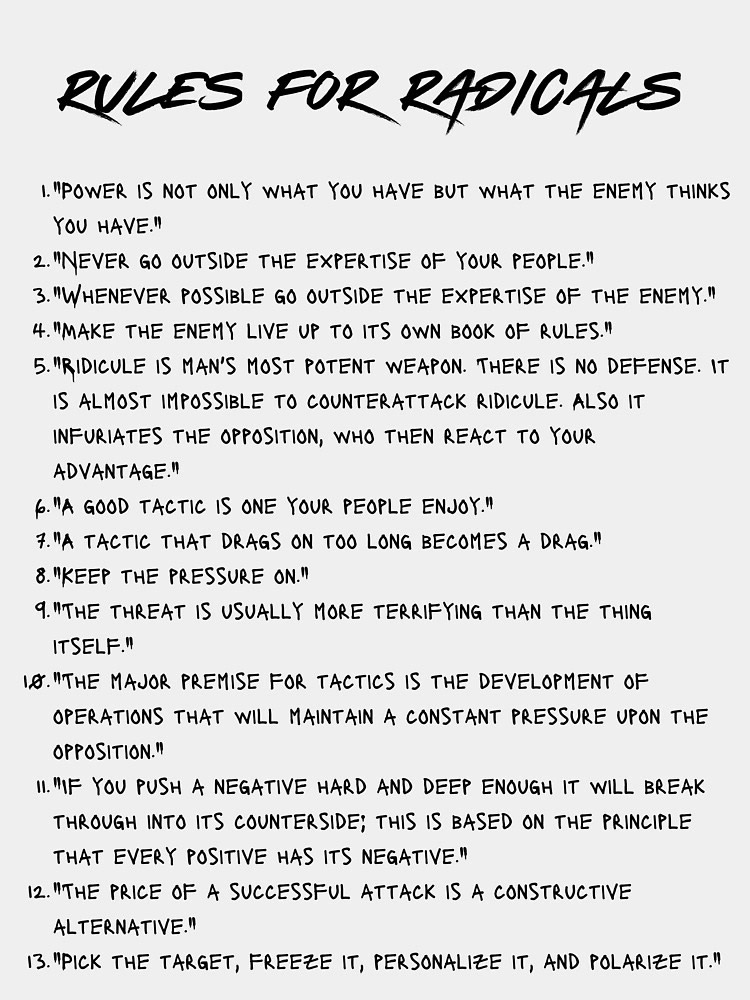
This piece of political propaganda serves as a manifesto titled "Rules for Radicals," outlining a specific philosophy of radical community organizing that prioritizes psychological strategy over physical confrontation. The text argues that leaders should manipulate the perception of their opponents to maintain power (Point 1) and advise organizers to bypass established expert advice or bureaucratic rules entirely (Points 3 & 4) in order to create chaos or "drag" opposition groups without actually destroying them.
simple-description (llama3.2-vision_11b)
The meme is a list of 13 "rules for radicals" that are actually advice for how to be a successful leader in a community. The rules are meant to be satirical and are not actually meant to be taken seriously. The rules are:
- "Power is not only what you have but what the enemy thinks you have."
- "Never go out of …
… … … … … … … … … … … … … … … … … … … … … … … … … … … … … … … … … … … … … … … … … … … … … … … … … … … …
… … … … … … … … … … … … … … … … … … … … … … … …
… … … …
… … … … … … … … …
… …
… … … … … …
… … … … …
… … … … … …
… … …
… … …
… … …
… … …
… …
… …
… … …
… … …
… …
… …
… …
… … …
… …
… …
… …
… …
… …
… …
… …
… …
… …
… …
… …
… …
… …
… …
… …
… …
… …
… …
… …
… …
… …
… …
… …
… …
… …
… …
… …
… …
… …
… …
… …
… …
… …
… …
… …
… …
… …
… …
… …
… …
… …
… …
… …
… …
… …
… …
… …
… …
… …
… …
… …
… …
… …
… …
… …
… …
… …
… …
… …
… …
… …
… …
… …
… …
… …
… …
… …
… …
… …
… …
… …
… …
… …
… …
… …
… …
… …
… …
… …
… …
… …
… …
… …
… …
…
… …
… …
… …
…
… …
… …
… …
… …
… …
…
… …
…
… …
…
… …
…
…
… …
…
…
…
…
…
…
…
…
…
…
…
…
…
…
…
…
…
…
…
…
…
…
…
…
…
…
…
…
…
…
detailed-analysis (gemma3_27b-it-q8_0)
Okay, let's break down this meme, "Rules for Radicals," from the perspective of Community Organizing, and then delve into relevant theoretical frameworks where applicable.
Overall Context: Community Organizing
This meme draws heavily from Saul Alinsky's 1971 book, Rules for Radicals: Practical Pragmatism for Realistic Radicals. Alinsky’s work is foundational in the field of community organizing, particularly in advocating for bottom-up power building by marginalized communities. The “rules” presented are tactical guidelines intended to help organizers challenge established power structures and win concrete improvements for their constituents. This meme isn’t about revolution per se but about effective, strategic disruption to force negotiation and change. It's a cynical, pragmatic approach, focused on understanding how power actually operates, rather than how it should operate.
Visual Description
The meme consists of a list of 13 numbered “rules” presented in a straightforward, no-frills text format. The font and layout create a sense of authority and instruction, mirroring a manual or guide. The starkness of the text emphasizes the direct, almost cold, tone of the advice. The title "Rules for Radicals" immediately signals that this is about challenging established norms and engaging in some form of resistance.
Marxist Conflict Theory
This meme is deeply rooted in Marxist Conflict Theory. Alinsky’s work, and by extension this meme, recognizes that society is characterized by inherent conflict between groups with differing interests – namely, those in power and those without. Several rules directly reflect this dynamic:
- Rule 1 ("Power is not only what you have but what the enemy thinks you have."): This speaks to the importance of perceptions of power. Marx would argue that the ruling class maintains control through ideological hegemony – convincing the proletariat that their powerlessness is natural. Disrupting this perception is crucial.
- Rules 4 & 9 ("Make the enemy live up to its own rules" & "The threat is usually more terrifying than the thing itself."): These rules aim to exploit the internal contradictions within the dominant power structure. By forcing the "enemy" to adhere to their own stated principles, organizers can expose hypocrisy and undermine their legitimacy. The use of threat is also about creating an imbalance and disrupting the status quo.
- Rule 10 ("The major premise for tactics is the development of operations that will maintain a constant pressure upon the opposition."): This reflects the Marxist view of history as a series of class struggles. Continuous pressure, forcing the opposing class to constantly react, is the key to eventual change.
- Rule 11 ("If you push a negative hard and deep enough it will break through into its counterside; this is based on the principle that every positive has its negative."): This highlights the inherent contradictions within capitalism, where the very pursuit of profit creates its own problems.
Foucauldian Genealogical Discourse Analysis
The meme’s emphasis on rules and power dynamics aligns with Michel Foucault’s ideas about power, discourse, and genealogy. Foucault argued that power is not simply a top-down imposition, but is dispersed throughout society, embedded in institutions, discourses, and practices.
- Rule 3 ("Whenever possible go outside the expertise of the enemy."): This speaks to challenging the dominant discourses controlled by those in power. By shifting the terrain of debate to areas where the opposition lacks expertise, organizers can disrupt their control over knowledge and meaning.
- Rule 5 ("Ridicule is man's most potent weapon."): Foucault’s work on discourse highlights the importance of language and representation in shaping power relations. Ridicule undermines the legitimacy of the opposition by deconstructing their carefully constructed narratives and exposing their vulnerabilities.
- The overall framing of "Rules": Foucault's genealogical approach would investigate how these "rules" themselves came to be, tracing their historical evolution and the power relationships that shaped them. They aren’t universal truths, but contingent strategies developed in response to specific contexts.
Critical Theory
The meme touches upon aspects of Critical Theory, particularly the Frankfurt School’s focus on challenging ideologies and systems of domination.
- Rule 2 ("Never go outside the experience of your people.") & 6 ("A good tactic is one your people enjoy."): These rules emphasize the importance of grounding organizing efforts in the lived experiences of the community. Critical Theory stresses that genuine liberation can only come from those who are directly affected by oppression.
- Rule 12 ("The price of a successful attack is a constructive alternative."): This reflects the Critical Theory notion that simply critiquing existing power structures is not enough. To be truly transformative, resistance must also offer a vision for a better future, a constructive alternative.
Postmodernism
While Alinsky isn’t explicitly a postmodernist, some aspects of the meme can be interpreted through a postmodern lens.
- The rejection of grand narratives: The pragmatism of the rules suggests a rejection of overarching ideological schemes. It's not about achieving some utopian vision, but about achieving concrete gains through strategic action.
- Deconstruction of power: The focus on disrupting perceptions of power, exploiting contradictions, and challenging dominant narratives aligns with the postmodern tendency to deconstruct traditional notions of authority and truth.
Queer Feminist Intersectional Analysis (Potentially Limited but Present)
While the meme itself is not inherently queer or feminist, it can be used within those frameworks. The focus on understanding the specific context of the "enemy" (Rule 3) and the importance of centering the experiences of your people (Rule 2) lend themselves to intersectional analysis. A queer feminist organizer would utilize these rules while specifically considering the overlapping systems of oppression that impact marginalized groups (race, class, gender, sexuality, etc.). The “target”, “personalize” and “polarize” directive can be dangerous if used without recognizing this as well.
- Rule 13 ("Pick the target, freeze it, personalize it, and polarize it."): This rule is the most problematic if considered from an intersectional perspective. Without critical awareness, it could easily be used to demonize individuals rather than address systemic issues. However, a careful organizer can use it to expose the specific actions of those in power that perpetuate harm to marginalized communities.
In conclusion:
This meme encapsulates a pragmatic, cynical, and strategic approach to social change rooted in the core principles of community organizing. It draws heavily from Marxist theory and intersects with Foucauldian concepts of power and discourse, critical theory’s emphasis on challenging ideologies, and postmodernism’s deconstruction of grand narratives. Its relevance to queer feminist intersectional analysis depends on the organizer’s ethical commitment to centering the experiences and needs of marginalized communities. Ultimately, it's a guide for those seeking to challenge power and create a more just society, but it must be wielded with careful consideration of its potential pitfalls.