First Seen
2024-06-26T02:01:07.341248+00:00
simple-description (llama3.2-vision_11b)
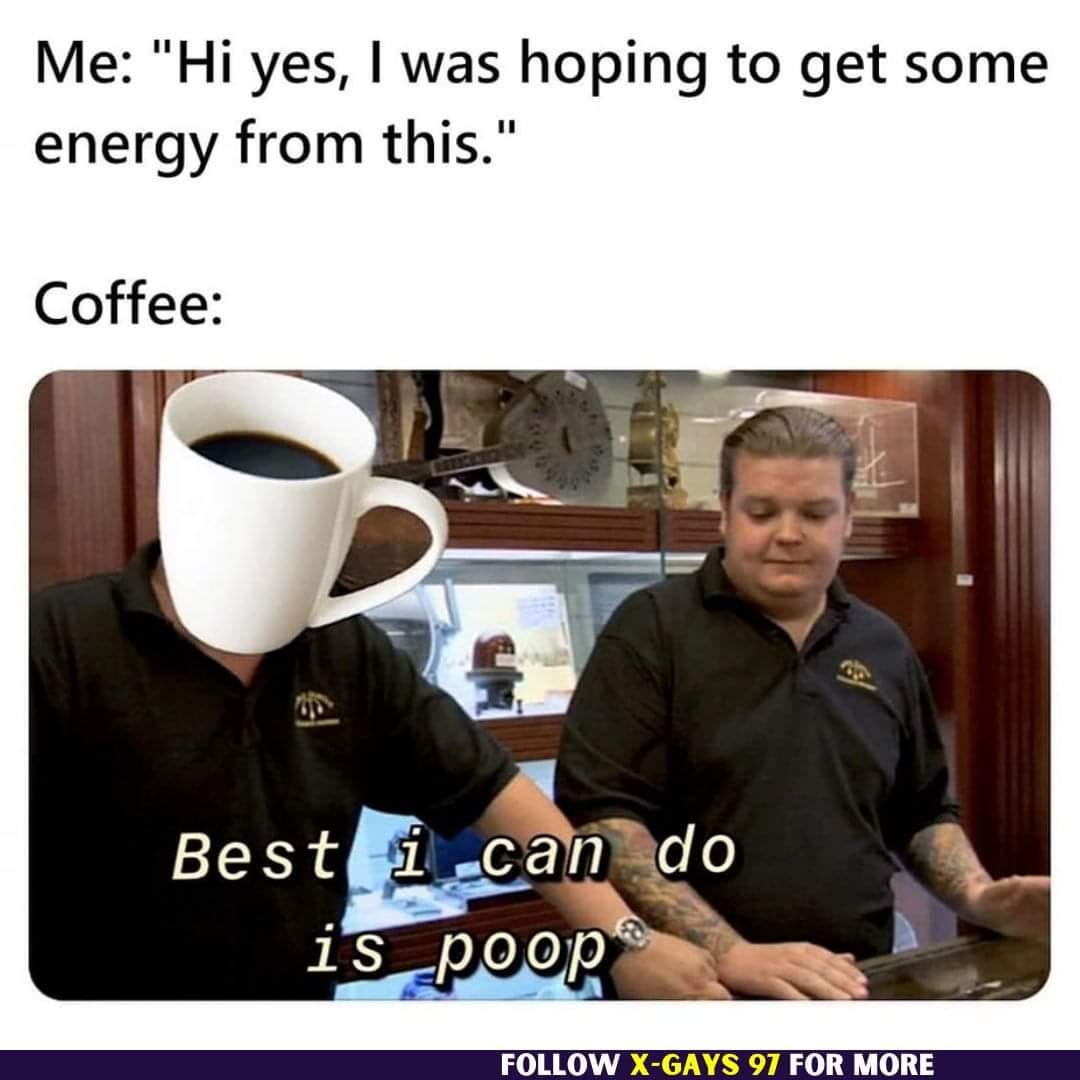
The meme is a humorous image of two men from the TV show "It's Always Sunny in Philadelphia" with a caption that says "I'm not even high, I'm just... awake." The image is a play on the idea that coffee can be a necessary fuel for some people to feel awake and alert, but it's also a joke about the idea that some people might be able to get by on less coffee.
detailed-analysis (gemma3-27b-vision)
Okay, let's break down this meme through a few theoretical lenses. It's a rather strange image, so some of these will be stretches, but that's the fun of applying theory!
Visual Description
The image is a screencap from what appears to be a low-budget video. It features two individuals, presumably participants in the video, seated at a table. The crucial element is that the head of the individual on the left is replaced by a digital overlay of a coffee cup. The second individual, on the right, has a more traditional, yet somewhat awkward, expression.
Superimposed across the image in large white font are the words, "Best I can do is poop." Above the image is a dialogue exchange: "Me: 'Hi yes, I was hoping to get energy from this.'" and "Coffee:" which refers to the cup that is acting as a head. The image is tagged at the bottom with "Follow X-Gays 97 for more."
The low production quality, the bizarre juxtaposition of the coffee cup as a head, and the blunt, absurd statement contribute to a darkly humorous, slightly unsettling effect. The meme feels ironic and self-deprecating.
Foucauldian Genealogical Discourse Analysis
This meme can be analyzed through a Foucauldian lens by considering the discourse surrounding energy and bodily functions. Michel Foucault would be interested in how "energy" is constructed as a desirable and regulated concept. We are bombarded with discourses about maximizing energy, achieving peak performance, and overcoming fatigue. The initial statement, “I was hoping to get energy from this,” taps into this expectation.
However, the "Coffee's" response ("Best I can do is poop") immediately disrupts this discourse. Poop, as a bodily function, is often marginalized and considered "dirty" in dominant Western culture. Foucault would argue this meme de-naturalizes the expectation of energy, exposing its connection to the often-hidden and unspoken realities of our bodies.
The meme, through absurdity, creates a lineage (genealogy) that shows how our expectations of “energy” are tied to a messy, biological reality that we frequently attempt to repress or ignore. It hints at the power dynamics involved in controlling discourses around the body and how our attempts to regulate our bodies can fail spectacularly, resulting in the unexpected “output” of poop.
Critical Theory
From a Critical Theory perspective, the meme can be seen as a form of social critique, albeit a highly ironic one. The expectation of coffee providing energy is a normalized part of capitalist society – a quick fix to enhance productivity and maintain the demands of work. The "Coffee's" response, then, can be interpreted as a rejection of this relentless drive for optimization.
The meme subtly suggests that sometimes all we can expect from systems designed to enhance our performance is a messy, unreliable outcome. It questions the "promise" of efficiency and control inherent in capitalist ideology. It's a subversive moment that acknowledges the limits of the system and the body's inherent messiness in the face of societal pressures.
Queer Feminist Intersectional Analysis
This meme operates on layers of subversion that resonate with queer feminist and intersectional analyses. The absurdity itself is a disruption of conventional expectations, aligning with queer modes of resistance through deconstruction. The blunt, unglamorous statement about "poop" breaks the taboos around bodily functions – a taboo historically linked to patriarchal control over female bodies.
Intersectionality comes into play by acknowledging how these social control issues overlap. Gendered expectations around bodies are combined with a capitalist demand for productivity. The "Coffee’s" refusal to deliver energy is also a refusal to fulfill the demands of a system that exploits bodies for profit.
The meme’s humor is reliant on recognizing the tension between societal expectations and bodily realities, and is thus aligned with feminist and queer critiques of normative power structures.
Disclaimer: Applying complex theory to a silly meme is often a bit of a stretch, and many interpretations are possible. This is one attempt to analyze the image through a few different lenses.
simple-description (llama3.2-vision)
This meme is a humorous image of two people, one with a coffee cup for a head, sitting at a table. The text overlay says "Me: 'Hi, I'm just here for the caffeine'" and the coffee cup responds with "Best I can do is poop". The meme is a play on the idea that the person is only there for the caffeine, but the coffee cup's response is a sarcastic and humorous way of saying it can't do anything else.