First Seen
2023-05-10T21:03:35+00:00
simple-description (llama3.2-vision_11b)
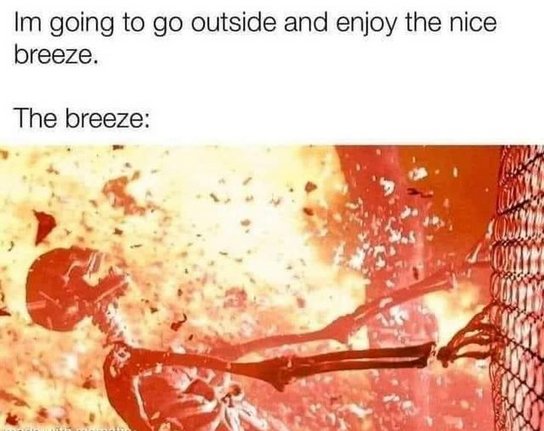
This meme is a humorous take on the irony of experiencing a pleasant outdoor environment while simultaneously being aware of the devastating effects of climate change. The image is a darkly comedic illustration of a person being burned to death, with the text "I'm going to go outside and enjoy the nice breeze" juxtaposed with the image. The meme is a satirical commentary on the disconnect between our desire for comfort and the reality of environmental destruction.
detailed-analysis (gemma3-27b-vision)
Here’s a breakdown of the meme using the requested analytical frameworks. It’s important to note that this is interpretive, and different readings are possible.
Visual Description
The image is a close-up, highly stylized, and dramatically lit illustration resembling a manga panel. It depicts a pair of hands, presumably a person’s, seemingly pushing against or being subjected to a violent, swirling, fiery-red gust of wind. The wind is rendered as abstract, energetic lines and intense color saturation, emphasizing force and chaos rather than natural wind. The background is blurred and indistinct, furthering the feeling of intense, localized disruption. The lighting is very dramatic, with stark highlights and deep shadows. The image is deliberately exaggerated, leaning towards hyperrealism with a clear aesthetic emphasis on energy and potential destruction.
Foucauldian Genealogical Discourse Analysis
The meme sets up a discourse between expectation and reality, between the language we use to describe experience (“nice breeze”) and the actual sensory experience. Foucault would encourage us to examine how the language of “nice breeze” comes to be a way we understand/frame natural phenomena. It relies on a historically constructed notion of “comfort” and “pleasure” associated with gentle wind.
The image then disrupts this discourse. Instead of the expected tranquility, we're presented with violent energy. This reveals the power dynamics inherent in how we name and experience the world. The "nice breeze" is not neutral; it's a framing that obscures potential dangers or disruptive forces.
The genealogy would trace how the concept of "nice breeze" developed through historical shifts in climate perception, societal values (control over nature, romanticization of nature, etc.), and even media representations. What once might have been understood as a powerful, unpredictable force of nature is now softened and romanticized. The meme implies that the "true" nature of the wind is far more chaotic and potentially destructive.
Critical Theory
The meme aligns with elements of Critical Theory, specifically its concern with uncovering hidden power structures and challenging taken-for-granted assumptions. The “nice breeze” functions as a representation of the status quo, a normalized and comforting way of understanding a natural phenomenon. The image violently negates this expectation.
This negation can be read as a critique of societal attempts to control and categorize nature. The meme suggests that nature, in its true form, is untamable and resists easy categorization. It is a disruption of the smooth, comfortable narrative that society often imposes on the natural world. The image implicitly questions the authority of language to accurately capture experience and exposes the gap between rhetoric and reality.
Postmodernism
The meme is fundamentally a parody. It juxtaposes the seemingly innocuous statement ("I'm going to enjoy the nice breeze") with a highly exaggerated and violent image, creating a sense of irony and absurdity. This is a hallmark of postmodern humor.
The image itself deconstructs the very notion of a "nice breeze." It subverts the expectation, refusing to conform to a conventional representation. There's a rejection of grand narratives and an emphasis on subjective experience. The “truth” of the breeze is not a comforting one, and the meme revels in this disjunction. It’s a statement that meaning is not inherent but constructed and open to interpretation.
Queer Feminist Intersectional Analysis
While not immediately obvious, a Queer Feminist reading could explore how the meme disrupts the expectation of a gentle and soothing natural force, mirroring the disruption of gender norms. Traditional gender roles often associate femininity with softness, passivity, and a desire for comfort. The violent wind, in its forceful, disruptive energy, refuses this expectation. It's a reclaiming of power and agency.
The act of being exposed to the "breeze" can be read metaphorically as an exposure to a hostile environment. The intersection of gender, power, and vulnerability becomes relevant. The image might be seen as a commentary on the challenges faced by marginalized groups who are often exposed to forces beyond their control.
Important Note: These are all interpretive readings. The strength of the meme lies in its open-endedness and capacity to generate multiple meanings.
simple-description (llama3.2-vision)
This meme is a humorous take on the phrase "I'm going to go outside and enjoy the nice breeze." However, the image shows a person being blown away by a massive explosion, implying that the "nice breeze" is actually a massive explosion that is blowing them away. The text "I'm going to go outside and enjoy the nice breeze" is juxtaposed with the image of a person being blown away, implying that the "nice breeze" is actually a destructive force.
tesseract-ocr
lm going to go outside and enjoy the nice breeze. The breeze: ge re | Pe ; &:. > ta i yeas Ea . = "0: .. 7 Es (NV &. a, ae 2 fg , \> . Ao, fast = a Se i. ER at. Qe ae A