First Seen
2023-08-23T02:38:54+00:00
simple-description (llama3.2-vision_11b)
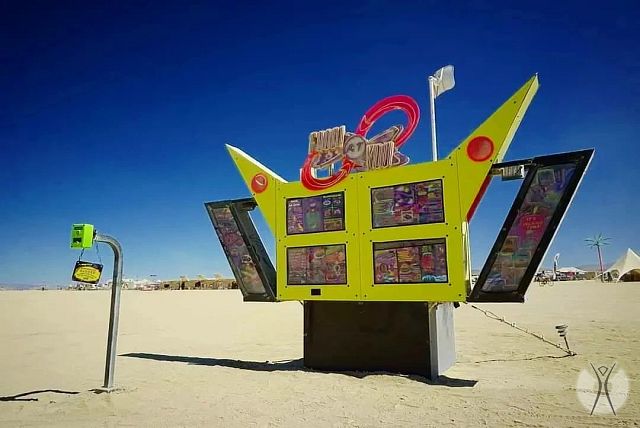
The meme is an image of a "Free Hugs" sign at Burning Man, a popular counter-cultural festival in the Nevada desert. The sign is a playful and ironic take on the traditional "Free Hugs" signs that are often seen in public places, but in this context, it's a humorous commentary on the festival's emphasis on self-expression and individuality. The text "Free Hugs" is written in bold, colorful letters, but the image is intentionally distorted and pixelated, as if it's been taken with a low-quality camera or smartphone.
detailed-analysis (gemma3-27b-vision)
Okay, let's break down the image of this roadside-style display, potentially found at Burning Man, through the lenses requested. Please note that some of these lenses will have more applicability than others.
1. Visual Description
The photograph depicts a large, brightly colored, triangular structure resembling a giant drive-in movie ordering board. It is set against a stark, flat desert landscape with a deep blue, cloudless sky. The structure is predominantly lime-green, with neon pink lettering spelling out "Galaxy Diner." Within the triangular frame, multiple illuminated panels display a collage of images and text, reminiscent of a menu board. The base is a rectangular black structure. To the left, there's a small, green, signage post. The overall aesthetic is retro-futuristic and playful, hinting at Americana and roadside culture, though highly stylized and located in what appears to be a remote, natural environment. The scale is imposing, suggesting a deliberate artistic installation rather than a functional diner. In the background, distant figures and structures suggest a large outdoor event.
2. Postmodernism
This piece is strongly rooted in postmodern aesthetic and philosophy. Several characteristics align:
- Pastiche & Intertextuality: The "Galaxy Diner" is a clear reference to mid-century American diner culture but transplanted into a radical, non-conventional context. It borrows and remixes elements, creating a playful layering of meaning.
- Simulacra & Simulation: The structure appears to be a diner ordering board, invoking expectations of food and service. However, it doesn't fulfill those expectations, creating a simulation of a diner experience. It's a signifier without a straightforward signified.
- Rejection of Grand Narratives: The context (presumably Burning Man) actively challenges traditional societal norms and established systems. This piece, as a temporary installation, further emphasizes the impermanence and deconstruction of fixed meanings.
- Irony and Playfulness: The whole installation is tongue-in-cheek. It's a grand gesture of Americana placed in an environment where such a concept seems incongruous, inviting a sense of amusement and questioning of established cultural norms.
3. Foucauldian Genealogical Discourse Analysis
A Foucauldian reading can illuminate the power dynamics at play:
- Discourse of Consumption & Americana: The "Galaxy Diner" participates in the historical discourse around American consumer culture, particularly the post-war boom and the development of car culture, roadside attractions, and mass consumption. It isn't merely a diner; it's a symbol of a certain way of life.
- Power/Knowledge: The diner structure, as a symbol, holds a particular kind of power – the power to evoke memories, nostalgia, and associations with a specific cultural period. This “knowledge” is not neutral, it’s historically and culturally constructed.
- Normalization: By presenting a seemingly ordinary object in an extraordinary setting, the installation forces a re-evaluation of what is considered “normal”. This challenges the ways in which power structures establish and maintain definitions of normalcy.
- Genealogical Tracking: We can trace the "genealogy" of the diner – from early roadside stands to the proliferation of fast food chains – to understand how this particular configuration of power and knowledge emerged. The installation acknowledges this history while simultaneously subverting it.
4. Critical Theory
The piece can be approached through a critical lens:
- Commodification and Spectacle: While seemingly playful, the installation can be seen as a commentary on the commodification of experience. The visual spectacle is designed to attract attention and potentially generate excitement, mirroring the tactics of advertising and consumer culture.
- Alienation and the "Fake": The diner isn’t a functional diner. It's a facade, a representation of a diner experience. This can be interpreted as a commentary on the alienation of modern life, where appearances often eclipse reality.
- The Role of Art as Critique: The installation isn't necessarily trying to solve problems, but rather to expose and question the values embedded in our culture. It prompts us to examine our relationship to consumerism, nostalgia, and the construction of identity.
5. Marxist Conflict Theory
While less directly applicable than some other lenses, we can explore:
- Capitalism and Spectacle: The structure can be seen as a critique of the ways in which capitalism relies on spectacle and the creation of desire. The bright colors and inviting imagery aim to attract attention and potentially stimulate consumption, even in a setting where traditional consumer transactions are absent.
- Alienation: As mentioned in Critical Theory, the display can be seen as an object that exemplifies a separation between the viewer and the labor that produced it. The structure stands as a symbol of a disconnected process.
6. Queer Feminist Intersectional Analysis
This is the least directly applicable lens, but potential readings could include:
- Subversion of Gendered Space: Diners, historically, were often spaces associated with particular gender roles (waitresses, male clientele). The installation, by removing the functional aspect and placing it in an unconventional context, can be seen as disrupting these traditional gendered expectations.
- Reclaiming Space: The desert setting, often associated with masculinity and exploration, is reclaimed as a space for art, creativity, and community.
- Intersectional Visibility: Depending on the images displayed within the panels, the installation could potentially provide a platform for marginalized voices and experiences.
In summary: This image is rich with layers of meaning. It’s a visual statement that can be interpreted through various theoretical frameworks, revealing its commentary on consumer culture, spectacle, the construction of identity, and the challenges to conventional norms. The artwork's strength lies in its ability to provoke thought and engage the viewer in a critical dialogue.
tesseract-ocr
- ——e vd j Z| ~ neon | A 4 (a 2 cI SS eo f 5 \ aoa eee | Ay 2 airway | Bee SS fae a , — | Je : = ws
simple-description (llama3.2-vision)
The meme is a photo of a "Lost and Found" board at Burning Man, a popular annual festival in the Nevada desert. The board is shaped like a giant bird, with its wings spread wide, and has a humorous message: "Lost: 1 brain. If found, please return to owner. Reward: endless supply of snacks."