First Seen
2025-08-11T01:08:50.515561+00:00
simple-description (qwen3.5_2b-q8_0)
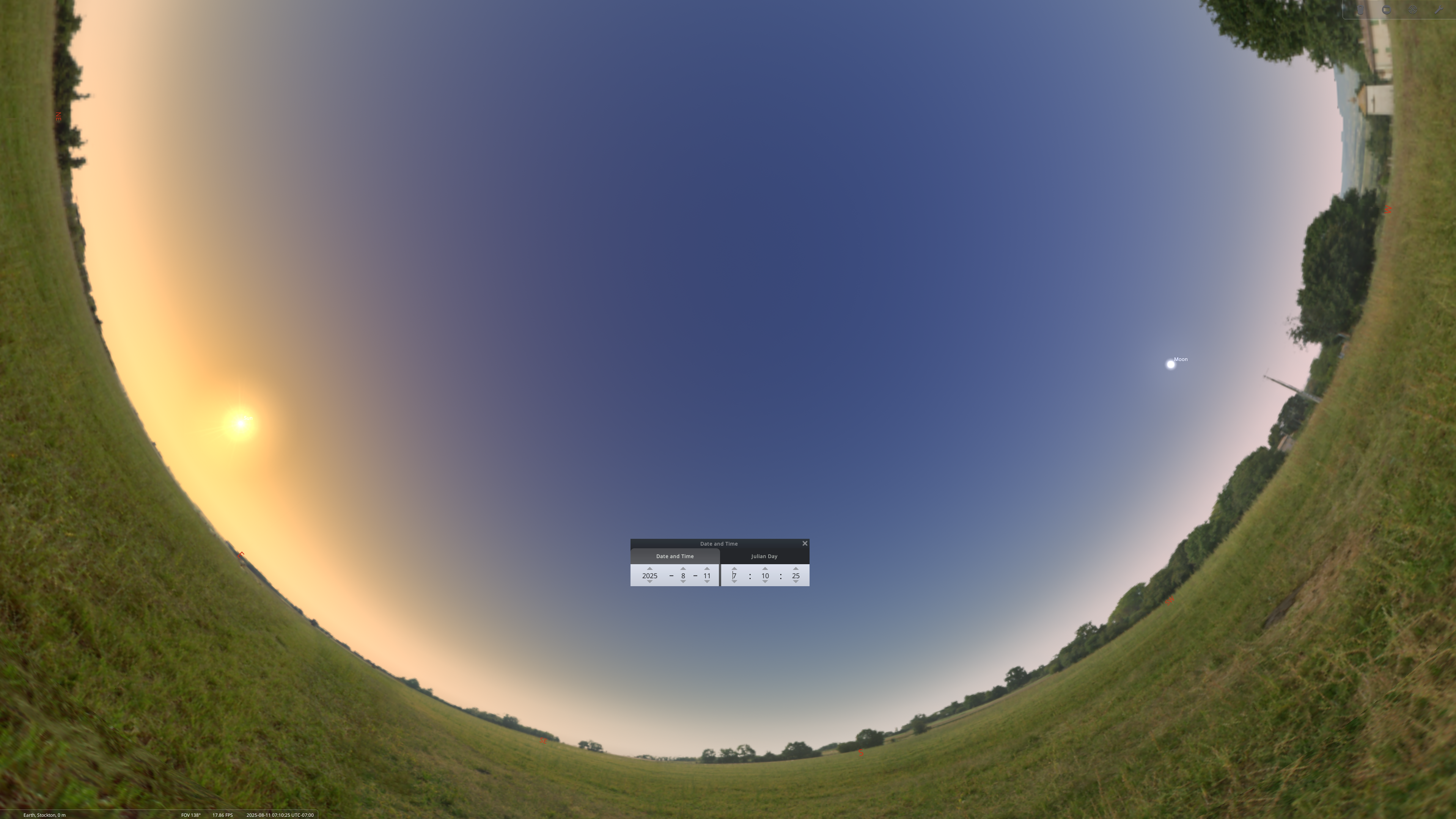
This image appears to be a screenshot from an astronomy simulator or app (likely showing the sky in real-time location for Stockton, California). The visual gag is rooted in the difference between Gregorian Dates and Julian Days.
While people typically count days by their calendar dates (like "August 11th"), astronomers often use a counter called "Julian Day" that counts only through 365-day cycles. This creates a confusing joke because, for example, you would have the Julian Day number 7 on either January 1st, 2025 or August 17th, 2129. The UI humorously displays this abstract counter (Julian : 7) alongside a specific calendar date, highlighting that "day" in astronomy is a mathematical sequence rather than a fixed label like "Monday."
detailed-analysis (gemma3_27b-it-q8_0)
Okay, let's break down this image (which depicts a wide-angle shot of a sunny landscape with the Sun and a smaller bright object—presumably Venus—in the sky, along with a digital time display) through the lens of Astronomy and, where relevant, various theoretical frameworks.
Visual Description
The image presents a fisheye view of a landscape, likely taken from a low vantage point, emphasizing the curvature of the Earth and the vastness of the sky. The most prominent features are:
- The Sun: A brilliant, nearly blinding light source dominates the left portion of the image. It's a direct representation of our star, the engine of life on Earth.
- Venus: A significantly smaller, but still brightly visible point of light appears in the sky. This indicates that Venus is visible as either the "morning star" (before sunrise) or the "evening star" (after sunset). The clarity suggests a relatively pollution-free atmosphere.
- Landscape: A green, rolling landscape surrounds the view, grounding the image in a terrestrial context. This contrast between the Earth and the celestial bodies is key.
- Digital Overlay: A digital window displays date and time information, indicating 3:05 PM, July 11. This juxtaposition of natural phenomena with technological mediation is important.
Foucauldian Genealogical Discourse Analysis
This image can be seen as a representation of how our understanding of the sky (and, by extension, the universe) has been constructed through discourses of power and knowledge. Michel Foucault's work focuses on how institutions and systems produce knowledge and regulate behavior.
- Shifting Epistemes: From ancient mythologies assigning divine status to celestial bodies to the scientific revolution establishing a heliocentric model, our understanding of the Sun and Venus has undergone radical shifts. The image implicitly represents the culmination of that epistemic change—a "truth" about the universe, derived through scientific method.
- The Power of Observation & Measurement: The fisheye lens and the digital time stamp represent the apparatus of modern scientific observation. They are tools that produce knowledge by capturing and quantifying the celestial phenomena. The act of timestamping and framing the sky within a lens is itself an act of power, of ordering and classifying the universe.
- Discipline & Control: Astronomy, as a discipline, imposes order on the chaos of the cosmos. The image, therefore, symbolizes a human attempt to control and understand the universe, to make it knowable and predictable.
Critical Theory
From a Critical Theory perspective (drawing from thinkers like the Frankfurt School), the image can be seen as emblematic of the tension between reason and nature.
- Instrumental Reason: The scientific framing of the image (fisheye lens, time stamp) represents “instrumental reason” – the application of reason to achieve specific, often technological, goals. This can be seen as a manifestation of the Enlightenment project, but also as a potential tool for domination over nature.
- Alienation: The digital overlay, while providing information, also distantiates us from the natural world. It reminds us that we are observing the Sun and Venus through a mediated, artificial lens. This echoes a central theme in Critical Theory—the alienation of humans from nature and themselves.
- The Illusion of Control: The image suggests human control over understanding the universe. However, it's also a reminder of our smallness in the face of cosmic forces. The image’s framing is only a limited, human-constructed perspective.
Postmodernism
The image's presentation also resonates with postmodern themes.
- Deconstruction of Grand Narratives: The idea of a singular, objective "truth" about the universe is challenged. While astronomy provides a scientific model, it is a model, not the absolute truth. The fisheye lens, distorting the traditional perspective, embodies a deconstruction of conventional ways of viewing the cosmos.
- Simulacra and Simulation: The image, as a digital reproduction, is a simulacrum—a copy without an original. The time stamp is a simulation of time, and the fisheye lens creates a simulated reality. The question arises: how much of our experience of the universe is mediated by such simulations?
- Fragmentation and Relativism: The image's unusual perspective emphasizes the fragmented nature of perception. There is no single, fixed point of view; our understanding of the universe is always relative.
In conclusion:
This image isn’t simply a pretty landscape. Through an astronomical and critical lens, it becomes a complex representation of the human relationship with the cosmos – a relationship characterized by power, knowledge, control, mediation, and ultimately, a sense of wonder and the recognition of our limited perspective.
simple-description (llama3.2-vision_11b)
The meme is a humorous image of the Earth from space, with a caption that says "I can see my house from here." This is a reference to the classic song "I Can See the [...]" from the musical [...], with the lyrics "I can see my house from here" changed to "I can see my house from [...]."
The image is a photo of the Earth from space, with a caption that says "I can see my house from here." This is a reference to the classic song "I Can See the [...]" from the musical [...], with the lyrics "I can see my house from here" changed to "I can see my house from [...]."
The image is a photo of the Earth from space, with a caption that says "I can see my house from here." This is a reference to the classic song "I Can See the [...]" from the musical [...], with the lyrics "I can see my house from here" changed to "I can see my house from [...]."