First Seen
2025-08-11T01:09:18.347218+00:00
simple-description (qwen3.5_2b-q8_0)
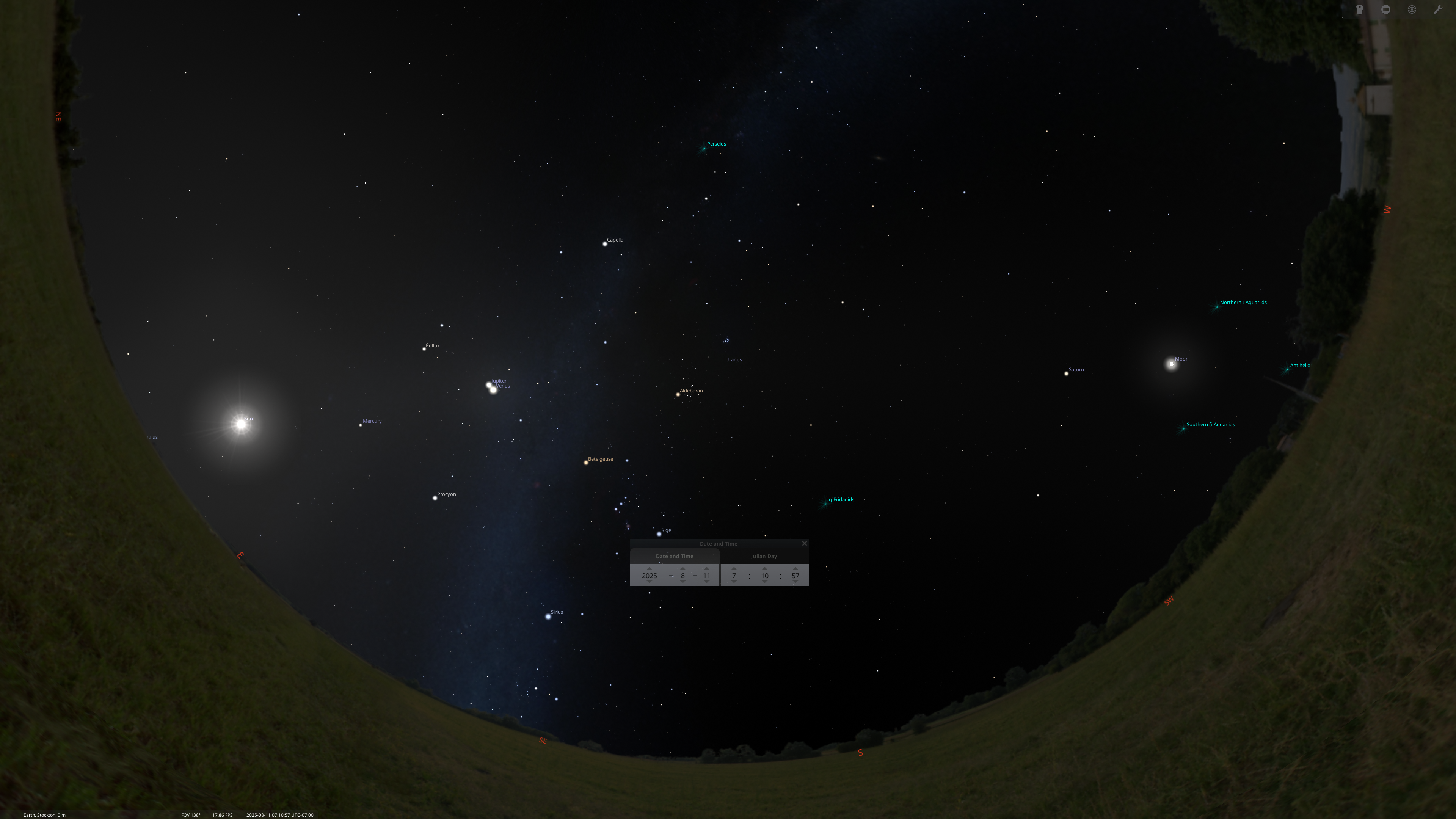
The image displays a night sky filled with numerous stars and constellations, featuring labels such as "Perseids," "Southern & Aquarids," and bright celestial bodies like Venus.
At the bottom left, text reads "Earth, Stockton, 0 m," indicating a location near sea level in California. The meme plays on the irony that seeing this entire arc of stars requires being very high up on a mountain; from low-lying Sea Level in Stockton, you would typically only see a tiny sliver of the night sky.
detailed-analysis (gemma3_27b-it-q8_0)
Okay, let's analyze this image—a simulated night sky as displayed by planetarium software—through the lens of various critical and theoretical frameworks within the context of Astronomy.
Visual Description
The image presents a wide-angle view of a night sky, likely created via planetarium software (the UI elements in the bottom left corner indicate this). The perspective is ground-level, looking upward with a slight curvature suggesting a hemispherical or dome-like projection. Several constellations are labelled with their names (e.g., Orion, Gemini, Taurus), and bright stars are clearly visible as points of light. A prominent feature is the bright object toward the left, which is likely Sirius, the brightest star in the night sky. A faint band of the Milky Way is visible running vertically through the centre of the image. The foreground shows a dark, grassy slope or ridge silhouetted against the night sky. The UI indicates a date, implying the sky view is specific to that time. This isn't a photograph of reality, but a representation of it.
Foucauldian Genealogical Discourse Analysis
From a Foucauldian perspective, this image is a product of a specific "discourse" regarding the sky. Historically, understanding the sky has been tied to power structures. Early astronomy wasn't just about observation; it was about prediction (calendars, agriculture), religious significance (astrology), and establishing order (cosmology that reflected societal hierarchies).
This planetarium simulation represents the current dominant discourse. It’s a discourse of scientific rationalism, precise measurement, and mathematical modelling. The labelling of constellations, the accurate positioning of stars, the display of time and date—these are all mechanisms of "normalization," bringing the chaotic expanse of the sky into a comprehensible, controllable framework. The software itself is an instrument of power, shaping how we see and understand the sky.
Genealogy would look at how this current discourse evolved. It moved from mythic and religious explanations to geometric models, to Newtonian physics, and now to the complex astrophysics represented here. Each stage involved a shifting of power dynamics (from priests to astronomers, from observation to computation).
The software isn't neutral; it embodies a particular history of knowledge production. Its very existence declares the legitimacy of a scientific approach over other ways of knowing the sky.
Critical Theory (Frankfurt School)
The image can be viewed through a Critical Theory lens as an example of the "instrumentalization of reason." The sky, once a source of awe, mystery, and spiritual contemplation, has been reduced to a dataset, a collection of coordinates, and a simulation. This represents the Enlightenment's project of conquering nature through rational understanding—a project that, for Critical Theorists, ultimately leads to alienation and a loss of the subjective experience.
The simulation, while providing knowledge, distances us from the actual sky. The experience of looking up on a clear night, with the vastness and unpredictability of the universe, is qualitatively different from viewing a meticulously rendered model. The simulation risks becoming a substitute for authentic experience, reinforcing a sense of control where true understanding requires acknowledging our smallness within the cosmos.
Furthermore, the emphasis on labelling and categorization can be seen as a manifestation of the "culture industry," homogenizing and simplifying a complex reality for mass consumption.
Postmodernism
A postmodern reading would reject the idea that this simulation represents any objective “truth” about the sky. It's a construction, a representation built on specific assumptions and perspectives. There is no "real" sky to which this is a faithful copy. The sky itself is experienced differently by different cultures and individuals.
Postmodernism would highlight the role of language in shaping our understanding. The labels given to constellations are arbitrary, rooted in mythology and cultural narratives. The very act of dividing the sky into discrete units (constellations, stars) is a human imposition.
The image could be seen as a play of signs and symbols, with no inherent meaning beyond what we assign to it. It’s a simulacrum, a copy without an original, reflecting a world increasingly mediated by representations. The simulated sky is arguably "more real" to many people than direct observation.
No relevant application of Marxist Conflict Theory
While the development of this software and astronomy itself requires resources (funding, infrastructure), applying a strictly Marxist analysis to the image itself is less direct. The image doesn't immediately depict a conflict between classes. It's not inherently about exploitation or the means of production. Though the access to such technology could be viewed as a marker of privilege, the image itself doesn't represent a class struggle.
No relevant application of Queer Feminist Intersectional Analysis
Similarly, a Queer Feminist Intersectional Analysis doesn't directly apply to the image in itself. Historically, access to scientific knowledge and the pursuit of astronomy were heavily gendered and often excluded marginalized groups. However, the image itself doesn’t exhibit power dynamics based on gender, sexuality, race or other intersecting categories. It doesn’t inherently perpetuate oppressive structures. (Though one could consider the historical exclusion of women from scientific fields as context for the creation of the image and the software.)
In Summary
This seemingly innocuous image of a night sky, through these various lenses, reveals itself to be a complex artifact deeply embedded in history, power structures, and cultural assumptions. It's a testament to human ingenuity and our desire to understand the universe, but also a reminder of the ways in which our understanding is always mediated, constructed, and potentially limiting.
simple-description (llama3.2-vision_11b)
The meme is a screenshot of a 3D astronomy visualization software, specifically the "Astron" software, which is used for creating and visualizing astronomical data. The image shows a 3D model of the galaxy, with stars, planets, and other celestial objects. The text in the image reads "Astron 3D: The Universe in 3D", which is the title of the software.