First Seen
2025-08-11T01:12:15.743210+00:00
simple-description (qwen3.5_2b-q8_0)
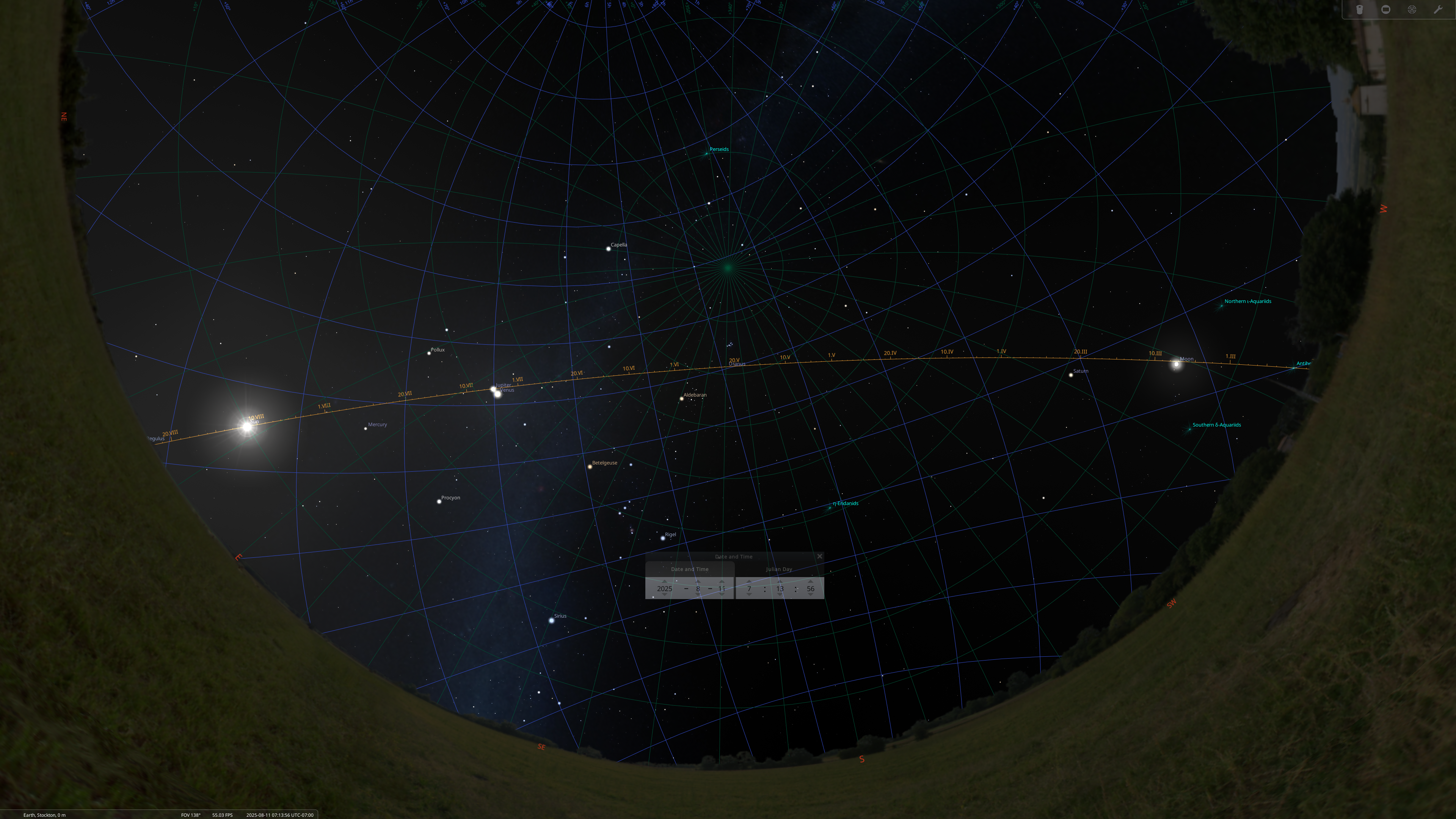
Based on the astronomy context, this image appears to be a screen capture from a 3D celestial map software (like Starry Night or SkyView) showing a Heliocentric Solar System view or an Ecliptic Path map.
For someone who cannot see it, here is the explanation:
The horizontal yellow line connecting the bright spot on the left to the bright spot on the right represents the Ecliptic—the flat plane along which the Earth, Sun, and all planets orbit. The visualizes a "string" of celestial bodies stretching across the sky, starting from a position near the Sun (left) and ending at the Moon (right), passing through other planets like Mercury, Venus, Mars, Jupiter, and Saturn. This creates the illusion that the Sun and Moon are connected by their orbital path, effectively showing they are in the same orbit around Earth even though they appear far apart across the sky because of the 6-month separation between them.
Key text elements visible on the interface confirm this astronomical context:
* "Earth, Stockton, 0 m": Shows the user's location at the time of capture (Stockton, California).
* "2025 - 8 - 11": Displays the date the photo was taken (August 11, 2025), likely near an equinox or solstice when the Sun and Moon have specific positions relative to each other.
* "Date and Time / Julian Day": Standard metadata for a coordinate map application.
detailed-analysis (gemma3_27b-it-q8_0)
Okay, let's analyze this image – a planetarium software screenshot – through the requested critical lenses, specifically from the context of Astronomy.
Visual Description
The image depicts a wide-angle view, simulating a night sky as would be seen from a specific location on Earth (indicated as "Earth, Northern Hemisphere, N"). It's a digital planetarium representation. Key elements include:
- Ecliptic: A prominent yellow arc indicating the apparent path of the Sun (and thus, the planets) across the sky throughout the year.
- Constellation Lines: Faint lines connecting stars to form recognizable patterns of constellations (e.g., Gemini, Taurus, Orion).
- Star Names: Labels identifying specific stars (e.g., Pollux, Capella, Procyon, Rigel).
- Celestial Coordinates: Grid lines and numbers denoting Right Ascension and Declination, the astronomical equivalent of longitude and latitude.
- Horizon: The lower edge of the image represents the horizon, with ground/landscape elements visible.
- Time/Date: Displayed in the lower left corner ("2024 Dec 06, 05:00 UTC"), indicating the specific date and time the simulation represents.
- Planets: Notable planets, such as Venus, are shown as larger, brighter points.
- Software Interface: The presence of icons at the top right reveals the image is generated using planetarium software.
Foucauldian Genealogical Discourse Analysis
From a Foucauldian perspective, this image isn't merely a representation of the night sky; it's a product of power/knowledge. The very act of mapping, naming, and categorizing the heavens represents a historical exercise in establishing control over understanding the cosmos.
- Discursive Formation: The system of astronomical knowledge – constellation definitions, celestial coordinates, planetary motion – has evolved through centuries of discourse. Early systems (Babylonian, Greek) were intertwined with mythology and astrology. The Scientific Revolution introduced a new discourse based on mathematical precision and observation. This image represents the current dominant discourse.
- Episteme: The underlying "episteme" (the accepted way of knowing) visible here is rooted in a scientific worldview that prioritizes quantifiable data, predictable laws, and objective observation. The image enforces this episteme by visualizing the sky in those terms.
- Panopticon of the Sky: The image could be interpreted as a kind of "panopticon" of the sky, allowing for complete surveillance and categorization of celestial objects. This allows for prediction and potentially control. The software itself represents the technology of that surveillance. The act of simulation, of being able to ‘look’ at any time and location, removes the power of the night sky as something unknowable or subject to the whims of deities.
Critical Theory (Frankfurt School)
A Critical Theory lens focuses on how this image reinforces ideologies.
- Instrumental Reason: The image reflects the dominance of "instrumental reason" – the use of knowledge solely for practical purposes. Astronomy, in this representation, is geared towards calculation, prediction, and potentially, technological applications (satellite navigation, space travel). The aesthetic beauty of the sky is largely subordinated to its quantifiable properties.
- Commodification of the Cosmos: This image, produced by commercial software, illustrates the commodification of the cosmos. What was once a source of wonder, spiritual contemplation, and myth is now a data set available for purchase and manipulation.
- Alienation: The image may contribute to alienation from the natural world. By presenting the sky as a grid of coordinates and data points, it detaches us from the direct, subjective experience of observing the stars. We no longer feel the vastness; we calculate it.
Marxist Conflict Theory
From a Marxist perspective, access to this knowledge (and the technology to generate this image) is not evenly distributed, reflecting class divisions.
- Means of Production: The software and the scientific infrastructure required to produce this image represent the "means of production" of astronomical knowledge. These are largely controlled by institutions (universities, research labs, corporations) that represent the interests of the dominant class.
- Ideological Apparatus: The image serves as an "ideological apparatus," reinforcing the worldview of the ruling class by presenting a scientific, rationalized view of the universe that justifies the status quo. A focus on technological advancement and exploration can deflect attention from social inequalities on Earth.
- Labor of Astronomers: The data behind this image is the product of the often-unacknowledged labor of astronomers, technicians, and programmers. The image obscures the human effort involved in creating it.
Postmodernism
A postmodern lens deconstructs the idea of a single, objective "truth" about the cosmos.
- Simulacra and Simulation: The image is a "simulacrum" – a copy without an original. It's a simulation of the sky, not the sky itself. This raises questions about the nature of reality and representation.
- Deconstruction of Grand Narratives: The image challenges the "grand narratives" of scientific progress and cosmic order. It highlights the constructed nature of astronomical knowledge and the fact that different cultures have different ways of interpreting the sky.
- Subjectivity: Even within this "objective" representation, the choice of what to display, the software's rendering algorithm, and the viewer's own perspective introduce subjectivity.
Queer Feminist Intersectional Analysis
This is perhaps the most challenging lens to apply directly, but we can consider it through the historical marginalization of voices in astronomy.
- Historical Exclusion: Historically, astronomy (and science in general) has been dominated by white, male perspectives. The constellations themselves often reflect patriarchal myths and narratives. The image implicitly continues this tradition by presenting a standard, historically-rooted view of the heavens.
- Epistemic Violence: The dominance of this "standard" astronomical discourse can be seen as a form of "epistemic violence" against other ways of knowing the sky – Indigenous astronomical traditions, for example, that may prioritize relationships with the cosmos over scientific quantification.
- Reclaiming the Sky: Reclaiming the sky means centering diverse cosmologies and challenging the notion that Western astronomy represents the only valid way to understand the universe.
In conclusion, this seemingly straightforward image of a planetarium simulation is a rich site for critical analysis. It reveals the power dynamics, ideological assumptions, and historical constructions that shape our understanding of the cosmos.
simple-description (llama3.2-vision_11b)
The meme appears to be a screenshot of a website or software used for astronomical observations, likely a planetarium or a tool for tracking celestial bodies. The image shows a 3D representation of the night sky, with various stars and planets visible. The text "I see what you mean" is likely a humorous comment from someone who has been using the software to track the movements of celestial bodies.