First Seen
2025-05-08T17:34:17+00:00
detailed-analysis (gemma3_27b-it-q8_0)
Okay, let's break down this image from an astronomy-centric perspective, incorporating relevant theoretical frameworks where appropriate.
Visual Description
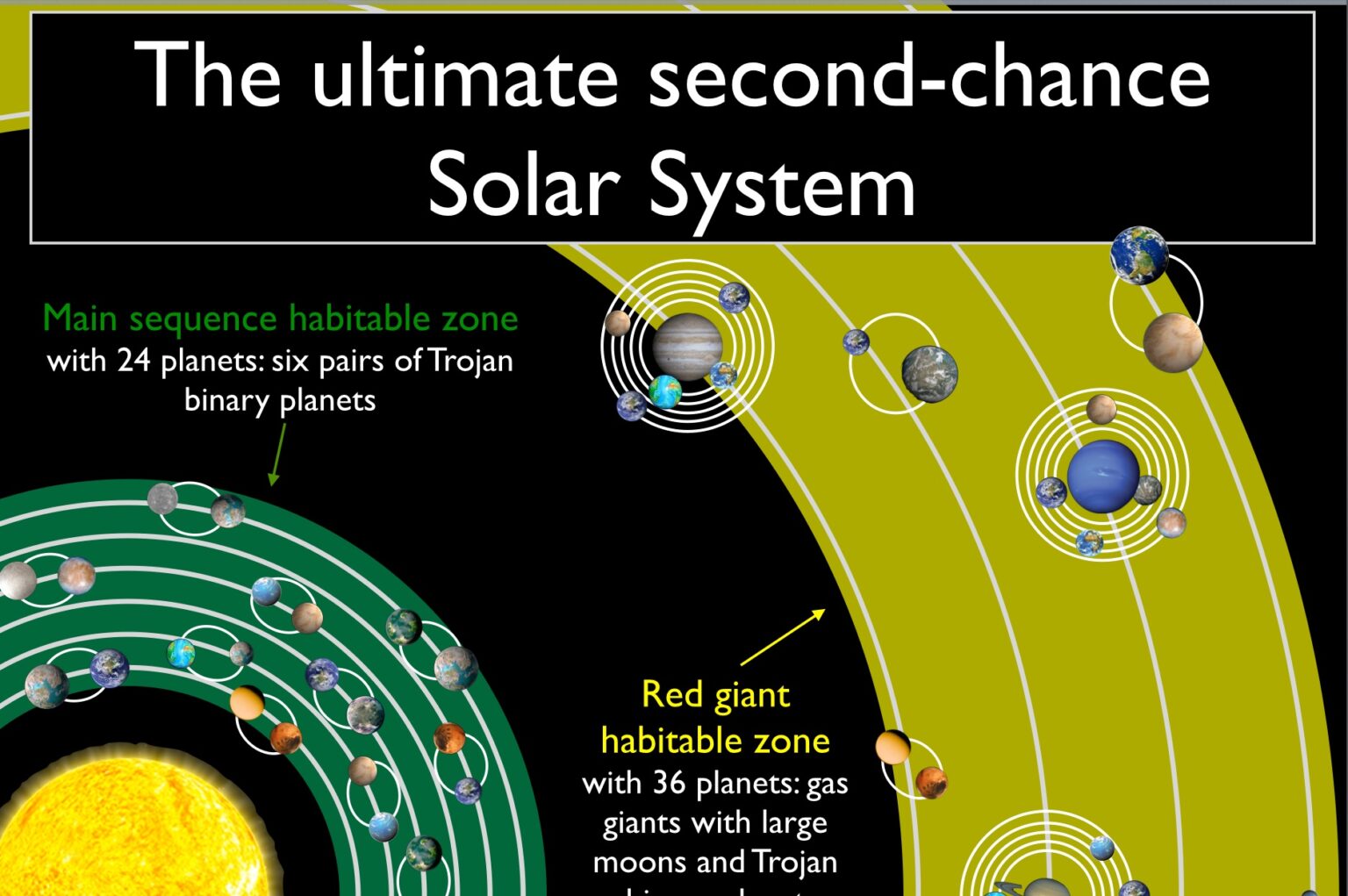
The image depicts a hypothetical solar system, dramatically different from our own. At the center is a star, appearing yellow, likely representing a main-sequence star (though the color is a bit stylized). Concentric, elliptical orbits surround the star, marked by green lines. Multiple planets populate these orbits, in both the “main sequence habitable zone” and the “red giant habitable zone”.
Key features:
- Two Habitability Zones: The most striking element is the existence of two habitable zones – one around the star in its current state, and another extending outwards for a red giant stage. This suggests a far longer period of potential habitability than our Solar System currently offers.
- Planet Density: There's an exceedingly high number of planets—24 in the main sequence zone and 36 in the red giant zone. This is vastly more than the eight planets in our solar system.
- Binary Planets: A significant detail is the mention of "six pairs of Trojan binary planets" in the main sequence zone. Trojan planets orbit the same orbit as another planet, stable on Lagrange points.
- Giant Planets/Moons: The red giant zone is populated by "gas giants with large moons and Trojan planets".
- Stylization: The image is clearly not a realistic simulation. The planets are depicted as simple spheres with color variations, and the orbits are highly idealized. The overall aesthetic is of a "thought experiment" or conceptual illustration.
Foucauldian Genealogical Discourse Analysis
The image participates in a discourse about habitability, planetary formation, and the potential for life beyond Earth. Michel Foucault would be interested in how this image shapes our understanding of these concepts.
- Power/Knowledge: The image demonstrates a form of power/knowledge. It’s not an objective depiction of reality, but a construction that privileges certain ideas about what is possible in a solar system. The “ultimate” designation implies a value judgment. It suggests this arrangement is somehow better than others.
- Genealogy: To trace the genealogy, we'd examine how the idea of habitable zones has evolved. Early astronomy focused on geometric proximity to the star. Later, concepts of atmospheric composition, liquid water, and planetary geology became crucial. This image reflects a later stage in that discourse, where the focus is on extending habitability over a longer timescale (via the red giant phase).
- Disciplinary Practices: The image arises from the “discipline” of astrophysics, but it also engages with popular science, science fiction, and perhaps even philosophical discussions about existential risk and the long-term future of life.
Critical Theory
From a critical theory perspective (drawing on the Frankfurt School, for example), this image could be seen as a manifestation of humanity’s desire to control and engineer the universe.
- Instrumental Reason: The "ultimate" solar system is presented as a solution – a way to overcome the limitations of our current cosmic situation. This reflects a reliance on "instrumental reason," where nature is viewed as a resource to be manipulated for human ends.
- Domination of Nature: The very idea of optimizing a solar system for habitability embodies a desire to dominate nature, to bend it to our will. It moves away from a reverence for the natural world towards a vision of it as a problem to be solved.
- Utopian/Dystopian Ambivalence: While superficially utopian (offering a vast number of habitable worlds), the image could be read as subtly dystopian. The sheer level of intervention implied to create such a system raises questions about its sustainability and potential consequences.
Postmodernism
A postmodern reading would focus on the instability of meaning and the rejection of grand narratives.
- Simulacra & Simulation: The image is arguably a simulacrum—a copy without an original. It's a representation of a hypothetical reality, divorced from any direct empirical observation. It represents the idea of planetary systems rather than actual ones.
- Rejection of Universal Truths: There's no claim that this is the best solar system, only that it’s “ultimate.” This challenges the notion of a single, objective truth about planetary habitability.
- Playfulness and Deconstruction: The image can be seen as a playful deconstruction of our expectations about what a solar system "should" look like. It's a deliberate disruption of conventional norms.
In summary:
The image is a fascinating thought experiment that reveals a lot about our current obsessions with space exploration, planetary habitability, and the long-term future of life in the universe. By applying different theoretical lenses, we can see it as a manifestation of power/knowledge relations, a product of instrumental reason, a simulacrum of reality, and a challenge to conventional understandings of the cosmos. It’s a complex piece of visual communication that says a lot about who we are as a species and what we value.
simple-description (llama3.2-vision_11b)
The meme is an image of a solar system with a red dwarf star at its center, surrounded by a ring of planets. The text above the image reads "The ultimate second-chance solar system" and "Not a planet, not a star, but a solar system". The meme is a humorous take on the idea of a solar system that is not a planet, not a star, but a solar system, implying that it's not a planet, not a star, but a solar system.