First Seen
2023-05-10T21:03:32+00:00
simple-description (llama3.2-vision_11b)
The meme features a robot with a confused expression, as if it's trying to understand a joke or a complex concept. The text "I'm not saying it's a good idea, but..." appears in the image, implying that the robot is contemplating a questionable plan or decision. The meme is likely poking fun at the idea of AI struggling to comprehend human humor or nuances.
detailed-analysis (gemma3-27b-vision)
Okay, here's a breakdown of the image, analyzed through the requested lenses. I'll indicate which sections are not applicable, and provide detailed analysis for those that are.
Visual Description
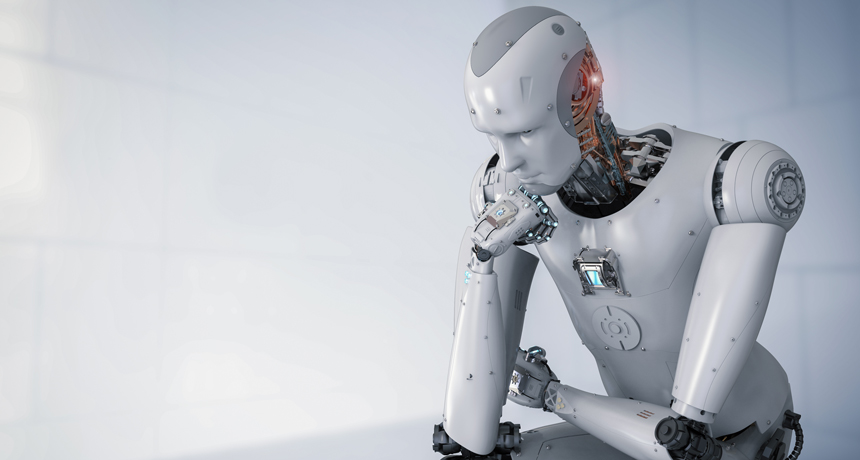
The image depicts a highly detailed, humanoid robot in a classic “thinker” pose – seated with its elbow on its knee and chin resting on its hand. The robot is primarily white, with visible metallic joints and a partially exposed internal structure near its neck, revealing what appears to be complex circuitry and a reddish/orange component. The design is sleek and modern, evoking both technological sophistication and a suggestion of vulnerability due to the exposed components. The background is a plain, light-blue, providing a clean, almost clinical context. The lighting emphasizes the metallic surface and the three-dimensional quality of the robot's form. The overall impression is one of thoughtful contemplation or perhaps even existential angst.
---
Foucauldian Genealogical Discourse Analysis
This image is rife with opportunities for a Foucauldian reading.
Discipline and Biopower: The very construction of this robot, with its intricate mechanical structure, speaks to our modern drive to understand and control, not just the external world, but life itself (biopower). The robot represents an attempt to engineer* thought, to externalize and replicate it in a machine. This is a disciplinary project - attempting to understand and codify the very processes of consciousness.
Genealogy of the "Thinker": The pose is a direct allusion to Rodin's "The Thinker," a sculpture that represents Western philosophical tradition. By recreating this iconic pose in a robot, the image forces us to question the origins and assumptions embedded within that tradition. What does it mean* to "think?" Is it uniquely human? This image disrupts the naturalized notion of thought as a purely organic function.
Power/Knowledge: The image illustrates the power/knowledge nexus. The ability to create this robot is power, and the very existence of the robot asserts a particular knowledge system about consciousness, intelligence, and being. The knowledge embedded in the robot's design defines what we consider* "thought" to be in the technological age.
Surveillance/Control: The robot's inherent technological nature also hints at the possibilities of surveillance and control. If thought can be made* or replicated, it can also be monitored, manipulated, or even suppressed.
---
Critical Theory
The image powerfully evokes themes central to Critical Theory, particularly those related to the Enlightenment project and its implications.
Instrumental Reason: The robot embodies instrumental reason – the focus on efficiency, calculation, and control that Max Horkheimer and Theodor Adorno critiqued in Dialectic of Enlightenment. The robot's existence is predicated on reducing thought to a set of quantifiable, reproducible processes. It is the ultimate manifestation of a desire to instrumentalize* consciousness.
Reification & Commodification: The robot represents the reification of thought – turning it into an object, a "thing" that can be manufactured and owned. This aligns with Marxist critiques of commodity fetishism, where the social relations embedded in production are obscured. The robot isn't simply a machine; it's a symbol* of the commodification of intellectual life.
Loss of Subjectivity: The image invites reflection on the potential loss of human subjectivity. If thought can be replicated by a machine, what does it mean to be human? Does it erode the uniqueness of conscious experience? The robot's contemplative pose is ironic - it mimics thought, but does it feel* it?
---
Marxist Conflict Theory
Although less immediately obvious, Marxist conflict theory applies to this image:
The Means of Production & Intellectual Labor: The creation of this robot represents a shift in the means of production of intellectual* labor. The machine can potentially replace or augment human thought processes, raising questions about the future of work and the control of knowledge. The ownership of the technology controlling the robot will inevitably create new power dynamics and class stratification.
* Alienation: If robots increasingly perform intellectual tasks, it could lead to a new form of alienation for human workers, who are separated from their creative and cognitive abilities. The image evokes a sense of displacement - what is the place of the human mind in a world of artificial intelligence?
* Class Struggle: The technology behind creating robots like this is not equally distributed. The benefits of such a technology will likely be enjoyed by the capitalist class, while the working class may be displaced.
---
Postmodernism
The image lends itself heavily to a postmodern reading:
Simulation & Hyperreality: The robot is a simulation of a thinker. It's an artificial representation of something traditionally considered deeply human. This aligns with Jean Baudrillard’s concepts of simulation and hyperreality, where the distinction between reality and representation collapses. The robot doesn't have thoughts; it performs* thinking.
* Deconstruction of the Subject: The image challenges the notion of a stable, unified subject. If thought can be externalized and replicated, what constitutes the "self?" This deconstruction of subjectivity is a central theme in postmodern thought.
* Irony & Parody: The image is inherently ironic. The "thinker" pose, historically associated with deep reflection, is now embodied by a machine. This parody of the human intellect questions the very meaning of thought.
* Fragmentation: The exposed inner workings of the robot speak to postmodern concerns with fragmentation and the loss of a unified whole.
---
Queer Feminist Intersectional Analysis
This one is trickier to apply directly, but relevant interpretations can be made:
* Gendered History of Technology: Historically, technological development has been a masculine-dominated field. The image of a robotic "thinker" reinforces this association. The very notion of a "rational" mind has been historically linked to masculine ideals.
* The Artificial as "Other": The robot, as an "artificial" being, can be read as a representation of "otherness" – a category that has historically been used to marginalize and oppress various groups (including women, people of color, and LGBTQ+ individuals). The robot's differentness can be seen as mirroring the experiences of marginalized groups.
* The Body & Technology: The image prompts questions about the relationship between the body, technology, and identity. How does technology shape our understanding of what it means to be human? For women and other marginalized groups, the body has often been subject to control and regulation. Technology can be seen as both a tool of control and a potential site of liberation.
Deconstruction of "Natural" Intelligence: The image can be interpreted as challenging the notion of "natural" intelligence, which has historically been used to justify social hierarchies. If intelligence can be created* in a machine, it undermines the idea that some individuals are inherently more intelligent than others.
I hope this detailed analysis is helpful! Let me know if you'd like me to elaborate on any of these sections.
simple-description (llama3.2-vision)
This meme is a still image of a robot with a human-like face, looking dejected and disappointed. The robot's face is contorted in a sad expression, and its body is slumped in a way that suggests it's feeling defeated. The text "I'm not a robot" is written in a small, awkward font in the top-left corner of the image.
tesseract-ocr
& | " s- See | (ae A ae 4 A é .