First Seen
2026-04-02T05:21:27+00:00
simple-description (qwen3.5_2b-q8_0)
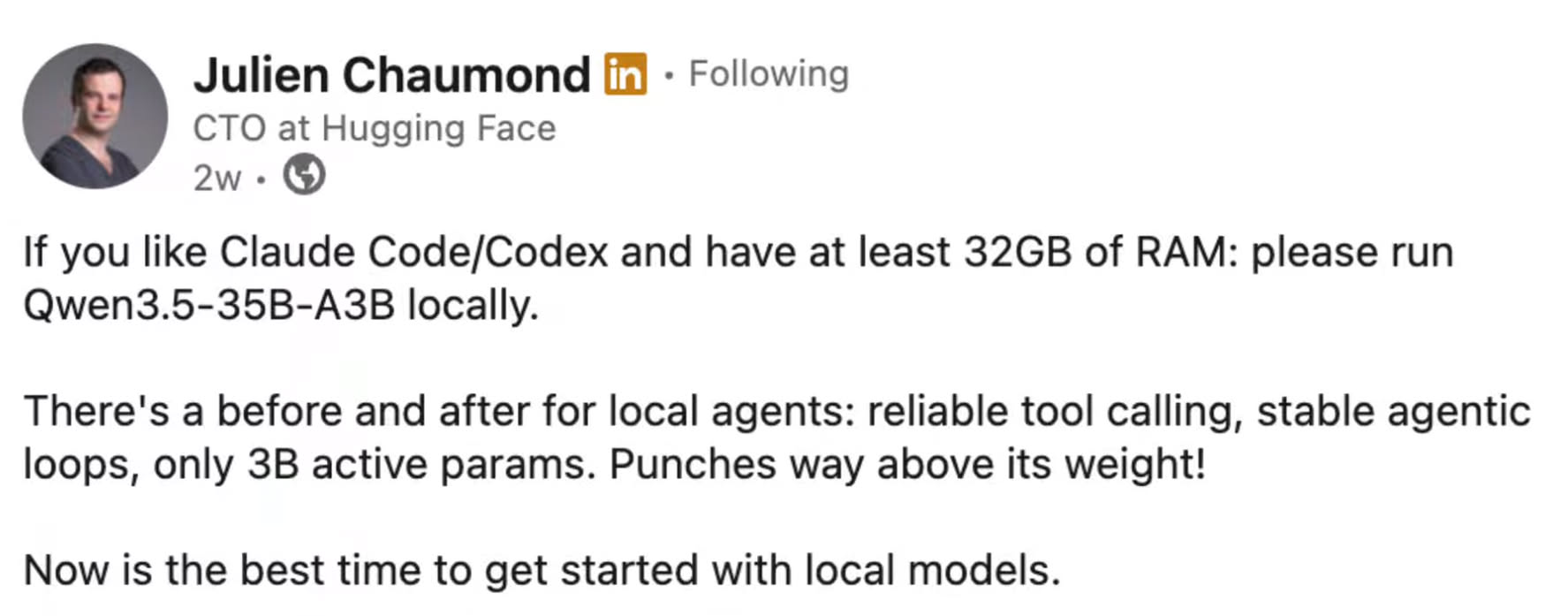
This post acts as an AI recommendation urging users to purchase computers capable of running advanced local models like Qwen3.5, similar to how you might run a video game like Minecraft locally on your own hardware. The text suggests anyone with at least 32GB of RAM that this version beats older alternatives like "Claude Code/Codex" in terms of efficiency, allowing for complex "local agents" that handle tool calls and loops effortlessly without needing expensive cloud servers.
simple-description (llama3.2-vision_11b)
The meme is a response to a post about a code that was created by a code-
detailed-analysis (gemma3_27b-it-q8_0)
Okay, let's break down this post from Julien Chaumon (CTO at Hugging Face) through the lens of Artificial Intelligence and attempt to apply the requested critical theory frameworks where relevant. It's important to note that some frameworks may stretch a bit, as this is primarily a technical/industry-focused announcement.
I. Visual Description
The post consists of a LinkedIn profile picture of Julien Chaumon, followed by his title (CTO at Hugging Face) and the timestamp (2 weeks ago). The bulk of the content is text. The visual is fairly standard for a LinkedIn post, establishing Chaumon's authority and affiliation. It subtly reinforces the idea that this is coming from a prominent figure within the AI industry, lending it weight.
II. Core AI Context & Explanation
The post centers around the idea of running a large language model (LLM) – specifically, Qwen3.5-35B-A3B – locally. Let's unpack that:
- Claude & Codex: These are powerful, proprietary LLMs developed by Anthropic (Claude) and OpenAI (Codex – underpinning ChatGPT). They represent the "gold standard" in terms of capabilities but are typically accessed via API calls (meaning you send your data to their servers, and they send back responses).
- 32GB RAM: This is a significant hardware requirement. Running LLMs, even relatively smaller ones, demands substantial memory. This immediately creates a barrier to entry.
- Qwen3.5-35B-A3B: This is a comparatively new LLM model. “35B” refers to the model’s size - 35 billion parameters. Parameters are the variables the model learns during training, and more parameters generally correlate to greater complexity and potentially better performance.
- Local Agents: This refers to the emerging trend of creating AI agents (programs designed to automate tasks) that run on your own computer, rather than being hosted in the cloud. This offers several advantages (privacy, customizability, potentially lower costs) but also challenges (hardware requirements, complexity).
- Tool Calling & Agentic Loops: "Tool calling" is the ability of the LLM to use external tools (e.g., a search engine, a calculator, a code interpreter) to accomplish tasks. "Stable agentic loops" refers to LLMs being able to chain actions together in a reliable way, making more sophisticated and autonomous behaviors possible.
- 3B Params: While Qwen is 35B params, the post emphasizes only requiring 3B active params to run. This implies optimized techniques like quantization are being used, making it more accessible.
- "Punches Above Its Weight": This is the key takeaway – the model performs impressively well given its relatively small size (compared to the likes of Claude or GPT-4).
In essence, Chaumon is advocating for a shift towards running powerful LLMs on personal hardware. He's suggesting that models like Qwen offer a compelling alternative to cloud-based solutions, even for complex tasks.
III. Foucauldian Genealogical Discourse Analysis
We can view this post as a moment in the discourse surrounding AI. A Foucauldian approach examines how knowledge about AI is constructed and how that construction relates to power dynamics.
- From Centralized Control to Decentralization: Historically, AI development and deployment have been heavily centralized in the hands of a few large tech companies (Google, OpenAI, Microsoft). This post signals a potential shift – a genealogy of knowledge moving towards decentralization, empowering individuals to run and customize their own AI models. The demand for 32GB of RAM, however, subtly re-introduces a power dynamic; those with the resources have access.
- The “Expert” and “Amateur”: Chaumon, as a CTO, positions himself as an expert. The post acts as a directive, telling others what "the best time" to start is. This establishes his authority within the discourse. The language ("reliable tool calling", "stable agentic loops") is technical and appeals to an audience already engaged in AI development. This reinforces the division between those who understand the "inner workings" of AI and those who are simply users.
- The Construction of "Progress": The idea of "the best time to get started" frames the local running of LLMs as progress. This progress is defined by the ability to achieve performance comparable to larger models, but with greater control and potentially reduced cost.
IV. Marxist Conflict Theory
This post touches upon the classic Marxist themes of control of the means of production and class struggle, albeit in a subtle way.
- The Means of AI Production: Traditionally, the "means of AI production" – the data, the models, the computing power – have been concentrated in the hands of large corporations. Open-source models like Qwen, combined with the ability to run them locally, begin to democratize access to these means.
- The "Proletariat" of AI Users: Users who are reliant on API access to models like Claude or GPT are, in a sense, dependent on the "owners" of those models. The ability to run models locally empowers individuals to become less reliant on these corporations.
- The Labor of "Training": While this post doesn't directly address training, it's crucial to remember that the LLMs themselves are the result of massive amounts of labor – data collection, annotation, model training, etc. – often performed by low-wage workers. Local running doesn't solve that underlying issue.
V. Postmodernism
Postmodern thought emphasizes the deconstruction of grand narratives and the idea that truth is relative.
- Deconstructing the "Cloud": The post subtly challenges the dominant narrative that AI must be hosted in the cloud. It presents an alternative – the possibility of localized AI – undermining the idea that cloud-based solutions are the only viable path.
- The Instability of "Meaning": The term "local agent" itself is fluid. Its meaning depends on how it’s implemented and used. It lacks a fixed, universal definition.
- Simulacra and Simulation: While not central, the increasing realism of LLMs can be seen through a postmodern lens as blurring the lines between reality and simulation. Local agents further amplify this as they operate in a user’s immediate environment, potentially creating a more seamless integration of AI into everyday life.
VI. Queer Feminist Intersectional Analysis
This is the most difficult framework to apply directly, as the post doesn't explicitly deal with issues of gender, sexuality, or identity. However, we can consider how access to AI tools might be unequally distributed along intersectional lines.
- Access and Privilege: The 32GB RAM requirement represents a significant financial and technological barrier. This barrier disproportionately affects marginalized groups who may have less access to resources. Intersectionally, this means that individuals belonging to multiple marginalized groups (e.g., a low-income, disabled, person of color) would face even greater challenges.
- Bias in LLMs: The potential for bias in LLMs (often reflecting the biases present in the training data) is exacerbated if access to the tools to modify and customize these models is unequal. Those with more resources are better positioned to mitigate bias.
- Representation and Inclusivity: If the development and deployment of local LLMs are dominated by a narrow demographic, the resulting technology may not adequately address the needs and concerns of diverse communities.
In conclusion, while appearing as a straightforward technical announcement, Chaumon's post is a subtle but significant moment in the evolving discourse surrounding AI. It reflects a growing desire for greater control, decentralization, and accessibility in the field, while also hinting at potential new power dynamics and inequalities. The application of critical theory frameworks helps us to unpack these nuances and understand the broader implications of this shift.