First Seen
2025-08-11T19:16:07+00:00
simple-description (qwen3.5_2b-q8_0)
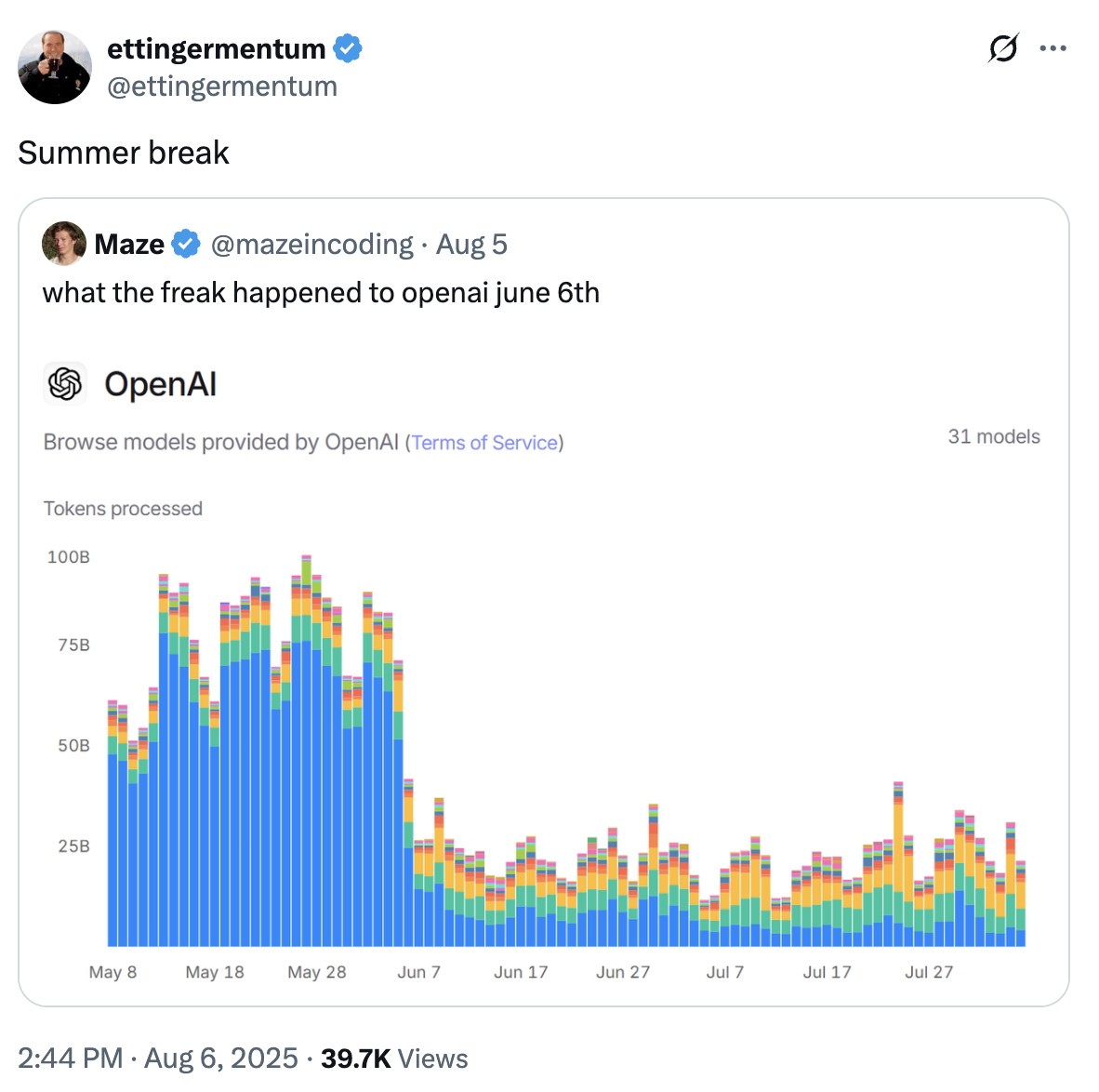
This meme set belongs to the Artificial Intelligence category, specifically commenting on the behavior of Large Language Models (LLMs) like OpenAI's GPT-4. The image features a stacked bar chart titled "Tokens processed" that tracks OpenAI models over time. The humor relies on the visual contrast between massive spikes in processing power during mid-May and an immediate, dramatic "crash" or decline in activity right around June 7th.
The caption—"what the freak happened"—references recent viral discussions where AI models were known to produce nonsensical, "fuzzy" logic; this meme suggests that despite previously high volumes of usage (billions of tokens processed), the models suddenly became unstable or crashed unexpectedly.
detailed-analysis (gemma3_27b-it-q8_0)
Okay, let's break down this meme, from an AI/tech perspective and through the requested theoretical lenses. It's a very pointed meme within the AI community, so understanding the context is key.
Visual Description
The image is a simple bar graph titled “Tokens Processed” with x-axis markings representing dates from May to July 2023. The y-axis displays the number of tokens (units of text) processed, ranging up to 100 billion. The graph shows a dramatic peak in token processing around May 28th - June 7th. Following this peak, there's a very steep and significant drop, followed by a period of significantly lower, fluctuating token processing levels. The bars are colored, ostensibly representing different models (OpenAI’s 31 models are referenced). The caption reads “what the freak happened to openai june 6th.” The image is posted by @ettingentum, who has a blue checkmark indicating verification, and retweeted by @mazeincoding.
Context within the AI Category
The date "June 6th" is crucial. On June 6th, 2023, OpenAI made substantial changes to its API access, dramatically restricting rate limits for its most powerful models (GPT-4, in particular). This meant developers could process far fewer tokens, and thus could run far fewer requests to the API. This was done, according to OpenAI, to combat abuse and ensure more equitable access, but it was widely perceived by the AI community as a heavy-handed and poorly communicated move, negatively impacting a huge number of applications built on the OpenAI platform. The meme visualizes this disruption – the sudden drop in "Tokens Processed" perfectly illustrates the immediate effect of the rate limit changes.
Now, let’s attempt to look at this through the requested theoretical lenses. Keep in mind some are more applicable than others here.
Foucauldian Genealogical Discourse Analysis
Michel Foucault would be interested in the power dynamics inherent in this image. The "Tokens Processed" graph isn’t just a neutral representation of data. It’s a trace of exercise of power by OpenAI.
- Discipline and Panopticism: OpenAI, through its API, exerts a form of "discipline" over developers. The rate limits are a form of control – defining what is permissible and what isn’t. Developers are, in a sense, under the "gaze" of OpenAI, needing to adapt their work to stay within the prescribed boundaries.
- Genealogy of “Abuse”: The justification for the rate limits – "abuse" – is a discourse. Foucault would ask us to trace the history of this concept of "abuse". What constitutes "abuse"? Who defines it? Is it legitimate concern, or a pretext for greater control? The meme challenges this justification by highlighting the disruption caused by the change, implying the benefits do not outweigh the costs.
- Episteme: The rise of large language models and the API-driven access model represents a shift in the "episteme" – the underlying rules and assumptions of knowledge production. OpenAI positions itself as the gatekeeper of this new knowledge, deciding who gets access to it and how.
Critical Theory (Frankfurt School)
From a critical theory perspective, this image illustrates the problematic relationship between technology, power, and rationality.
- Instrumental Reason: OpenAI's decision is framed as a rational response to a technical problem (abuse). However, critical theorists would argue that this "instrumental reason" obscures deeper power dynamics and potentially stifles innovation. It prioritizes control over the potential for creative, democratic uses of AI.
- Culture Industry: OpenAI could be seen as a component of a broader “culture industry” controlling the means of algorithmic production. The API isn't just a technical tool; it’s a means of shaping how AI is developed and deployed.
- Commodification of Information: The API is a commodity. The rate limits and pricing structures govern access to this commodity, potentially excluding smaller developers and reinforcing existing inequalities.
Marxist Conflict Theory
This meme reveals a conflict between different classes within the AI ecosystem.
- Bourgeoisie vs. Proletariat: OpenAI represents the “bourgeoisie” – those who own the means of production (the AI models and infrastructure). Developers building applications on the API are the “proletariat” – reliant on access to OpenAI’s resources to create value. The rate limits are essentially a form of exploitation, limiting the “proletariat’s” ability to profit from their labor.
- Alienation: Developers are alienated from the creative process because they are dependent on OpenAI’s rules and limitations. Their ability to innovate is curtailed.
- Class Consciousness: The meme itself is an expression of “class consciousness” among developers – a recognition of their shared interests and their exploitation by OpenAI.
Postmodernism
A postmodern reading would question the very idea of a single, objective "truth" about what happened on June 6th.
- Grand Narratives: OpenAI's explanation (combating abuse) is a "grand narrative" – a sweeping claim that attempts to justify its actions. Postmodernism would deconstruct this narrative, revealing the power relations and underlying assumptions that shape it.
- Simulacra and Simulation: The "Tokens Processed" graph itself can be seen as a simulacrum – a copy without an original. It represents data about data, creating a mediated reality that obscures the complexities of the situation.
- Deconstruction: The meme “deconstructs” OpenAI’s official narrative by visually showcasing the drastic change in token processing. It doesn’t offer an alternative explanation but emphasizes the disruption caused by the change, highlighting the instability of meaning and the lack of a single, authoritative interpretation.
Queer Feminist Intersectional Analysis
This is the least directly applicable lens, but can still be insightful.
- Access and Exclusion: Rate limits and API costs disproportionately impact smaller developers, particularly those from marginalized communities who may have less access to capital and resources. This intersects with issues of gender, race, and socioeconomic status.
- Control and Surveillance: The API access and rate limits are a form of surveillance and control. This can be seen as part of broader systems of oppression that seek to regulate and discipline bodies and behaviors.
- Disruption as Resistance: The meme, as a form of collective expression, can be seen as a micro-act of resistance against the dominant power structure.
In Conclusion
The meme is far more than a simple graph. It’s a concentrated expression of frustration, power dynamics, and a challenge to the narrative presented by a dominant tech company. It invites a multitude of critical interpretations, reflecting the complex and contested nature of AI development and deployment. It embodies a community’s disappointment and a questioning of the ethical implications of centralized control over powerful AI technologies.
simple-description (llama3.2-vision_11b)
The meme is a screenshot of a tweet from the Twitter account @matt_dryer, featuring a graph of a large spike in the number of tweets mentioning the term "AI" in 2023. The tweet is captioned "2023: The year AI became a thing" and includes a link to a graph showing the number of tweets mentioning "AI" in 2023, with a peak in the number of tweets mentioning the term in June 2023.