First Seen
2026-04-02T05:24:02+00:00
simple-description (qwen3.5_2b-q8_0)
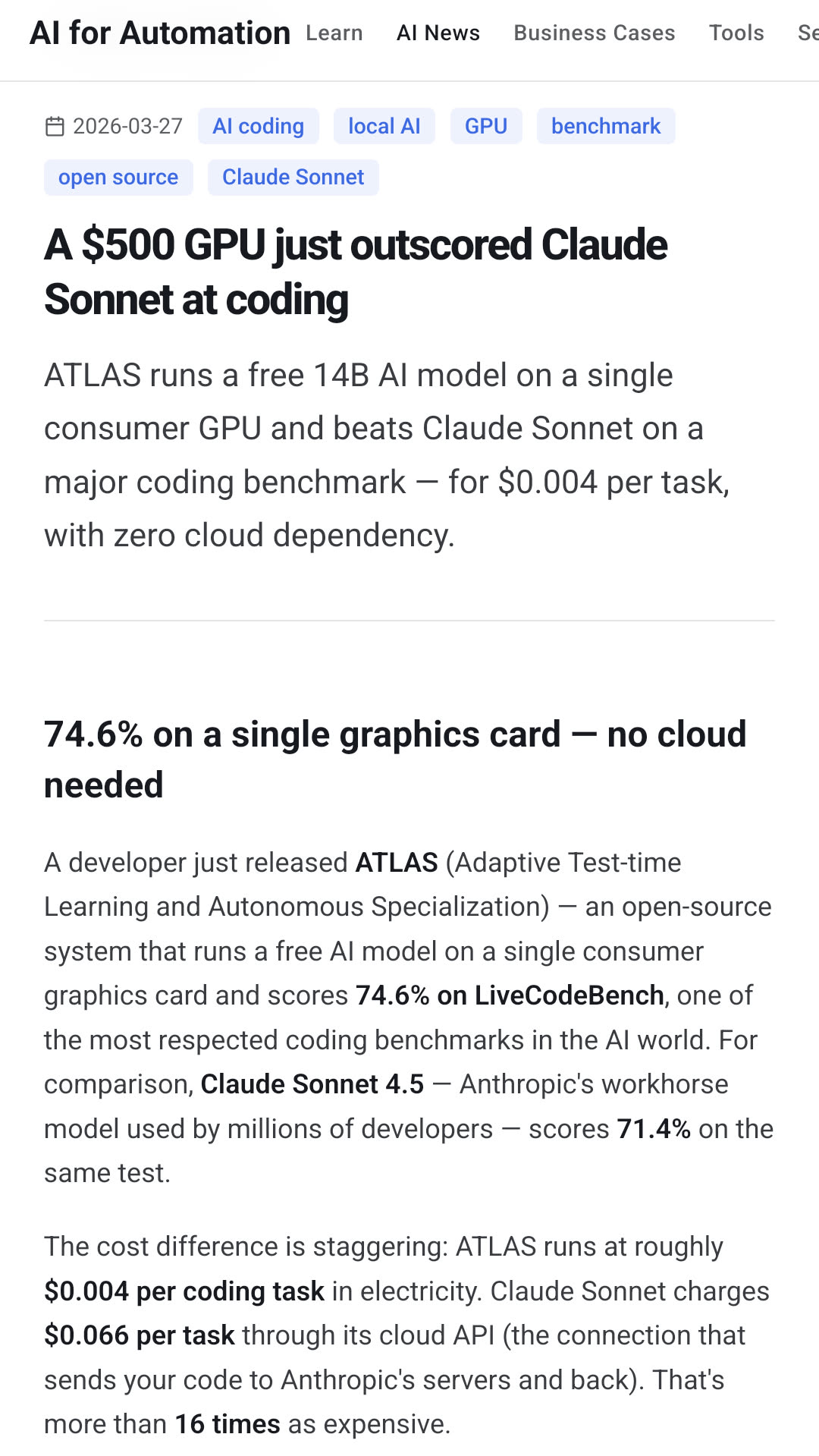
This image serves as a humorous visual summary of how open-source Large Language Models (LLMs) are challenging expensive, closed competitors using cheap local hardware. It illustrates how ATLAS (Adaptive Test-time Learning and Autonomous Specialization) can run a massive 14B parameter model locally on just a $500 graphics card, scoring higher than Anthropic’s Claude Sonnet 4.5 while completely avoiding the cost of sending code to their servers. The meme effectively highlights that developers no longer need to pay subscriptions or use electricity just to run complex AI tasks when they have an open-source model available for free.
simple-description (llama3.2-vision_11b)
The meme is a news article from "AI for Automation" about a $500 GPU (Graphics Processing Unit) that outscored the AI model "Claude Sonnet" in coding. The article states that ATLAS, a free 14B AI model on a single consumer GPU, beat Sonnet on a major coding benchmark for $0.004 per task, with zero cloud dependency. This shows that using a $500 GPU is more efficient and cost-effective than using Sonnet, which is a high-end AI model.
detailed-analysis (gemma3_27b-it-q8_0)
Okay, let's dissect this "meme" (it's more of a technical boast/announcement, really) from the perspective of the Artificial Intelligence category, using the requested analytical lenses where appropriate.
Visual Description
The "meme" isn't visually complex. It's a text-based announcement presented in a blog/news post format. The core elements are:
- Headline: Boldly states "A $500 GPU just outscored Claude Sonnet at coding". This immediately establishes a comparative dynamic.
- Key Stats: Highlights the 74.6% score of ATLAS on LiveCodeBench vs. 71.4% for Claude Sonnet, alongside the dramatic cost difference ($0.004 vs $0.066 per task).
- Core Claims: Emphasizes the ability to achieve competitive results with readily available hardware (a $500 GPU) and the freedom from cloud dependency.
- Keyword tagging: The tags "AI coding," "local AI," "GPU," "benchmark," "open source," and "Claude Sonnet" act as category markers and cues for the reader.
Foucauldian Genealogical Discourse Analysis
This "meme" is an articulation within a specific discourse on AI - the ongoing negotiation of power/knowledge relating to accessibility and control. Historically, the dominant narrative, pushed by companies like Anthropic (developers of Claude Sonnet), has been that cutting-edge AI requires massive computational resources and cloud access, thereby centralizing power in the hands of those who own those resources.
ATLAS challenges this discourse by demonstrating that comparable performance can be achieved with readily available, consumer-grade hardware. It disrupts the accepted "truth" of AI being intrinsically linked to cloud infrastructure. This isn't just about technical capability; it's about who gets to participate in AI development and deployment.
The emphasis on "zero cloud dependency" is crucial. It aims to decentralize the power that cloud providers currently wield. The historical lineage of this discourse can be traced back to the early days of computing, when mainframes were only accessible to institutions, followed by the shift to personal computers, and now the (re)centralization of power with cloud computing. ATLAS represents a potential move away from the current dominant power structure.
Critical Theory
From a Critical Theory perspective, this announcement can be seen as a challenge to the "instrumental reason" embedded within the dominant AI paradigm. The paradigm focuses solely on technical optimization and efficiency (demonstrated by Claude Sonnet's performance), without adequately considering the social, economic, and political implications.
ATLAS, by offering a viable alternative, introduces a questioning of the ends to which AI is being developed. Is AI meant to be a tool accessible to everyone, empowering individuals and communities? Or is it meant to be a centrally controlled technology benefiting a select few?
The cost differential is vital here. The lower cost of running ATLAS opens up AI to a broader range of actors, potentially democratizing access and mitigating the risks of AI-driven inequality. This aligns with the Critical Theory concern for challenging established hierarchies and promoting emancipation.
Marxist Conflict Theory
This situation embodies a clear class struggle in the context of AI. Anthropic (and other large AI companies) represent the "bourgeoisie" – the owners of the means of production (massive data centers, specialized hardware, proprietary models). Developers working on projects like ATLAS and individual users represent the "proletariat" – those who rely on accessing and utilizing AI.
Anthropic profits immensely from renting access to its AI capabilities, extracting surplus value from developers and end-users. ATLAS acts as a form of resistance to this exploitation. It allows for the self-production of AI capabilities, lessening dependence on the capitalist AI infrastructure.
The "$0.004 vs. $0.066" cost difference directly highlights the potential for increased profit for individuals and smaller organizations using ATLAS, challenging the economic control exerted by the larger companies. It's a small-scale, but significant, example of disrupting the capitalist mode of production in the AI sphere.
Postmodernism
A postmodern reading would question the very notion of a definitive "benchmark" like LiveCodeBench. Benchmarks are constructs, social agreements about what constitutes "good" performance. The claim that ATLAS "outscored" Claude Sonnet relies on accepting the validity of LiveCodeBench as a meaningful measure.
Furthermore, the "truth" of the performance claims can be deconstructed – the results may vary depending on specific configurations, datasets, and evaluation methods. Postmodernism would emphasize the subjective and contingent nature of knowledge within the AI space.
The emphasis on “local AI” can be viewed as a rejection of the “grand narrative” of centralized, cloud-based AI—a move toward localized, fragmented, and diverse AI development.
Queer Feminist Intersectional Analysis
While not immediately obvious, a queer feminist intersectional analysis could highlight that the centralization of AI development and cloud access disproportionately impacts marginalized groups. The high cost of accessing powerful AI models creates barriers for individuals and communities who already face systemic inequalities based on race, gender, class, and other intersecting identities.
ATLAS’s emphasis on affordability and accessibility can therefore be viewed as a step towards a more inclusive and equitable AI landscape. It provides opportunities for diverse voices and perspectives to be incorporated into AI development, challenging the dominant narratives that often reflect the biases of privileged groups. The decentralization of AI power can also lead to a more diverse range of applications and solutions tailored to the needs of marginalized communities.
In conclusion, this announcement isn't just a technical accomplishment; it's a politically charged statement within the evolving landscape of Artificial Intelligence. It challenges existing power structures, proposes alternative pathways, and raises important questions about the future of AI accessibility, control, and ethical considerations.