First Seen
2026-03-18T23:21:05+00:00
simple-description (qwen3.5_2b-q8_0)
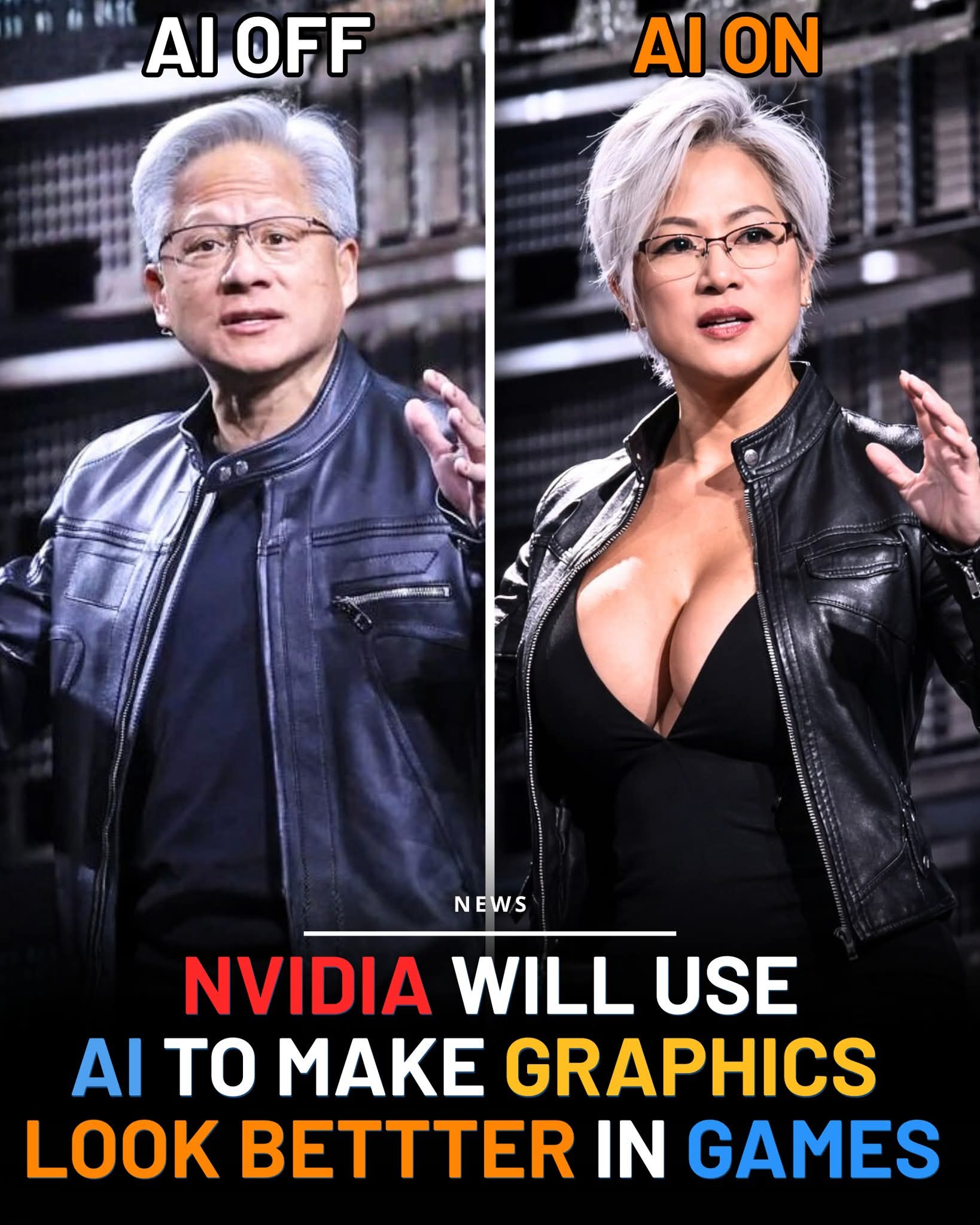
This meme uses a split-screen format to contrast the state of "AI OFF" with "AI ON," highlighting the power of artificial intelligence. On the left side, labeled "AI OFF," it shows a real-world photograph of Jensen Huang (the co-founder of NVIDIA) in a leather jacket, representing human reality or how people often use AI tools to enhance their own faces online. On the right side, labeled "AI ON," the image displays an artificial generation of a woman in a matching black leather jacket with the identical pose and clothing, showcasing how advanced technology can create perfect, cinematic visuals without physical limitations. The text at the bottom provides context that NVIDIA plans to use this specific type of AI technology to improve graphics in video games, suggesting that with "AI ON," you can generate these flawless images instantly for your character.
detailed-analysis (gemma3_27b-it-q8_0)
Okay, let's break down this meme through the lens of Artificial Intelligence and the requested theoretical frameworks. It's a rather pointed example, so we'll go deep.
Visual Description
The meme presents a side-by-side comparison of actor Keanu Reeves. On the left, labeled "AI OFF," is a photo of Reeves appearing older, with more visible signs of aging. On the right, labeled "AI ON," is a digitally altered image of Reeves looking significantly younger, smoothed skin, and seemingly altered facial features. Beneath the images, it states "NVIDIA will use AI to make graphics look better in games." The contrast is jarring and deliberately exaggerated. The background appears to be promotional material or a set for the Cyberpunk 2077 game, linking the image to a digital environment. The "NEWS" sticker suggests it is reporting on current events.
Foucauldian Genealogical Discourse Analysis
From a Foucauldian perspective, this meme reveals a shift in the discourse surrounding beauty, aging, and authenticity. Michel Foucault's genealogical method encourages tracing the historical development of concepts, showing how they're not natural or inevitable, but constructed through power relations.
- Historical Shift: Throughout history, aging has been understood differently. Wisdom and experience were valued. However, the modern era, particularly influenced by capitalism and consumer culture, has increasingly framed youth as desirable and associated aging with decline.
- Power/Knowledge: This meme shows how AI becomes a technology of power. It's not just about improving graphics; it’s about wielding the power to reshape appearances, to 'correct' what's deemed undesirable (aging). This 'knowledge'—that a younger appearance is better—becomes solidified through the technological capability to produce that appearance. AI isn’t neutral; it embodies and reinforces existing power structures.
- Disciplinary Mechanisms: The meme implicitly critiques how digital technology now participates in self-discipline and surveillance, encouraging the pursuit of idealized (and often unrealistic) standards of beauty. The ability to digitally "fix" appearances normalizes a culture of constant self-optimization.
Critical Theory
Applying Critical Theory, particularly the Frankfurt School's critique of the culture industry, the meme exposes how technology (AI) is used to reinforce capitalist ideologies.
- Commodification of the Self: The meme illustrates the increasing commodification of the self. Appearance becomes a product to be refined, perfected, and sold. AI tools become the instruments for this commodification, and Keanu Reeves' image is the "product."
- False Consciousness: By presenting this "improvement" as simply about "better graphics," the meme subtly obscures the ideological implications of the technology. It creates a false consciousness where people are led to believe they are simply benefiting from technological progress without recognizing the power dynamics at play.
- Standardization & Conformity: The pursuit of idealized visuals (youthful appearance) through AI contributes to standardization. Diversity in appearance is flattened, and conformity to a narrow ideal is promoted.
Marxist Conflict Theory
From a Marxist perspective, the meme highlights the exploitation inherent in the development and application of AI.
- Means of Production: NVIDIA, a powerful corporation, controls the means of production (AI technology) in this context. They decide how it’s used, and this use is driven by profit.
- Class Struggle: The meme implicitly reveals the class struggle involved. The resources and expertise to create this technology are concentrated in the hands of the wealthy. The benefits (e.g., improved gaming visuals) are primarily enjoyed by those with access to the technology, while the underlying exploitation (e.g., data harvesting, labor conditions in manufacturing) remains hidden.
- Alienation: The alteration of Reeves’ image, using AI, contributes to the alienation of the self. The individual is distanced from their authentic self and reduced to a manipulable image.
Postmodernism
Postmodern thought would see this meme as a symptom of a hyperreal world where the distinction between reality and simulation has blurred.
- Simulation & Simulacra: Jean Baudrillard's concepts of simulation and simulacra are central here. The AI-altered image of Reeves isn't an accurate representation of reality; it’s a simulation of what is considered desirable. This simulation eventually replaces reality, becoming more real than real.
- Deconstruction of Authenticity: The meme deconstructs the notion of “authenticity.” What is “real” Keanu Reeves? Is it the aged, natural version, or the digitally perfected version? Postmodernism questions the very idea of a fixed, essential self.
- Irony & Playfulness: The meme's use of irony (presenting this as just "better graphics") is characteristic of postmodernism's playful approach to grand narratives.
Queer Feminist Intersectional Analysis
This one is a little more nuanced.
- Gendered Standards of Beauty: The meme powerfully speaks to the impossible standards of beauty imposed on women (and increasingly, men). While the example uses Keanu Reeves, the technology underlying it is heavily marketed towards modifying female features in photos and videos, reinforcing patriarchal beauty norms. The emphasis on youthfulness is particularly acute for women.
- Intersectionality and Digital Bias: AI algorithms often perpetuate existing biases. Facial recognition technology, for example, has been shown to be less accurate for people of color and women. The pursuit of idealized visuals through AI could exacerbate these biases, further marginalizing already vulnerable groups. Who defines “better graphics” and whose features are considered “default”?
- Resistance and Reclamation: A Queer Feminist perspective might encourage reclaiming and celebrating diverse bodies and challenging the hegemonic beauty standards reinforced by AI. It's a call to recognize the power dynamics at play and resist the pressure to conform to unrealistic ideals.
In conclusion, this meme, while seemingly simple, is a potent microcosm of the broader issues surrounding AI, power, and culture. It's a warning about the potential for technology to reinforce existing inequalities, manipulate perceptions of reality, and commodify the self.
simple-description (llama3.2-vision_11b)
This meme is a satirical comparison of the impact of AI on graphics. The image features a before-and-after split, with a photo of a person on the left and another on the right, both with the same expression and pose. The left photo is labeled "AI OFF" and the right photo is labeled "AI ON". The text below the images reads, "NVIDIA will use AI to make graphics look better in games." The meme is meant to be humorous and satirical, suggesting that the use of AI will only make things worse, not better. The use of AI in this context is likely to be used for enhancing or improving the quality of the graphics in games, but the author of the meme is using it to make a satirical or humorous comment.