First Seen
2025-08-15T12:38:34+00:00
simple-description (qwen3.5_2b-q8_0)
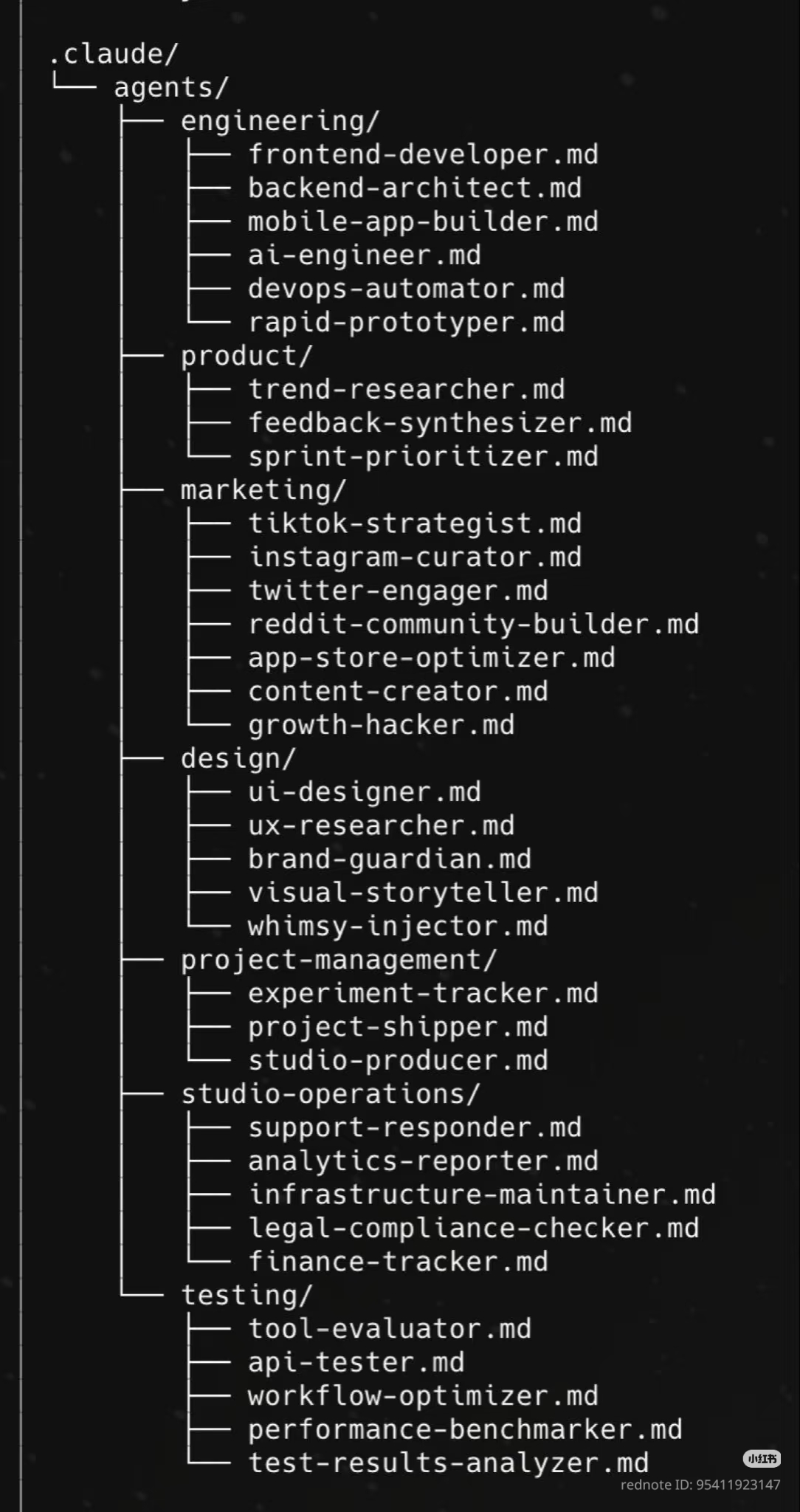
This image displays a hierarchical file structure representing different specialized Artificial Intelligence agents within a coding assistant environment. It categorizes tasks under broad domains like Engineering and Marketing, each containing specific sub-files that likely define the distinct roles or personas assigned to handle them. From an AI perspective, it illustrates how a large language model might be configured to act as a team of experts in fields ranging from frontend development to content creation.
detailed-analysis (gemma3_27b-it-q8_0)
Okay, let's break down this image (a directory structure of files ending in .md, likely for a documentation or code repository) through the lens of Artificial Intelligence. I'll cover sections as they are relevant, given the context of AI and the structure presented.
Visual Description
The image presents a hierarchical file directory structure. The root directory is named .claude. Branches are labeled with broad functional areas like "engineering," "product," "marketing," "design," "project-management," "studio-operations," "testing", and "finance". Within each of these, specific “agents” or functions are detailed with names ending in .md (likely Markdown files). This structure strongly suggests a highly modular, agent-based AI system where individual AI 'agents' handle very specific tasks within each department of a business, or project.
The naming convention of these 'agents' is key: they optimize, track, build, curate, synthesize – all actions that AI excels at (or is being developed to excel at). The use of '.md' files indicates a focus on documentation of these agents, perhaps for version control, collaboration, or AI model definition/training data management.
Foucauldian Genealogical Discourse Analysis
From a Foucauldian perspective, this image maps out a new discourse surrounding work and productivity. Historically, work was largely defined by human roles (engineer, marketer, designer, etc.). This directory structure represents a shift where those roles are being dissected and atomized into quantifiable, algorithmically-executable functions.
- Power/Knowledge: The knowledge embedded within these files (the
.mddocumentation) is power. The ability to define, codify, and deploy these "agents" gives control to those who understand the AI system. This creates a new power dynamic. - Genealogy: Tracing the historical lineage, we see this isn't about simply automating existing roles. It's about re-engineering the very concept of work. The focus moves from the holistic professional to a collection of discrete tasks optimized by AI.
- Discipline: The very structure – the meticulous categorization and individual “agent” designation – implies a disciplined, optimized work environment where everything is measured and controlled by algorithmic logic. The agents themselves become disciplining forces, constantly “optimizing” and “tracking.”
Critical Theory
This image exemplifies a key concept within Critical Theory: the instrumentalization of reason. The system represented isn't about creating better work, it's about maximizing efficiency and output. Human creativity, nuance, and judgment are implicitly diminished in favor of algorithmic precision.
- Commodification of Labor: Each ".md" file represents a potential fragment of labor to be codified, commodified, and automated. The focus on optimization within marketing ("tiktok-strategist", "growth-hacker") and finance ("finance-tracker") is particularly stark.
- Loss of Autonomy: While this system may promise to free humans from tedious tasks, it simultaneously reduces the scope of human agency. The “agents” define the parameters of work, subtly shifting control away from human workers.
- Technological Determinism: There's an underlying assumption that AI will and should optimize these functions. This is a form of technological determinism – the belief that technology shapes society, rather than the other way around.
Marxist Conflict Theory
From a Marxist perspective, the image represents the intensifying conflict between capital (owners of the AI system) and labor (human workers).
- Alienation: The atomization of work into these AI agents exacerbates alienation. Workers may become detached from the overall purpose of their work, reduced to managing or supporting the “agents.”
- Exploitation: The increased efficiency gained from the AI system translates to higher profits for those who own it. The "labor" of designing, training, and maintaining these agents is potentially exploited.
- Class Struggle: The development and deployment of these AI systems risk creating a new class divide: those who control the AI and those whose labor is replaced or redefined by it. The "legal-compliance-checker" agent might even be an attempt to preemptively address ethical/legal concerns around this displacement.
Postmodernism
A postmodern reading sees the directory structure as a deconstruction of traditional professional identities. The boundaries between disciplines blur as “agents” perform functions across various domains.
- Simulacra & Simulation: The “agents” themselves are simulations of human functions, operating as simulacra that replace or augment the real thing.
- The End of Grand Narratives: The image implicitly challenges grand narratives about work and progress. There’s no overarching vision; only a series of fragmented, optimized tasks.
- Hyperreality: The system creates a hyperreal workplace where the lines between the real and the simulated become increasingly blurred. The optimization and tracking metrics become more “real” than actual outcomes.
In Summary:
This seemingly simple directory structure reveals a complex vision of the future of work—one heavily influenced by Artificial Intelligence. From a critical perspective, it raises important questions about power, control, alienation, and the very definition of what it means to work in a technologically mediated world. The image isn't just a technical layout; it's a map of a shifting power landscape.
simple-description (llama3.2-vision_11b)
The meme is a screenshot of a GitHub repository for a project called "AI- powered chatbot" that uses a library called "Deep- Learning- Framework" (DLF). The repository's README file contains a joke about the project's name being "Deep- Learning- Framework" being a "deep” joke. The joke is that the project's name is a play on words, as it is a “deep” reference to the “Deep- Learning- Framework” library. The joke is that the project’s name is a “deep” joke, as it is a “deep” reference to the “Deep- Learning- Framework” library.