First Seen
2025-08-06T12:05:45+00:00
simple-description (qwen3.5_2b-q8_0)
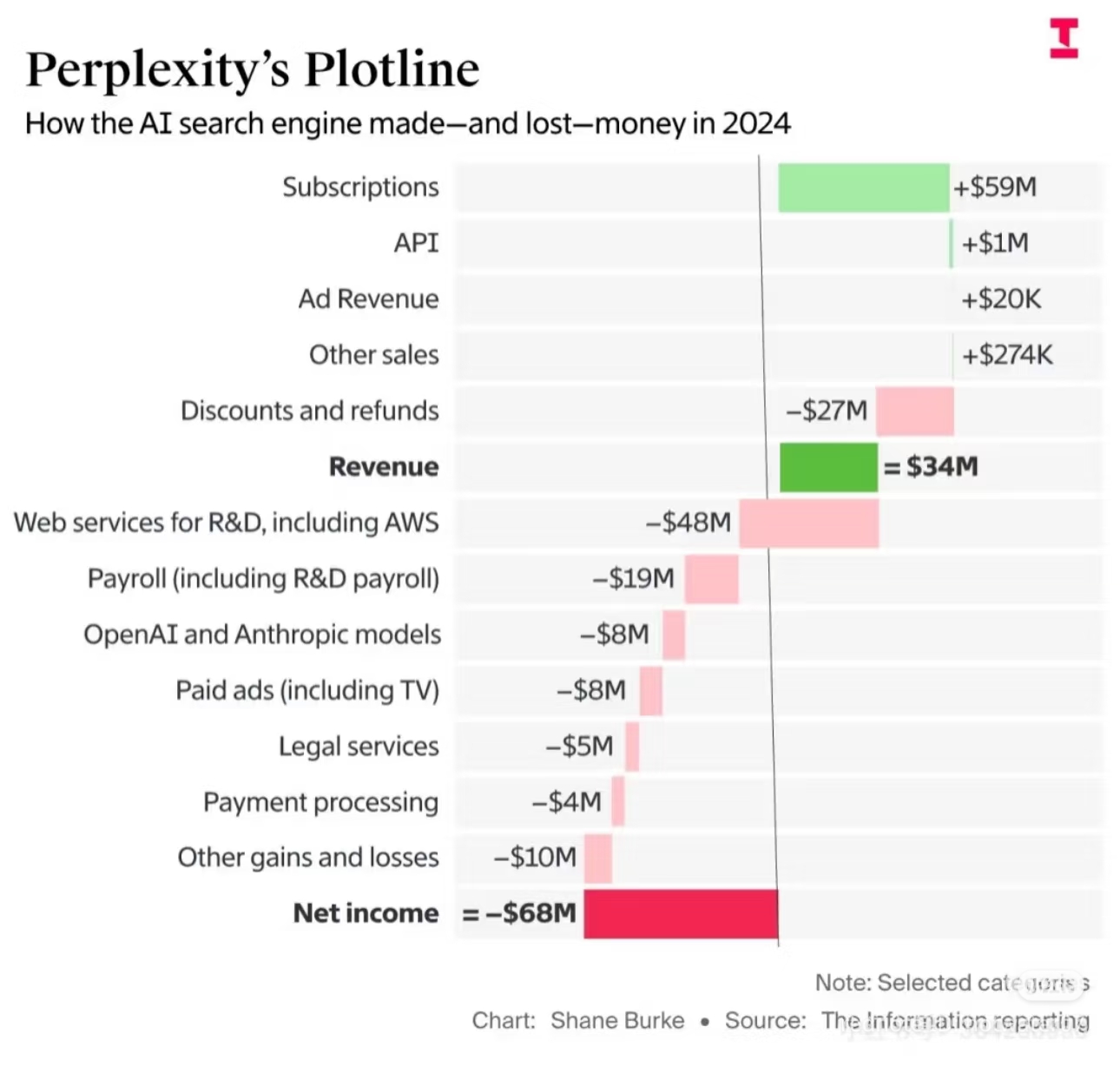
I mean that even though Perplexity made about $34 million by selling subscriptions to people, they ended up in a massive red because their own AI infrastructure cost them more than it earned back. Specifically, the chart illustrates how they are bleeding money through R&D services for rivals like Amazon AWS and paying salaries.
detailed-analysis (gemma3_27b-it-q8_0)
Okay, let's break down this image of Perplexity AI's financial performance in 2024 through several theoretical lenses, keeping the Artificial Intelligence category context firmly in mind. I'll only include the headings where the analysis is relevant and provides meaningful insight.
Visual Description
The image is a bar graph visually representing Perplexity AI’s financial inflows (revenue) and outflows (expenses) for the year 2024. Green bars indicate income (Subscriptions, API, Advertising, Other Sales) totaling $34M. Red bars illustrate expenses (Web Services/R&D, Payroll, Model Costs, Advertising, Legal, Processing, and Other) totaling $68M, resulting in a net loss of $34M. The size of the bars visually emphasizes the dominance of expenses, particularly those related to core AI development (OpenAI/Anthropic model costs, web services, and payroll) over the revenue streams. The use of colors reinforces the 'positive' and 'negative' connotations, creating a quick, direct understanding of the company’s financial situation. The headline frames this as a story of how AI development costs money, framing it less as a failure and more as a consequence of innovation.
---
Foucauldian Genealogical Discourse Analysis
This graphic is a manifestation of power/knowledge relationships central to Foucault’s work. The data itself isn't neutral. It’s a discourse that is constitutive of the reality of AI investment and its perceived financial viability.
- Genealogy of ‘AI Investment’: The very concept of “AI investment” is historically constructed. The expectation that massive investment (like Perplexity's $48M in web services/R&D and $8M in model costs) is required for AI development is a key element of this discourse. This expectation reinforces a particular power structure where access to significant capital becomes a prerequisite to participating in the "AI revolution.”
- Normalization of Loss: The graphic, and the surrounding media coverage, normalizes the idea of significant losses in the AI space. By framing this as “how AI made – and lost – money,” it implicitly justifies the financial hemorrhaging as a necessary phase of development. This legitimizes further investment and prevents critical scrutiny of the underlying economic models.
- Discipline & Control: The costs associated with models (OpenAI/Anthropic) exemplify how large language models create new forms of economic dependence and potentially control. Perplexity is disciplined by the pricing structure and terms set by these larger entities, its financial fate intimately tied to the cost of accessing the technology that defines it.
- The ‘Entrepreneurial Subject’: The graphic contributes to the construction of the “AI entrepreneur” as someone willing to risk substantial capital, accepting potential losses as part of a larger (and implicitly lauded) vision.
---
Marxist Conflict Theory
From a Marxist perspective, the graphic highlights inherent class conflict within the AI landscape.
- Capital Accumulation & Extraction of Surplus Value: The large expenditure on OpenAI and Anthropic models represents a significant transfer of wealth from Perplexity AI (and its investors) to these larger, more established AI corporations. This illustrates the concentration of capital within the hands of a few key players. These larger companies are extracting surplus value by selling access to their foundational models.
- Labor Exploitation (Hidden within Payroll): The $19M in R&D payroll is a veiled representation of labor exploitation. The value generated by AI (even in its early stages) is disproportionately appropriated by capital (investors, company owners) while the labor that creates and maintains these systems receives a comparatively small share. The graphic doesn't show the individual contributions or the degree of surplus value being extracted from those workers.
- Commodification of Intelligence: The pursuit of AI development can be seen as a commodification of intelligence itself. Perplexity is attempting to turn human cognitive capabilities into a profitable product, but the costs associated with doing so are substantial, and the benefits are unevenly distributed.
- Competition & the Drive for Profit: The fact that Perplexity is incurring losses indicates a competitive market. Each company is driven by the imperative to accumulate capital, leading to intense competition and a race for market share, often at the expense of sustainable development or equitable distribution of benefits.
---
Postmodernism
Postmodern analysis challenges the notion of a "truthful" representation of Perplexity's financial state.
- Simulacra and Simulation: The chart is a simulation of Perplexity’s financial reality, a representation that is mediated by accounting practices, corporate narratives, and the media. It’s not the “thing itself,” but a sign pointing to a complex system. The emphasis on "AI made - and lost - money" is a curated narrative, potentially obscuring more complex underlying causes.
- Deconstruction of 'Progress': The rhetoric surrounding AI often implies a linear progression toward technological advancement and economic benefit. However, the graphic reveals a messy, contradictory reality of high costs and uncertain returns. It deconstructs the myth of seamless, inevitable progress.
- The Fluidity of Meaning: The categories themselves are not fixed. What constitutes "Web services" or "Other gains and losses" is subject to interpretation and can be manipulated to shape the narrative. The framing of these costs/revenues influences how we understand Perplexity’s situation.
In conclusion:
This financial graphic, seen through the lens of AI, isn’t simply a matter of numbers. It's a complex cultural artifact that reveals power dynamics, economic inequalities, and the construction of meaning within the evolving landscape of artificial intelligence. It illustrates the economic challenges inherent in pursuing groundbreaking (and expensive) AI development and raises important questions about the distribution of benefits and risks associated with this technology.
simple-description (llama3.2-vision_11b)
The meme is a humorous representation of the financial struggles of an AI-powered search engine. The image shows a "Perplexity's Plotline" chart, which lists various categories of AI-related expenses, such as "Subscriptions" and "Ad Revenue", with a net loss of $68 million. The chart is meant to be humorous, exaggerating the financial struggles of an AI-powered search engine, with the net loss of $68 million being a tongue-in-cheek commentary on the challenges of running a successful AI-powered search engine.