First Seen
2025-08-29T16:56:43+00:00
simple-description (qwen3.5_2b-q8_0)
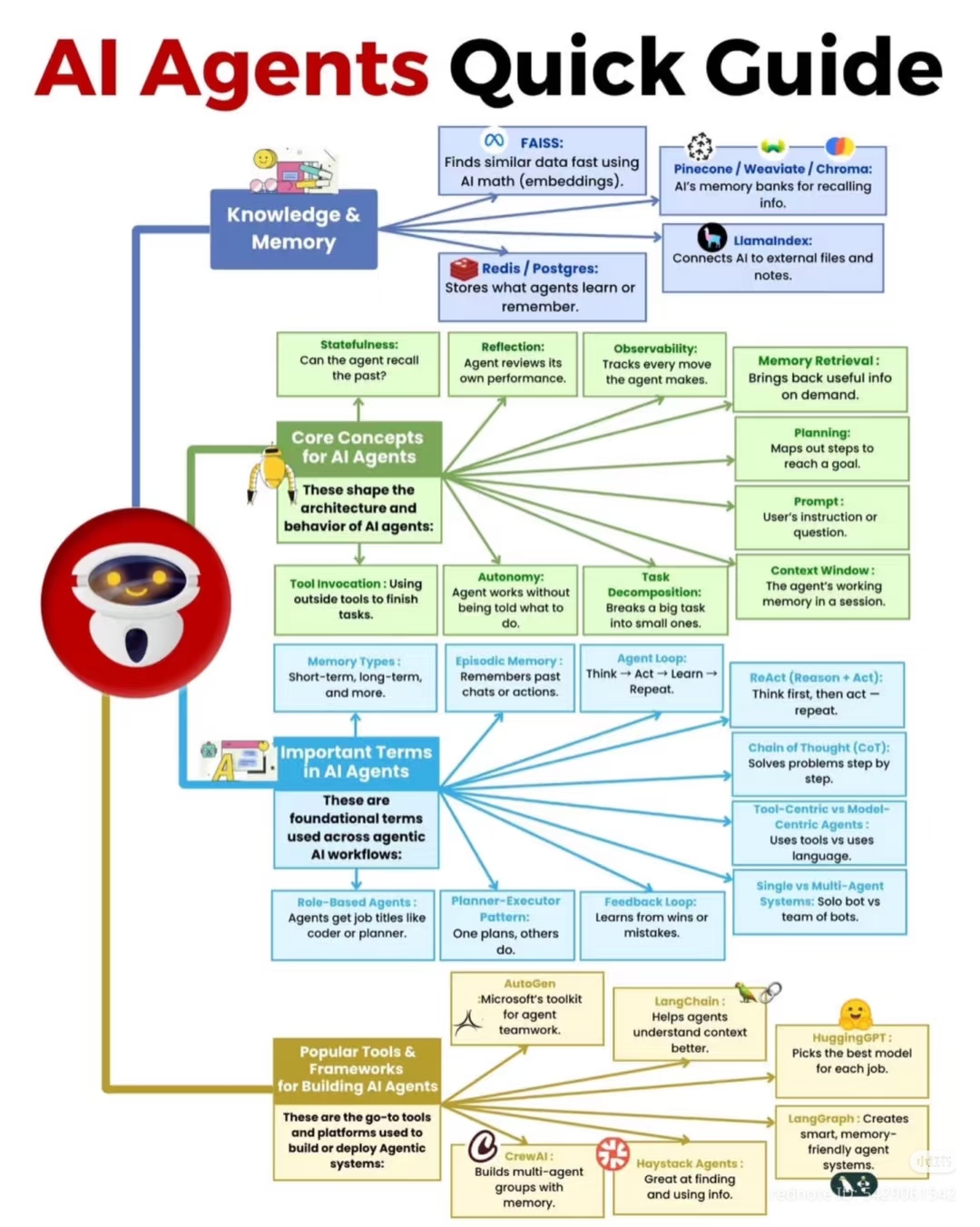
From the perspective of Artificial Intelligence, this infographic acts as a visual "meme" or taxonomy that breaks down the complex concept of an AI Agent into manageable, bite-sized components. It features a central robot avatar serving as the mascot for the agent itself, surrounded by text bubbles that categorize its capabilities—ranging from storing information in databases like FAISS and Redis to core concepts like Autonomy and Tool Invocation.
The guide effectively "meme-izes" the vast amount of technical jargon into four main sections: Knowledge & Memory (how an agent stores info), Core Concepts (how it thinks and plans), Important Terms (specific patterns like Chain of Thought), and Popular Tools (like LangChain or CrewAI) that help build these systems.
detailed-analysis (gemma3_27b-it-q8_0)
Okay, let's break down this "AI Agents Quick Guide" image from an Artificial Intelligence perspective, and then explore its implications through the requested critical theory lenses (where relevant).
Visual Description
The image is a mind-map style infographic titled "AI Agents Quick Guide". It visually outlines key concepts, tools, and terminology related to the development and understanding of AI agents. It's organized with a central cluster titled “Core Concepts of AI Agents” branching out into sub-categories like “Knowledge & Memory”, “Important Terms in AI Agents”, and “Popular Tools & Frameworks”.
- Central Concepts: The core concepts revolve around ideas like autonomy, task decomposition, memory types (episodic, short-term, long-term), and the agent loop (Think-Act-Learn).
- Tools and Frameworks: The “Popular Tools & Frameworks” section lists a range of technologies. Notable tools include LangChain, Pinecone/Weaviate (vector databases), and others focusing on multi-agent systems (CrewAI, Haystack).
- Connections: Lines and arrows connect concepts, indicating relationships – how these tools support the core concepts, how different terms are related, etc.
- Overall Impression: The graphic is dense, demonstrating the complexity and rapidly evolving nature of the AI agent field. It aims to be a comprehensive, but relatively high-level overview. It presents a “toolkit” perspective on building AI agents.
Foucauldian Genealogical Discourse Analysis
From a Foucauldian perspective, this graphic itself is a product of a specific discourse – the discourse of “AI agency”. Let’s unpack that:
- Power/Knowledge: The infographic doesn’t just describe AI agents; it constitutes how they are understood and discussed. By structuring knowledge in this way—emphasizing autonomy, planning, memory—it defines what is considered important and legitimate within the field. This is power/knowledge in action.
- Genealogy of Agency: The idea of an "agent" itself has a history. Historically, agency was firmly attributed to humans. The very term "AI agent" is an attempt to extend, or perhaps usurp, that category. Tracing the genealogy of "agency" reveals how it’s being redefined to accommodate non-biological entities. This is a shift in the conditions of possibility for agency itself.
- Normalization: The infographic subtly normalizes the idea of complex AI systems operating with “autonomy”, “reflection”, and “memory” – concepts traditionally associated with consciousness and human intelligence. This normalization is critical for the acceptance and further development of these technologies.
- Disciplinary Effect: The organization into “Tools” and “Concepts” creates a disciplinary structure. It maps out what needs to be learned and known to participate in the field, influencing those entering it.
Critical Theory (Frankfurt School)
- Instrumental Reason: This diagram embodies the core concern of the Frankfurt School – the dominance of instrumental reason. The entire image is focused on how to make things work, on efficiency, and on technical mastery. There's little to no consideration of the why—what the ethical or social implications of increasingly autonomous agents are.
- Technological Rationality: The listing of tools and the emphasis on building "systems" reflect technological rationality - the belief that technology is a neutral force that can solve any problem. The infographic implicitly supports this view, presenting AI agent development as a technical challenge rather than a socio-political one.
- Loss of Subjectivity: If agents are increasingly able to "think" and "act," it raises questions about the uniqueness of human subjectivity. The diagram, by focusing on replicating cognitive functions in machines, arguably contributes to a devaluing of human experience.
Marxist Conflict Theory
- Capital Accumulation: The tools listed (LangChain, Pinecone, etc.) are often commercially available. The development and deployment of AI agents are heavily driven by capital accumulation - the pursuit of profit. The infographic represents a key component of that accumulation process.
- Labor Displacement: The “Role-Based Agents” section (coder, planner) hints at the potential for automating tasks traditionally performed by human labor. AI agents have the potential to displace workers, exacerbating existing class conflict.
- Control of the Means of Production: The companies that develop and own these AI tools (and the data they require) wield significant power. This reflects a concentration of the means of production in the hands of a few.
- Alienation: As work is increasingly automated and mediated by AI agents, humans may experience increased alienation from their labor and from each other.
Postmodernism
- Deconstruction of Agency: A postmodern reading would challenge the very notion of "agency" being applied to machines. Postmodernists question the idea of a stable, coherent self. If agency is inherently tied to consciousness, intention, and moral responsibility, can it be meaningfully attributed to an algorithm?
- Simulacra and Simulation: AI agents are, in a sense, simulations of intelligence and autonomy. They create simulacra—copies without originals. The diagram represents a layering of simulations upon simulations.
- Relativism and Multiple Perspectives: The graphic doesn’t acknowledge the diversity of perspectives on AI. It presents a particular, technically-focused view, ignoring critiques from ethicists, social scientists, and other disciplines.
- Fragmentation: The mind-map format itself reflects a postmodern emphasis on fragmentation and non-linearity. It resists a singular, overarching narrative.
Queer Feminist Intersectional Analysis
- Bias in Data & Algorithms: The tools listed (like vector databases) rely on large datasets. These datasets often reflect existing societal biases related to gender, race, and other marginalized identities. AI agents built on biased data can perpetuate and amplify those biases, leading to discriminatory outcomes. This isn't explicitly in the diagram, but it's a critical underlying issue.
- Reproduction of Existing Power Structures: The development and deployment of AI agents often occur within a predominantly male, white, and privileged tech industry. This can lead to the reproduction of existing power structures and the marginalization of diverse voices.
- Deconstruction of “Intelligence”: A queer-feminist perspective would challenge the very definition of "intelligence" as it is implicitly assumed in the diagram. Traditional notions of intelligence are often tied to masculine and Eurocentric values.
- Reclaiming Agency: The diagram’s focus on “autonomy” could be viewed as a potentially problematic extension of Western individualism. A queer-feminist analysis might emphasize the importance of interdependence, collectivity, and relationality in understanding agency.
In conclusion:
This "AI Agents Quick Guide" isn’t just a neutral technical document. It’s a cultural artifact that reflects—and reinforces—specific power dynamics, assumptions, and ideological commitments. Analyzing it through these critical lenses reveals the complex social and political implications of AI agent technology. It demonstrates that the "toolkit" isn't neutral but embedded within complex cultural, political, and economic landscapes.
simple-description (llama3.2-vision_11b)
The meme is a humorous illustration of a robot's internal monologue, highlighting the absurdity of AI's self-awareness. The text "I'm a robot, I'm a robot, I'm a robot" is repeated in a loop, emphasizing the robot's self-awareness and its own existence. The image is a play on the concept of AI's self-awareness, poking fun at the idea of a robot's internal monologue.