First Seen
2025-08-11T15:35:25+00:00
simple-description (qwen3.5_2b-q8_0)
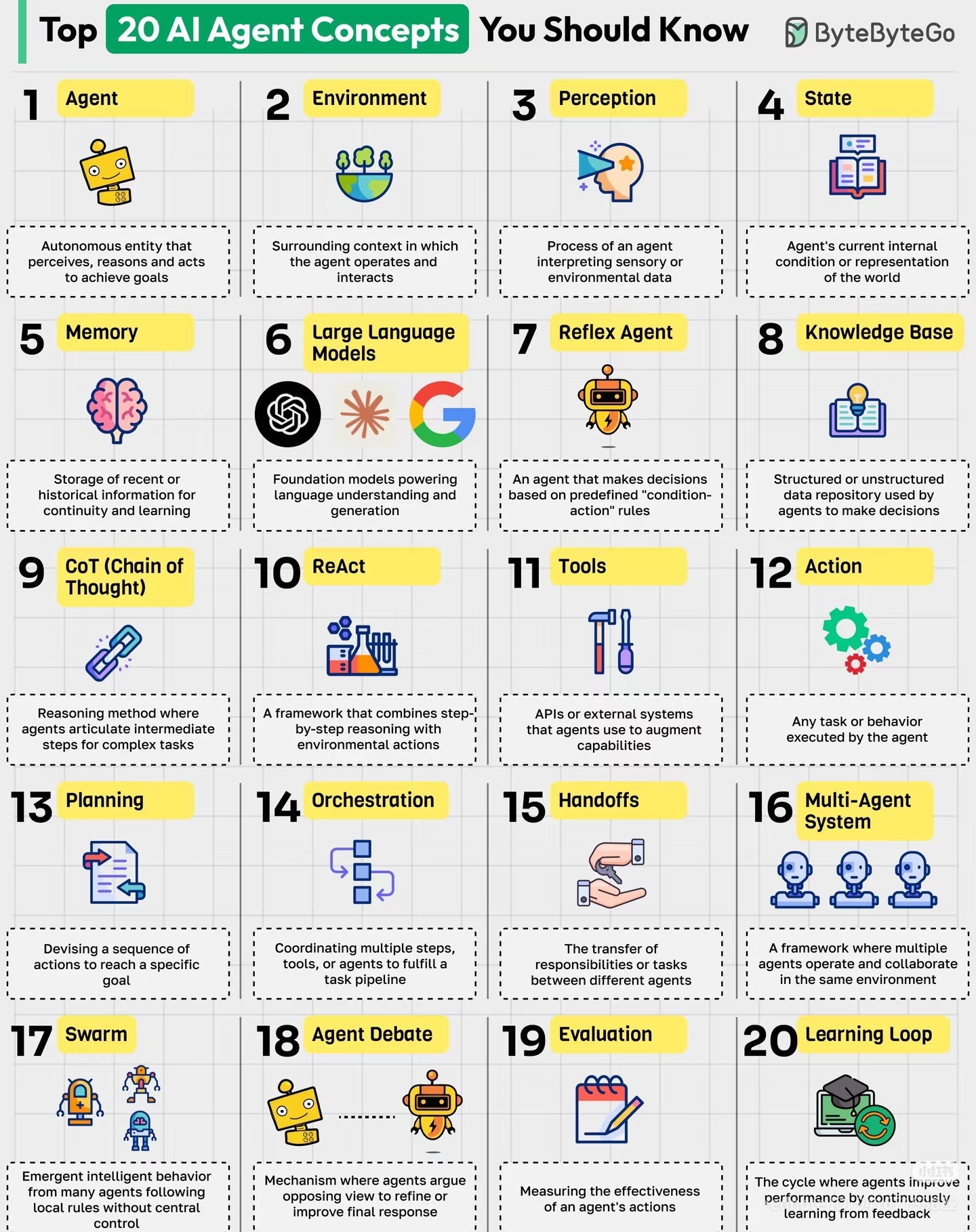
This infographic acts as a viral 'listicle' for Artificial Intelligence enthusiasts, breaking down dense technical terms into digestible numbered points. It explains how agents utilize Large Language Models to generate text or form Swarms without central control. By pairing clear icons with short definitions—such as ReAct frameworks and Chain of Thought reasoning—the guide ensures that even a non-technical person can understand how autonomous systems operate.
detailed-analysis (gemma3_27b-it-q8_0)
Okay, let's break down this "Top 20 AI Agent Concepts" infographic through various theoretical lenses. It's a pretty dense image, so we'll aim for clarity.
Overall Context: The infographic outlines core components and concepts relevant to building and understanding Artificial Intelligence (AI) agents. These aren't just simple programs; they're envisioned as entities capable of perceiving their environment, reasoning, making decisions, and acting to achieve goals. The trend is towards increasingly sophisticated agents that go beyond pre-programmed responses (reflex agents) to agents that can plan, learn, collaborate and even 'debate.'
---
1. Visual Description
The image presents a 4x5 grid layout of icons and brief text descriptions representing 20 distinct AI agent concepts. The style is clean, modern, and utilizes a limited color palette (mostly blues, pinks, and whites). Each concept is assigned a number and a short explanation. The icons are fairly abstract, representing the idea rather than a literal visual representation. The overall impression is of a structured, systematic breakdown of a complex field. There is a ByteByteGo branding.
---
2. Foucauldian Genealogical Discourse Analysis
This infographic is a discourse, actively shaping how we understand and talk about AI agents. A Foucauldian lens asks: What power relations are embedded within this framing? How has this concept of the "agent" become the dominant way of thinking about AI?
- Historical Formation: The emergence of the "agent" as a core concept in AI is linked to a historical shift away from viewing AI as simply automating tasks and towards modeling intelligence as goal-directed behavior. This shift required new forms of knowledge, new technical capabilities, and new ways of defining "intelligence" itself.
- Power/Knowledge: This graphic exerts a form of power by defining the "essential" concepts one should know. It implicitly establishes a hierarchy of knowledge, where these 20 concepts are positioned as foundational. Those who master this list gain authority within the discourse.
- Disciplinary Effect: The grid format, numbered points, and concise definitions create a disciplinary effect. It organizes thought and directs attention, guiding practitioners toward a particular understanding of AI agent design. It also serves as a guide or training.
- Genealogy of 'Agency': Tracing the term "agent" itself reveals its roots in philosophy (intentionality, free will) and computer science (autonomous programs). The graphic appropriates this historical baggage, imbuing AI systems with a sense of “agency” that is highly contested.
---
3. Critical Theory (Frankfurt School)
Critical theory would ask: What is the purpose of framing AI in this way? What ideologies are being reinforced?
- Instrumental Reason: The infographic emphasizes technical aspects—planning, memory, perception, reaction—of agents. This can be seen as an example of “instrumental reason” (Horkheimer & Adorno). The focus is on how to create agents, rather than why we should or what the broader societal implications are. The focus is on efficiency and optimizing function.
- Domination and Control: By focusing on ‘agency’ in artificial systems, are we implicitly accepting a model of power that emphasizes control and prediction? The very concept of an agent implies a subject capable of acting upon an object (the environment). This can reinforce hierarchical thinking and potentially justify systems of surveillance and manipulation.
- The Illusion of Autonomy: The infographic presents agents as active, goal-oriented entities. Critical theory might question whether this is a genuine autonomy, or simply a sophisticated illusion created by complex algorithms. The “agency” is still ultimately determined by the programmers and the data they use.
---
4. Marxist Conflict Theory
From a Marxist perspective, the infographic highlights the role of AI agents in potentially restructuring the relations of production.
- Automation & Labor: Many of these agent concepts (Planning, Orchestration, Tools) directly relate to automation. AI agents promise to replace or augment human labor, potentially exacerbating class conflict. The "efficiency" gains from these agents are likely to accrue to the owners of capital, while workers may face displacement or wage stagnation.
- Control of the Means of Computation: The creation, deployment, and control of AI agent technologies represent a concentration of power in the hands of a few corporations and states. This control over the “means of computation” is analogous to control over the means of production in traditional Marxist analysis.
- Commodification of Intelligence: The emphasis on creating "intelligent" systems raises questions about the commodification of cognitive abilities. If intelligence can be replicated and sold, what becomes of the value of human intellect?
---
5. Postmodernism
A postmodern take would deconstruct the infographic’s claims to objective knowledge and highlight the constructed nature of “intelligence” and “agency.”
- Deconstruction of 'Agent': Postmodernism would challenge the very notion of a stable, unified “agent.” The infographic presents agents as coherent entities, but in reality, they are fragmented systems built from multiple components, algorithms, and datasets.
- Relativism: There is no single, “correct” way to define an AI agent. The concepts presented are just one possible interpretation, shaped by specific historical, cultural, and technological contexts.
- Simulation and Hyperreality: The agents described in the infographic exist primarily as simulations. Their actions and interactions take place within digital environments. This blurs the line between reality and simulation, potentially creating a “hyperreality” where the distinction becomes meaningless.
---
6. Queer Feminist Intersectional Analysis
This lens would focus on the potential biases embedded within AI agent design and the ways in which these agents may perpetuate existing systems of oppression.
- Bias in Data & Algorithms: AI agents learn from data. If that data reflects societal biases (gender, race, class, etc.), the agents will likely perpetuate those biases. This can lead to discriminatory outcomes. The concept of Evaluation (No. 19) is critical here - but who is doing the evaluating, and what values are informing their judgments?
- Representation & Exclusion: Who is involved in designing and building these AI agents? If the field is dominated by a narrow demographic, the resulting technologies may not be inclusive or representative of diverse needs and perspectives.
- Reinforcement of Normative Ideals: The emphasis on “goal-oriented” behavior can reinforce normative ideals of rationality, efficiency, and productivity, potentially marginalizing alternative ways of being and knowing.
- Power Dynamics: The "Orchestration" (No. 14) and "HandOffs" (No. 15) concepts could be read as illustrating hierarchical structures, where certain agents are positioned to control or direct the actions of others. This can replicate existing power imbalances.
---
In conclusion, this infographic is more than just a list of technical concepts. It's a cultural artifact that reflects, reinforces, and potentially challenges existing power structures and ways of thinking about intelligence, agency, and the future of technology. Each theoretical lens reveals different layers of meaning and raises important questions about the societal implications of AI agent development.
simple-description (llama3.2-vision_11b)
This meme is a visual representation of the top 20 AI agent concepts, with each concept represented by a simple icon and a brief description. The image is a grid of 20 squares, each containing a concept name (e.g. "Agent", "Environment", "Perception", etc.) and a short description of what each concept means in the context of AI. The text at the top of the image reads "Top 20 AI Agent Concepts You Should Know".