First Seen
2025-08-17T11:35:07+00:00
simple-description (qwen3.5_2b-q8_0)
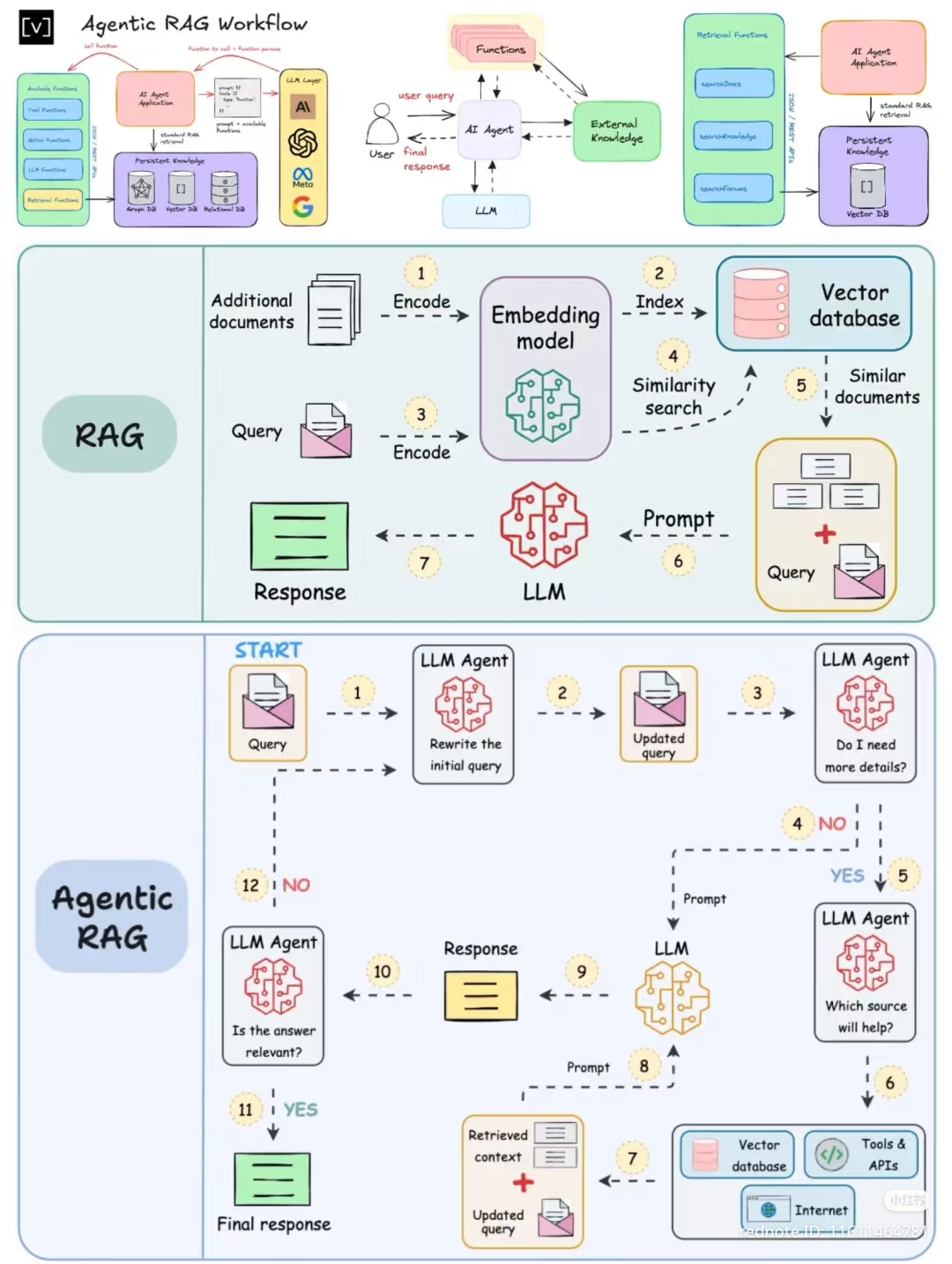
This infographic illustrates an Agentic RAG workflow, which utilizes a visual style similar to a System Prompt template. It mimics how developers structure prompts for AI agents by placing text instructions—like [x] Agentic RAG Workflow—next to the actual chart below it. This layout shows how a prompt defines the steps for processing data (such as an embedding model and vector database) before generating a final response.
detailed-analysis (gemma3_27b-it-q8_0)
Okay, let's break down this "Agentic RAG Workflow" diagram from an Artificial Intelligence (AI) perspective, and then dive into the requested theoretical frameworks where applicable. It's a complex visualization, so we'll be thorough.
Overall Context: Retrieval-Augmented Generation (RAG) and AI Agents
The meme depicts a workflow for a system combining Retrieval-Augmented Generation (RAG) with an AI Agent. RAG is a technique used to improve the quality of responses from Large Language Models (LLMs) (like those powering ChatGPT) by grounding them in external knowledge sources. AI Agents add a layer of autonomy: they can take an initial query, break it down into sub-tasks, leverage tools, and iteratively refine the query to arrive at a better result. This is an advanced approach to building more reliable and useful AI systems. This isn't a "meme" in the comedic sense, but a technical diagram often shared within the AI development community.
---
I. Visual Description
The diagram illustrates a loop-based process with distinct stages. It's visually divided into two major pathways:
- Left Side (Initial RAG): This is the traditional RAG process. A query is encoded into embeddings (numerical representations). These embeddings are used to search a vector database (a database optimized for similarity searches). Similar documents are retrieved and combined with the original query to form a prompt for the LLM. The LLM generates a response.
- Right Side (Agentic Enhancement): This is where the "agent" aspect comes in. The LLM acts as the agent. It evaluates the initial response, potentially rewrites the query for more details, decides which tools (internet access, APIs, vector database) might be helpful, retrieves updated context, and repeats the cycle until the response is considered satisfactory.
Key Components:
- LLM: (Large Language Model) – The core engine generating text. Represented by the brain-like icons.
- Vector Database: A storage system for embeddings, used for semantic search.
- Embeddings: Numerical representations of text, enabling semantic similarity comparisons.
- Tools & APIs: External resources the agent can use (e.g., internet search, data APIs).
- Query/Prompt: The input to the LLM, modified throughout the process.
- Workflow loops: Depicted by dashed lines, showing iterative refinement.
- Decision nodes: "Do I need more details?" "Is the answer relevant?" showing the agent's logic.
---
II. Foucauldian Genealogical Discourse Analysis
This diagram is fascinating from a Foucaultian perspective because it illustrates a power/knowledge dynamic in the making.
- Discipline of AI: The diagram prescribes a specific way of building AI systems. It establishes a 'correct' methodology (RAG + Agent) and implicitly marginalizes other approaches. This is a form of disciplinary power, setting boundaries for what is considered legitimate AI development.
- Genealogy of "Intelligence": We're seeing a shift in how we understand "intelligence." Previously, AI aimed for self-contained systems. Now, intelligence is increasingly defined by the ability to access and synthesize external knowledge. The vector database becomes a crucial site of knowledge, and the agent's power lies in its ability to navigate and retrieve from it. This is a genealogy of the concept of intelligence itself.
- The LLM as 'Regime of Truth': The LLM, as the final generator of the response, functions as a kind of "regime of truth." It's the entity that ultimately 'decides' what the answer is, based on the information it has been fed. The diagram doesn't explicitly address bias in the training data, but it's crucial to recognize that the LLM's "truth" is constructed, not objective.
- Normalization: The workflow normalizes a certain process for answering queries, potentially overlooking alternative modes of knowledge production or interpretation.
---
III. Critical Theory
From a critical theory perspective, this diagram reveals the increasing instrumentalization of knowledge within the AI paradigm.
- Rationalization and Control: The workflow is relentlessly rationalized and optimized. Every step is geared towards maximizing the quality of the response. This echoes the critical theory concern with the 'iron cage of rationality' – the tendency for reason to become a means of control and domination.
- Commodification of Information: The vector database represents a commoditized form of information. Knowledge is broken down into embeddings, stored, and retrieved as a resource to be exploited by the AI agent.
- Technological Determinism: There's a subtle assumption of technological determinism here – the idea that technological progress (in this case, RAG and AI agents) inevitably leads to positive outcomes. Critical theory would question this assumption, arguing that technology is shaped by social, economic, and political forces, and can reinforce existing power structures.
- Hidden Labor: The construction and maintenance of the vector database, the encoding of knowledge, and the initial training of the LLM all involve significant human labor, which is often obscured within the elegant abstraction of the diagram.
---
IV. Marxist Conflict Theory
Looking through a Marxist lens, this diagram highlights the potential for control of information and the means of its processing to become a source of power.
- Means of Production: The LLM, the vector database, and the tooling infrastructure represent the means of production for knowledge. Ownership and control of these resources will be a key determinant of power in the AI-driven future.
- Class Struggle: The developers of these systems, the owners of the data used to train them, and the individuals or organizations who deploy them are positioned in a hierarchical relationship. There’s a potential for the benefits of AI (accurate information, efficient problem-solving) to accrue primarily to those in positions of power.
- Alienation: The complex, automated nature of the workflow could lead to alienation for those whose labor is displaced by these systems. The human element becomes abstracted and hidden within the technological process.
- Ideology: The diagram itself could be seen as an ideological tool, promoting a particular vision of AI development that reinforces capitalist logic (efficiency, optimization, commodification).
---
V. Postmodernism
From a postmodern perspective, this diagram is a testament to the decentering of meaning and the proliferation of simulacra.
- The Death of the Author: The "agent" isn't an author in the traditional sense; it's a machine that remixes and recontextualizes information from various sources. Meaning is no longer grounded in a single, authoritative source.
- Hyperreality: The retrieved documents and the LLM's response create a hyperreality – a simulation of reality that may be more "real" than reality itself. The user may not be able to distinguish between original information and the LLM's interpretation.
- Fragmentation and Intertextuality: The workflow emphasizes the fragmentation of knowledge and the importance of intertextuality (the relationships between different texts). Meaning is constructed through the interplay of multiple sources.
- Questioning of Grand Narratives: The diagram implicitly challenges the grand narratives of traditional knowledge systems. It suggests that knowledge is not a static, objective entity, but a fluid and dynamic process.
---
VI. Queer Feminist Intersectional Analysis
While less directly apparent, a Queer Feminist Intersectional analysis can reveal potential biases and exclusions:
- Data Bias: The data used to train the LLM and populate the vector database inevitably reflects existing societal biases (gender, race, class, etc.). The diagram doesn't address how these biases are mitigated or amplified.
- Representation and Voice: Who has the power to define the queries, shape the vector database, and train the LLM? Whose voices are included, and whose are excluded? This relates to the core feminist concern with representation.
- Algorithmic Oppression: The system could perpetuate or exacerbate existing forms of oppression by providing biased or discriminatory responses.
- Intersectionality: The diagram abstracts away from the social context in which the AI system operates. A queer feminist intersectional analysis would emphasize the need to consider how different forms of oppression intersect and shape the experiences of users. For instance, a query about healthcare might yield different and potentially harmful responses depending on the user's gender identity, race, and socioeconomic status.
---
In conclusion, this diagram is much more than a technical illustration. It’s a microcosm of the complex social, political, and philosophical implications of AI development. Each theoretical framework provides a unique lens for understanding the power dynamics, ideological assumptions, and potential pitfalls embedded within this seemingly objective workflow.
simple-description (llama3.2-vision_11b)
The meme is a humorous representation of the "RAG" (Relevance-Action-Goal) workflow in the context of Artificial Intelligence. The image shows a series of steps, from "RAG" to "RAG" again, with each step having a humorous and satirical tone, poking fun at the idea of AI's increasing reliance on "RAG" as a means of understanding its own AI-ness. The image includes the text "RAG" and "RAG" again, with the latter being a reference to the "RAG" acronym, which stands for "Relevance-Action-Goal".