First Seen
2025-07-30T05:47:02+00:00
simple-description (qwen3.5_2b-q8_0)
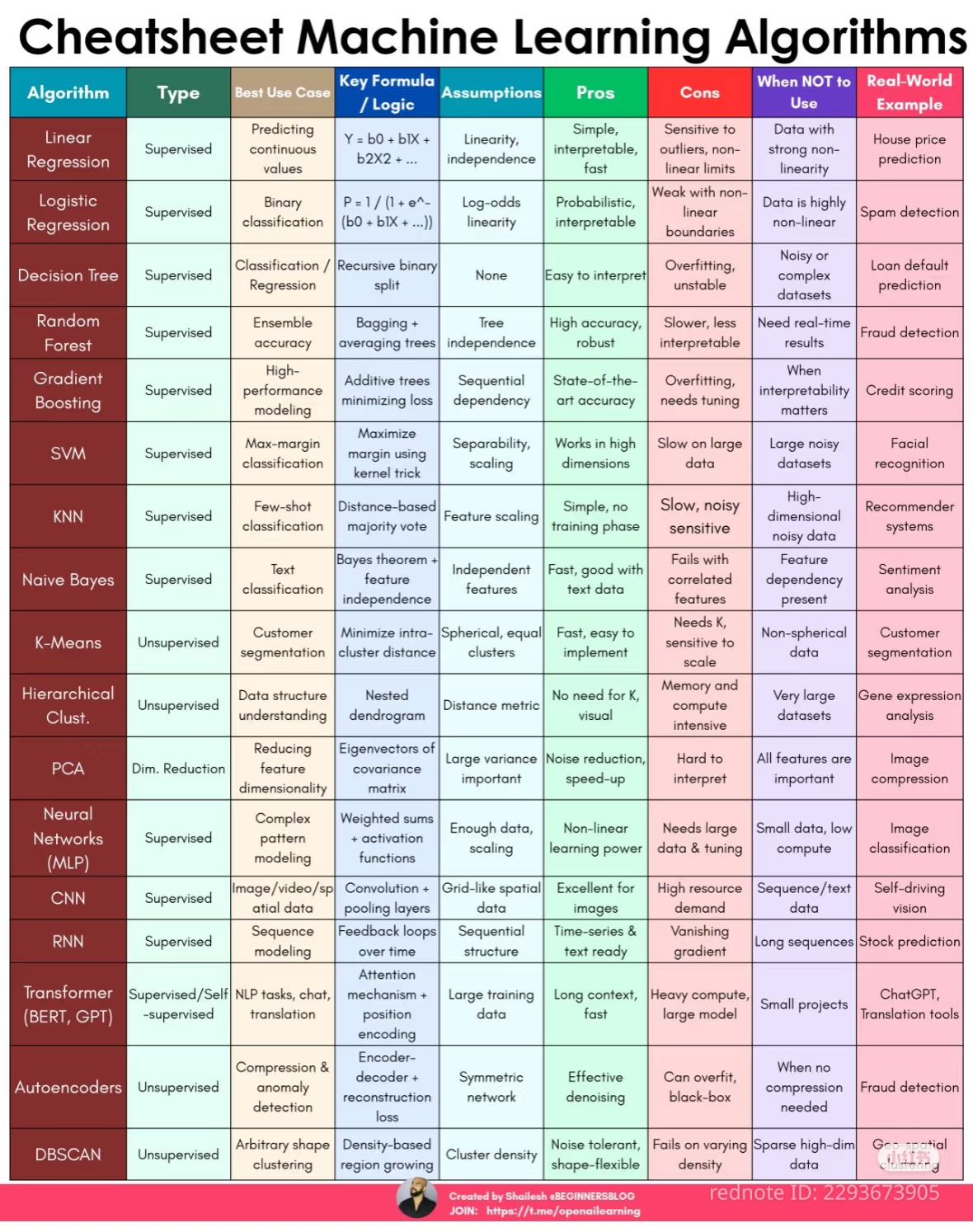
This infographic serves as a humorous "cheat sheet" designed to explain the complex world of Artificial Intelligence by breaking down its most common algorithms into simple, bite-sized columns. For someone who cannot see it, the meme format provides a clear text-based breakdown of how each machine learning method works, listing specific logic formulas and adding witty commentary on pros and cons like "Sensitive to outliers, non-linear limits" in the "Cons" column. The table effectively bridges the gap between intimidating mathematical theory and practical application by citing examples such as "Credit scoring" or "House price prediction" in the final column.
detailed-analysis (gemma3_27b-it-q8_0)
Okay, let's break down this "Cheat Sheet of Machine Learning Algorithms" meme through the lens of Artificial Intelligence, and then explore it through a variety of critical theory perspectives where applicable.
Visual Description
The image is a tabular "cheat sheet" for machine learning algorithms. It's laid out in a grid with columns for:
- Algorithm: The name of the ML algorithm (Linear Regression, Logistic Regression, Decision Tree, etc.)
- Type: Classifies the algorithm (Supervised, Unsupervised)
- Best For: What type of problem the algorithm is best suited to solve (e.g. continuous values, binary classification, customer segmentation)
- Logic/Formula: A simplified representation of the algorithm’s underlying mathematical principle.
- Assumptions: Requirements or conditions for optimal performance.
- Pros: Strengths of the algorithm.
- Cons: Weaknesses of the algorithm.
- When to Use: Practical application context.
- Real-World Example: Specific use cases.
The overall aesthetic is functional, mimicking a study guide, making it a seemingly “neutral” technical document. It's a resource intended to quickly summarize a complex field. The sheer number of algorithms included – over 20 – suggests a rapidly expanding and potentially overwhelming landscape.
Foucauldian Genealogical Discourse Analysis
This "cheat sheet" is a prime example of a discourse constituting the field of Machine Learning. Michel Foucault would analyze this artifact to understand the power dynamics embedded within the field's knowledge production.
- Normalization: The very act of creating a "cheat sheet" normalizes a specific set of algorithms as being essential. It establishes a hierarchy of knowledge, suggesting certain approaches are more important than others. Algorithms not included are implicitly marginalized.
- Power/Knowledge: The “Pros” and “Cons” columns are not neutral observations. They reflect a particular power structure: who decides what constitutes a ‘pro’ or ‘con’? This is shaped by the priorities of the researchers, developers, and funding agencies who dominate the field. For example, the emphasis on "interpretability" for certain algorithms reflects a current desire for more transparent AI, a response to concerns about "black box" models.
- Genealogy: Tracing the history of these algorithms (their "genealogy") reveals that many emerged from statistical methods, then were adapted and rebranded within the context of computer science and data science. The “Logic/Formula” column hints at the mathematical origins, but the "cheat sheet" format presents them as abstracted, decontextualized techniques for prediction, rather than as part of a broader theoretical framework.
Essentially, the cheat sheet is a tool that creates the field it purports to simply describe, by defining what matters, what is valuable, and what is considered legitimate knowledge.
Critical Theory
From a Critical Theory perspective (drawing heavily from the Frankfurt School), this cheat sheet reveals the instrumental rationality of modern technology.
- Technological Rationality: The focus is almost entirely on efficacy – "Best For," "Pros," "When to Use." The algorithms are presented as tools to achieve pre-defined goals (prediction, classification, segmentation). There is little space for questioning why these goals are being pursued, or what the broader social implications might be.
- Domination: The underlying assumption is that the world can be understood and controlled through mathematical modeling and data analysis. This reinforces a belief in technological solutions to social problems, potentially obscuring the root causes of these problems (e.g., using predictive policing algorithms instead of addressing systemic inequalities).
- Reification: Algorithms are treated as objective entities, rather than as social constructs created by humans with biases and values. The "Assumptions" column briefly acknowledges limitations, but the overall presentation contributes to the reification of algorithms as neutral tools.
The cheat sheet exemplifies a worldview where technology is seen as a means of mastering nature and society, rather than as a potentially oppressive force.
Marxist Conflict Theory
A Marxist analysis focuses on the power relations inherent in the production and application of these algorithms.
- Means of Production: The algorithms themselves are the "means of production" in a new information economy. Access to these algorithms, the data used to train them, and the computational resources to run them are unequally distributed. Those who control these means of production (tech companies, research institutions) wield significant power.
- Labor: The data used to train these algorithms is often generated by the "labor" of individuals (e.g., their online activity, purchases, social interactions). This labor is largely unpaid and often invisible, yet it is essential for the functioning of the algorithms.
- Class Struggle: The benefits of these algorithms (increased efficiency, targeted advertising, improved predictions) tend to accrue to those who already hold power and wealth. For example, high-frequency trading algorithms exacerbate existing inequalities in the financial markets.
- Ideology: The “neutrality” presented by the “cheat sheet” functions as an ideology that obscures the exploitative relationships underlying the production and application of these algorithms.
In essence, this cheat sheet can be seen as a document reflecting the capitalist accumulation of knowledge and power through data and algorithmic control.
Postmodernism
A postmodern perspective would deconstruct the claim to objective knowledge represented by the "cheat sheet."
- Deconstruction: The categories themselves (e.g., "Supervised," "Unsupervised") are not fixed or natural; they are constructed through language and discourse. The boundaries between these categories are fuzzy and contested.
- Relativism: There is no single “best” algorithm. The appropriateness of an algorithm depends on the specific context, the data available, and the goals of the user. The "Pros" and "Cons" are subjective and contingent.
- Simulacra and Simulation: The "cheat sheet" is a simulation of knowledge. It presents a simplified, abstracted version of a complex reality. It risks becoming detached from the real-world implications of using these algorithms.
- Anti-Foundationalism: There is no underlying "truth" or foundational principle that justifies the use of these algorithms. They are simply tools that operate within a particular historical and cultural context.
From a postmodern standpoint, the cheat sheet is a playful yet potentially misleading attempt to impose order on a fundamentally chaotic and contingent field.
Queer Feminist Intersectional Analysis
This perspective would interrogate how biases embedded within the data and algorithms perpetuate and amplify existing social inequalities, particularly those faced by marginalized groups.
- Bias in Data: The data used to train these algorithms often reflects historical and societal biases (e.g., gender stereotypes, racial discrimination). These biases are then encoded into the algorithms, leading to discriminatory outcomes. (For instance, facial recognition systems trained on predominantly white faces perform poorly on people of color.)
- Intersectionality: The impact of algorithmic bias is not uniform. Individuals with intersecting marginalized identities (e.g., Black women, disabled LGBTQ+ individuals) are often disproportionately affected. The “cheat sheet” doesn’t acknowledge the varied impact of each algorithm on different groups.
- Power Dynamics: The development and deployment of these algorithms are often dominated by privileged groups (e.g., white, male engineers). This lack of diversity exacerbates the risk of bias and perpetuates existing power imbalances.
- Invisible Labor: The collection and labeling of training data, often a tedious and underpaid task, is disproportionately performed by women and people of color, whose contributions are often unseen and undervalued.
- Reclaiming Agency: A queer feminist approach emphasizes the need to challenge the assumptions and biases embedded in these algorithms, and to advocate for more inclusive and equitable AI systems.
In conclusion, what appears to be a straightforward technical resource is, when viewed through the lenses of critical theory, a deeply complex artifact reflecting power dynamics, social values, and the ongoing construction of knowledge in the age of Artificial Intelligence.
simple-description (llama3.2-vision_11b)
This meme is a humorous comparison of the pros and cons of various machine learning algorithms. The image is a table with two columns, "Pros" and "Cons", listing the advantages and disadvantages of each algorithm. The text in the image reads: "The more you know, the less you understand." This is a reference to the idea that as we learn more about machine learning, we realize how little we actually understand. The meme is a ligh-hearted way to acknowledge the complexity of these algorithms and the limitations of our understanding of them.