First Seen
2025-08-15T12:40:19+00:00
simple-description (qwen3.5_2b-q8_0)
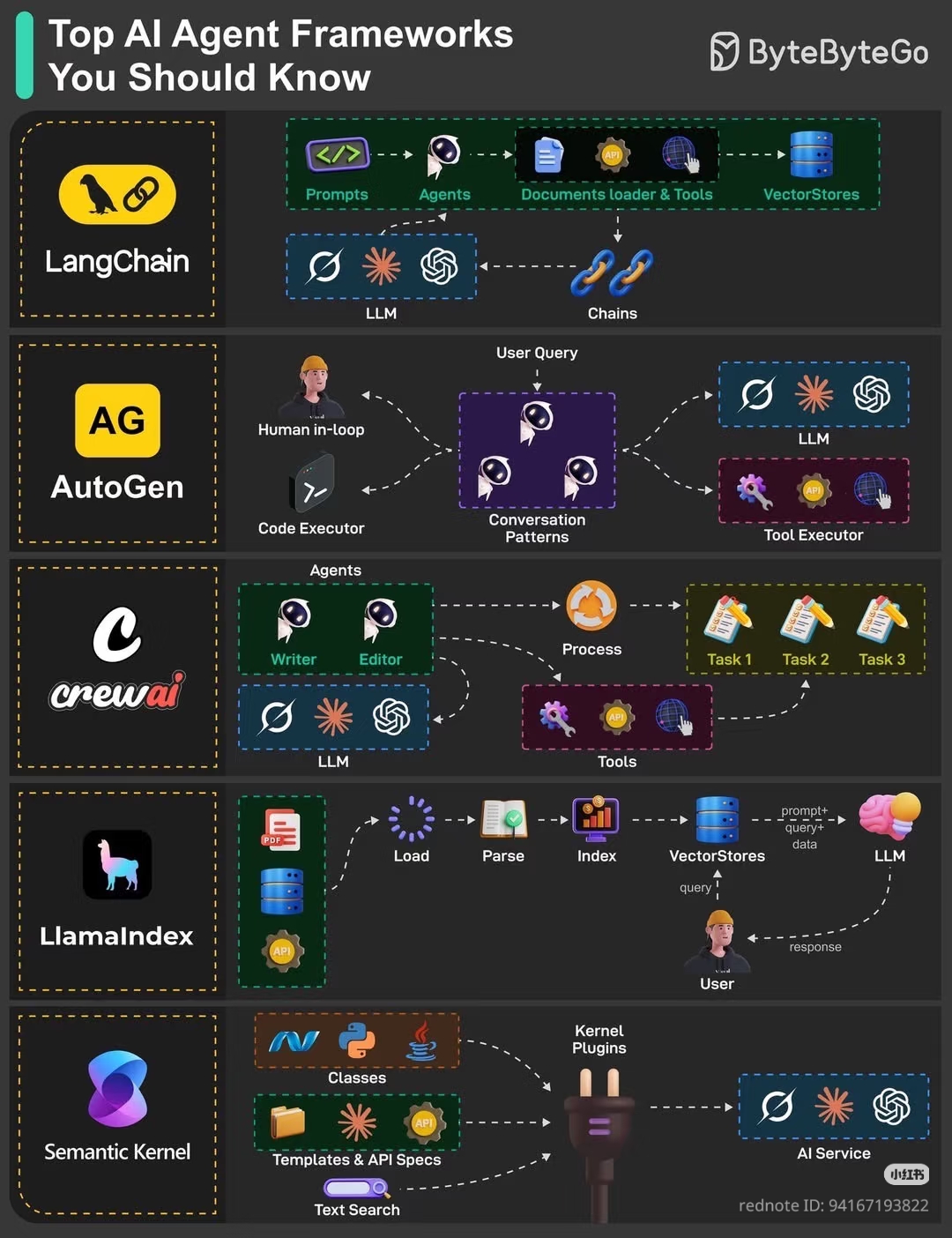
Based on the provided image, which appears to be an infographic or a post from a platform like RedNote (indicated by the "rednote ID" at the bottom right), here is an explanation of what the content depicts. While it is technically an educational chart about AI technology rather than a traditional internet "meme," it serves as a viral summary for people who want to understand complex software architecture quickly.
The image compares five major AI Agent Frameworks (categories):
- LangChain: Located at the top left, this framework visualizes how an agent interacts with data using "Prompts," "Agents," and "Documents loader & Tools." It connects these elements via a flow to "VectorStores" (like Google Sheets or PostgreSQL). Crucially, it uses "Chains" (represented by dashed blue loops) to connect the LLM (Large Language Model) back to the input data, essentially treating the agent as a continuous chain of reasoning.
- AutoGen: In the second row, this is designed for more complex interactions. It includes a "Human in-loop" and a "Code Executor," suggesting users can manually intervene or write code. The agents use "Conversation Patterns" to communicate with an LLM, while also running a "Tool Executor" (represented by gear icons) that executes logic or calls APIs to solve the task.
- CrewAI: This row highlights division of labor within an agent team. It features an "Agents" box containing a Writer and an Editor, which are directed by a "Process." These agents work on distinct "Tasks" (Task 1, Task 2, Task 3) to produce output.
- LlamaIndex: This framework focuses heavily on data processing and retrieval. It takes raw data (like a PDF icon labeled "Load" or a database icon labeled "API") through a pipeline of "Parse" and "Index" steps. The data is stored in "VectorStores," which allow an "User" to query the system and get a response from the LLM.
- Semantic Kernel: Located at the bottom, this framework allows users to build applications by plugging in various components. It uses "Classes," "Templates & API Specs," and a feature called "Text Search." These are piped into a central "Kernel Plugins" area to drive an AI Service.
The text labels throughout (like "LLM," "Tool Executor," and "VectorStores") represent the key technical components that define how these AI agents work together.
detailed-analysis (gemma3_27b-it-q8_0)
Okay, let's break down this graphic, “Top AI Agent Frameworks You Should Know”, from the perspective of Artificial Intelligence, with an attempt to engage the requested theoretical frameworks where applicable. Given the inherently technical nature of the graphic, some frameworks will be more suitable than others.
Visual Description
The graphic is a series of five side-by-side visual diagrams, each representing a prominent AI Agent framework: LangChain, AutoGen, CrewAI, LlamaIndex, and Semantic Kernel. Each diagram employs a flow-chart style, illustrating the core components and processes of each framework.
- Common Elements: All frameworks prominently feature a “LLM” (Large Language Model) icon – a stylized brain – which forms a central element of operation. They also include elements related to data handling (loading, parsing, indexing, VectorStores), user interaction (prompts, queries), and some kind of "tool" or "agent" execution.
- LangChain: Depicts a workflow from prompts/agents to tools to vector stores.
- AutoGen: Highlights a collaborative, multi-agent approach with “Human-in-the-Loop” integration, and a focus on conversation patterns and tool execution.
- CrewAI: Focuses on a "crew" of specialized agents (Writer, Editor, Process) tackling "Tasks" sequentially.
- LlamaIndex: Emphasizes the process of ingesting data (Load, Parse, Index), then using VectorStores and LLMs to respond to queries.
- Semantic Kernel: Illustrates a user interaction driven by "Templates and API Specs" and facilitated by "Kernel Plugins”.
The overarching presentation suggests a competition between different architectural solutions to the problem of building intelligent agents powered by LLMs. It's a "who's who" of current, popular frameworks.
Foucauldian Genealogical Discourse Analysis
This graphic represents a specific discourse surrounding AI development: the discourse of agentification. A Foucauldian analysis would look at how the concept of "AI Agents" has been constructed through a historical lineage, with power dynamics shaping its very definition.
- Shift in Power/Knowledge: Originally, AI was largely focused on rule-based systems and expert systems. The emphasis was on explicit programming. Now, we have a shift toward LLM-powered agents where the “rules” are emergent and embedded within the model itself. This represents a shift in power, where the knowledge isn’t residing in the explicit program but within the data and the model.
- Normalization of Agency: The use of the term "Agent" itself is significant. It’s imbuing AI with a concept – agency – that historically belonged to humans. This linguistic shift helps normalize the idea of increasingly autonomous AI systems and potentially downplays the underlying power structures (who controls the data, the models, the algorithms?).
- The ‘Technologies of the Self’: The "Human-in-the-Loop" element in AutoGen can be viewed through a Foucauldian lens as a technology of the self. It attempts to govern and shape the relationship between humans and AI by embedding human oversight, at least ostensibly, into the system.
- Surveillance and Control: VectorStores and the process of data loading, parsing, and indexing reflect a form of data surveillance and control, mapping and categorizing information for future use by the agent.
Critical Theory
From a critical theory perspective, the graphic exposes the underlying ideological assumptions driving AI development.
- Technological Determinism: The very presentation of these frameworks implies a linear progression of technological advancement. It suggests that the development of these agents is inevitable and inherently progressive, downplaying the social, political, and ethical consequences.
- Commodification of Intelligence: The frameworks are presented as "tools" – things to be used. This reinforces the commodification of intelligence, turning cognitive capabilities into marketable products. These tools, while ostensibly open-source or accessible, are likely tied to larger commercial interests.
- The Illusion of Objectivity: The focus on technical components (LLMs, VectorStores) obscures the inherent biases embedded in the data, the models, and the algorithms themselves. The “objectivity” of the AI is an illusion; it's shaped by the values and perspectives of its creators.
Marxist Conflict Theory
Applying a Marxist lens, we see the graphic reflecting the competition within a rapidly developing and potentially highly profitable industry.
- Capital Accumulation: Each framework represents a potential avenue for capital accumulation. The companies and individuals developing these tools are competing to dominate the market, extract value, and establish a dominant position.
- Labor and Automation: The agents (Writer, Editor, Process in CrewAI) are, in effect, automating tasks traditionally performed by human labor. This raises questions about the displacement of workers and the potential for increased exploitation in the age of AI.
- Class Struggle: Access to and control over these advanced AI tools will likely be unevenly distributed, potentially exacerbating existing class inequalities. Those with the resources to develop and deploy these agents will gain a significant advantage.
- Ownership of the Means of Production: The LLMs, the data, and the infrastructure that power these agents represent the “means of production” in this new technological landscape. The control over these means of production will determine who benefits from the increasing productivity of AI.
Postmodernism
A postmodern reading would challenge the notion of a singular, objective "AI agent".
- Deconstruction of Agency: The graphic itself is a representation, a construct. The very idea of “agency” is deconstructed; it's a label we are imposing on a complex set of algorithms. The agent appears to have agency, but this is a product of our interpretation.
- Fragmentation and Simulacra: The diverse range of frameworks suggests a fragmented landscape where there is no single, "true" form of AI agency. Each framework offers a different simulation, a different version of intelligence.
- Rejection of Grand Narratives: The graphic challenges the grand narrative of "artificial general intelligence" (AGI). It focuses on specific, practical frameworks for solving particular problems, rather than pursuing a singular, utopian vision.
- Emphasis on Discourse: As discussed in the Foucauldian analysis, postmodernism would highlight the importance of the discourse surrounding AI. The way we talk about AI agents shapes our understanding of them and influences their development.
Queer Feminist Intersectional Analysis
This framework is the least directly applicable, but still offers insights:
- Bias Amplification: LLMs are trained on biased data, and AI agents can amplify existing societal biases related to gender, race, sexuality, and other marginalized identities. The frameworks themselves do not explicitly address these issues, potentially reinforcing discriminatory outcomes.
- Reproductive Labor & AI: The “Human-in-the-Loop” element of AutoGen raises questions about the potential for AI to offload emotional labor and care work onto humans, potentially reinforcing gendered expectations. (This is a stretch, but a potential avenue for inquiry).
- Exclusionary Design: The development of these frameworks is likely dominated by a narrow demographic (e.g., white, male engineers). This can lead to designs that are not inclusive or accessible to all users. The focus on technical expertise can exclude diverse perspectives.
- Intersectionality of Bias: It’s crucial to understand how biases intersect. An AI agent might exhibit different biases depending on the combination of factors (e.g., a system biased against women and people of color).
In Conclusion
The graphic of “Top AI Agent Frameworks You Should Know” is a deceptively complex artifact. It’s not just a technical overview; it's a snapshot of a rapidly evolving field with significant social, political, and ethical implications. Applying these critical frameworks helps us to deconstruct the underlying assumptions, power dynamics, and potential consequences of AI development.
simple-description (llama3.2-vision_11b)
The meme is a humorous representation of the "Top AI Agent Frameworks You Should Know" list, where each framework is represented as a character with a unique personality and job title. The meme uses humor to highlight the absurdity of having a "human in-loop" code executor, a "code executor" who is also a "human in-loop", and a "code executor" who is also a "human in-loop" who is also a "code executor". The text in the image reads: "Code executor: 'I'm a code executor, I'm a code executor, I'm a code executor...'".