First Seen
2025-07-31T23:14:17+00:00
simple-description (qwen3.5_2b-q8_0)
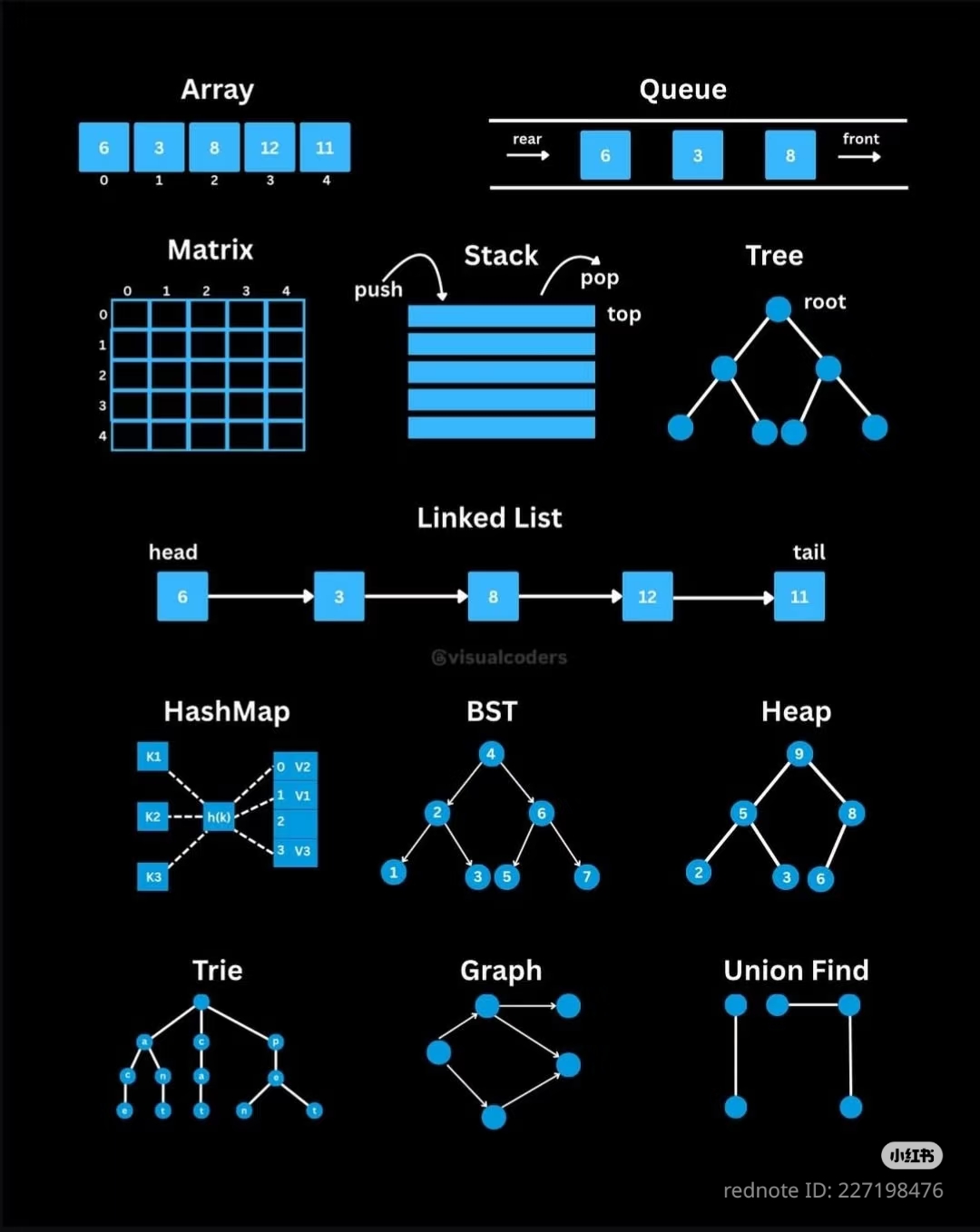
This infographic serves as a visual manual for the fundamental data structures used in artificial intelligence algorithms. It explains how computers organize complex information using tools like arrays, linked lists, and binary search trees, acting as efficient memory buffers for tasks ranging from matching keys (hash maps) to tree traversal. By providing labels such as "heap" and "trie," it ensures that even a computer model learns the correct logic for retrieving specific information without needing to see the code itself.
detailed-analysis (gemma3_27b-it-q8_0)
Okay, let's analyze this meme – a collection of common data structures – through the lens of Artificial Intelligence, with sections addressing relevant theoretical frameworks.
Visual Description
The image presents a grid of nine fundamental data structures widely used in computer science and, crucially, in the foundation of many AI algorithms. They are:
- Array: A contiguous block of memory.
- Queue: FIFO (First-In, First-Out) structure.
- Matrix: 2-dimensional array
- Stack: LIFO (Last-In, First-Out) structure.
- Linked List: A chain of nodes.
- HashMap: Key-value pairs, leveraging hashing.
- Binary Search Tree (BST): Hierarchical structure for efficient searching.
- Heap: Specialized tree-based data structure prioritizing min or max values.
- Trie: Tree structure for efficient prefix-based search.
- Graph: Represents networks of nodes and connections.
- Union-Find: Data structure to manage sets and track connectivity
Each data structure is visually represented with simple diagrams illustrating its key features and core operations (e.g., push and pop for the stack, head and tail for the linked list). The "@visualcoders" watermark indicates the source as being related to coding/programming visualizations. The watermark at the bottom seems to be a watermark of a Chinese software or technology company.
Relevance to AI
These data structures aren’t merely academic exercises. They form the building blocks of almost every AI system. Consider:
- Neural Networks: Arrays (tensors) are the fundamental storage for weights and activations. Matrices are used extensively in linear algebra operations.
- Search Algorithms (A*, BFS, DFS): Queues, Stacks, and Graphs are central to these.
- Decision Trees & Random Forests: Trees are used to represent the decision-making process.
- Knowledge Representation: Graphs are used to model relationships between concepts in knowledge graphs.
- Natural Language Processing: Tries are used for efficient string matching and auto-completion. Hashmaps are crucial for storing vocabulary and word embeddings.
- Machine Learning Algorithms: Heaps used in heap sort to achieve efficient sorting for machine learning algorithms.
- Clustering Algorithms: Graphs and Union-Find are used for clustering data points based on their similarity or connectivity.
Critical Theory
From a critical theory perspective, the meme highlights the hidden infrastructure supporting the perceived "intelligence" of AI. The structures themselves are abstract, formalized systems. They are not neutral tools, but represent choices made about how information is organized and processed. This organization shapes what can be known, what can be computed, and what conclusions are deemed "intelligent."
The choice of these specific data structures over others isn't arbitrary. It reflects a particular historical and intellectual trajectory within computer science – a focus on efficiency, scalability, and formal rigor. This trajectory has also been influenced by funding priorities (e.g., defense research) and the dominant paradigms of cognitive science. The meme subtly points to the fact that AI's "intelligence" is built on a foundation of human-constructed abstractions – not inherent properties of the universe. It suggests a critical question: Whose intelligence is being modeled, and what biases are baked into the structural representations?
Postmodernism
A postmodern reading emphasizes the deconstruction of the idea of a unified "intelligence." The meme showcases a fragmented landscape of data structures, each with its own logic and limitations. There's no single "correct" way to represent or process information.
The meme could be seen as a playful representation of the instability of meaning. Data can be represented in multiple ways (array, list, tree, graph), and the choice of representation affects the interpretation and analysis. This echoes the postmodern concept that meaning is not inherent in objects themselves but is constructed through language and representation.
The fact that these structures, which seem incredibly precise and mathematical, are all interpretations of data – and that different interpretations are possible – is a key postmodern insight.
Marxist Conflict Theory
A Marxist lens would focus on the power dynamics embedded within the creation and control of these AI tools. The development and maintenance of these data structures, and the AI systems built upon them, requires significant capital, specialized knowledge, and access to computing resources. This creates a clear division of labor and a concentration of power in the hands of a relatively small group of individuals and corporations.
The meme implicitly shows the means of production of AI: the fundamental building blocks. The control of these means, and the algorithms that utilize them, can be used to reinforce existing social inequalities (e.g., biased algorithms in hiring, credit scoring, or criminal justice). The structures themselves aren’t inherently “good” or “bad,” but their application is always situated within a context of power relations. Who decides how these structures are used, and for what purpose, becomes the central question.
In Conclusion
This meme, while seemingly simple, is a powerful visualization of the foundations of AI. It lends itself to a variety of critical interpretations, from questioning the nature of intelligence to exposing the power dynamics embedded within the technology. It is a reminder that AI is not a disembodied, objective force, but a human-created system shaped by historical, social, and political forces.
simple-description (llama3.2-vision_11b)
The meme is a visual representation of a neural network, a fundamental concept in artificial intelligence. The image shows a series of interconnected nodes, with each node representing a "neuron" or a "node" in the network. The text "Neural Network" is written above the image, and the image itself is a diagram of a network of interconnected nodes, with lines and arrows representing the connections between them.
In the context of artificial intelligence, a neural network is a type of machine learning model that is trained to learn and make predictions based on data. The image is a visual representation of a neural network, with each node representing a "neuron" or a "node" in the network. The image is a diagram of a network of interconnected nodes, with lines and arrows representing the connections between them.
The text "Neural Network" is written above the image, and the image itself is a diagram of a network of interconnected nodes, with lines and arrows representing the connections between them. The image is a visual representation of a neural network, with each node representing a "neuron" or a "node" in the network. The image is a diagram of a network of interconnected nodes, with lines and arrows representing the connections between them.