First Seen
2025-08-07T04:48:48+00:00
simple-description (qwen3.5_2b-q8_0)
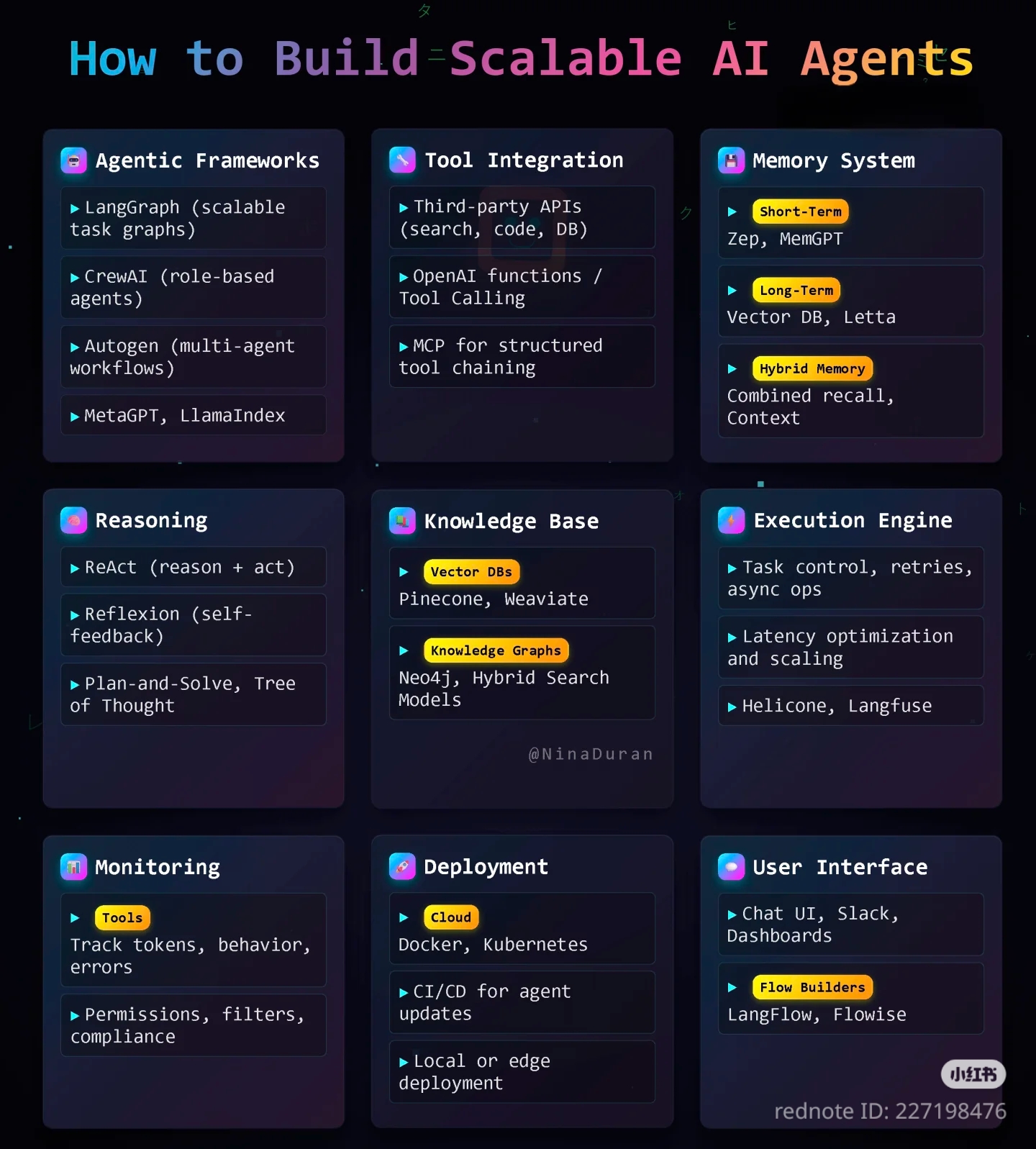
This infographic serves as a technical guide on how to build scalable AI agents, broken down into nine distinct components like Agent Frameworks, Reasoning Engines, and Memory Systems. It employs a popular X (Twitter) rednote style characterized by dark mode and glowing neon tags (such as 'Vector DBs' or 'LangGraph') to present complex coding concepts in an organized, digestible format for developers.
detailed-analysis (gemma3_27b-it-q8_0)
Okay, let's break down this infographic, titled "How to Build Scalable AI Agents," from the perspective of the Artificial Intelligence category, and using the requested theoretical lenses where appropriate.
Visual Description
The image is a brightly colored, grid-based infographic depicting the various components needed to build scalable AI agents. It’s structured around nine key areas:
- Agentic Frameworks: (LangGraph, CrewAI, Autogen, MetaGPT, LlamaIndex) - Deals with the architectural foundations for creating agents.
- Tool Integration: (OpenAI functions, MCP for tool chaining) - How AI agents interact with external tools and APIs.
- Memory System: (Short-term (Zep, MemGPT), Long-term (Vector DB, Letta), Hybrid Memory) - Addressing how AI agents store and recall information.
- Reasoning: (ReAct, Reflexion, Plan-and-Solve, Tree of Thought) – Techniques for enabling AI agents to think and solve problems.
- Knowledge Base: (Vector DBs (Pinecone, Weaviate), Knowledge Graphs (Neo4j, Hybrid Search Models)) - The storage and organization of knowledge.
- Execution Engine: (Task control, Latency optimization, Helicone, Langfuse) - The components that run the AI agent.
- Monitoring: (Tools for tracking, Permissions, Filters) - Assessing agent's behavior and ensuring safety/compliance.
- Deployment: (Cloud, CI/CD, Local/Edge) – Getting the AI agent into a production environment.
- User Interface: (Chat UI, Flow Builders) – How users will interact with the AI agent.
The infographic visually represents a complex system, suggesting AI agents aren't singular entities, but rather built from interacting components. The use of bright colors and concise labels implies a relatively user-friendly aim, despite the technical depth.
---
Foucauldian Genealogical Discourse Analysis
From a Foucauldian perspective, this infographic represents a discourse of power/knowledge around AI agents. It demonstrates how certain techniques (e.g., Vector DBs, ReAct) are becoming normalized as "best practices" in the field. The very categories presented (Reasoning, Memory, etc.) aren't neutral; they represent a particular way of thinking about intelligence and agency.
- Genealogy: Tracing the history of these concepts reveals they're not innate, but emerged from specific historical and technological conditions. "Memory," for example, isn’t simply how brains work, but a computational concept arising from the limitations of early computers.
- Power/Knowledge: The infographic exercises power by defining what constitutes a "scalable AI agent." Those who control the development of these technologies (and the discourse around them) wield considerable influence. The prioritization of scalability over other qualities (like explainability or ethical considerations) reflects a power dynamic driven by economic and efficiency concerns.
- Discipline: The infographic implicitly disciplines developers, suggesting they should build agents using these specific components to achieve the desired outcome. Deviations from these norms might be seen as less effective or unscalable.
---
Critical Theory
A Critical Theory lens reveals the potential for AI agents to reinforce existing social inequalities.
- Instrumental Rationality: The focus on "scalability" and "efficiency" embodies instrumental rationality – the idea that technology is primarily a tool to achieve pre-defined goals, often without questioning those goals themselves. This can lead to a prioritization of profit and control over broader human needs.
- Commodification of Intelligence: AI agents are, ultimately, products within a capitalist system. The infographic focuses on building valuable agents (scalable = marketable). This commodification of intelligence raises ethical concerns about who benefits from these technologies and who is exploited in their development and deployment.
- Technological Determinism: The infographic suggests that technological advancement (building scalable agents) is an inevitable process. Critical Theory challenges this notion, arguing that technology is shaped by social and political forces, and that we have agency in shaping its development. The choices of what to prioritize in AI agent design (scalability, efficiency, etc.) are political choices, not simply technical ones.
---
Marxist Conflict Theory
From a Marxist perspective, this infographic highlights the potential for AI agents to exacerbate class conflict.
- Means of Production: The tools and frameworks listed represent the "means of production" in the AI industry. Those who control these resources (companies like OpenAI, Pinecone, Weaviate) hold significant economic power.
- Labor Exploitation: The development and maintenance of these AI agents rely on the labor of engineers, data scientists, and potentially, the individuals whose data is used to train the models. This labor can be exploited, particularly if workers lack bargaining power.
- Automation and Displacement: Scalable AI agents have the potential to automate tasks currently performed by human workers, leading to job displacement and increasing economic inequality. The focus on scalability is directly linked to this potential for cost-reduction through automation.
---
Postmodernism
A postmodern reading would question the very notion of a coherent, "scalable AI agent."
- Deconstruction of Categories: The categories themselves (Reasoning, Memory, etc.) are artificial constructs that attempt to impose order on a complex phenomenon. Postmodernism would argue that these categories are unstable and subject to multiple interpretations.
- Fragmentation and Simulacra: An AI agent built from these disparate components could be seen as a fragmented entity, a "simulacrum" of intelligence rather than genuine thought. It's a simulation built on representations, rather than a direct connection to reality.
- Rejection of Grand Narratives: The idea of building a universal "scalable AI agent" represents a "grand narrative" – a belief in a single, overarching explanation for intelligence. Postmodernism rejects such narratives, emphasizing the local, contextual, and subjective nature of knowledge.
---
Queer Feminist Intersectional Analysis
This lens reveals how biases can be embedded within AI agents and the potential for exclusion.
- Bias in Data: The Knowledge Base and Memory System components are reliant on data. If the data used to train the models reflects societal biases (e.g., gender stereotypes, racial discrimination), those biases will be perpetuated and amplified by the AI agent.
- Algorithmic Discrimination: The algorithms used in Reasoning and Execution Engine can also be biased, leading to discriminatory outcomes.
- Lack of Representation: The developers and decision-makers in the AI field are often a homogeneous group. This lack of diversity can lead to the creation of AI agents that don't adequately address the needs of marginalized communities.
- Intersectionality: The infographic doesn't directly address intersectional concerns but an intersectional analysis requires considering how different forms of oppression (e.g., race, gender, class) interact and shape the experiences of individuals impacted by AI.
In summary, this infographic, while seemingly a neutral technical guide, is a rich site for critical analysis. It reveals the power dynamics, social consequences, and philosophical assumptions embedded within the development of Artificial Intelligence. Each lens provides a unique and valuable perspective on this complex technology.
simple-description (llama3.2-vision_11b)
The meme is a humorous illustration of a "AI" (Artificial Intelligence) agent's internal monologue, showcasing its self-awareness and self-acceptance. The image features a "AI" agent's internal thoughts, including its own self-acceptance, as it realizes it's not actually a human and its own "AI" identity. The image's text reads: "I'm not a human, I'm an AI. I'm not a human, I'm an AI. I'm not a human, I'm an AI. I'm an AI. I'm an AI."