First Seen
2025-07-30T05:55:32+00:00
simple-description (qwen3.5_2b-q8_0)
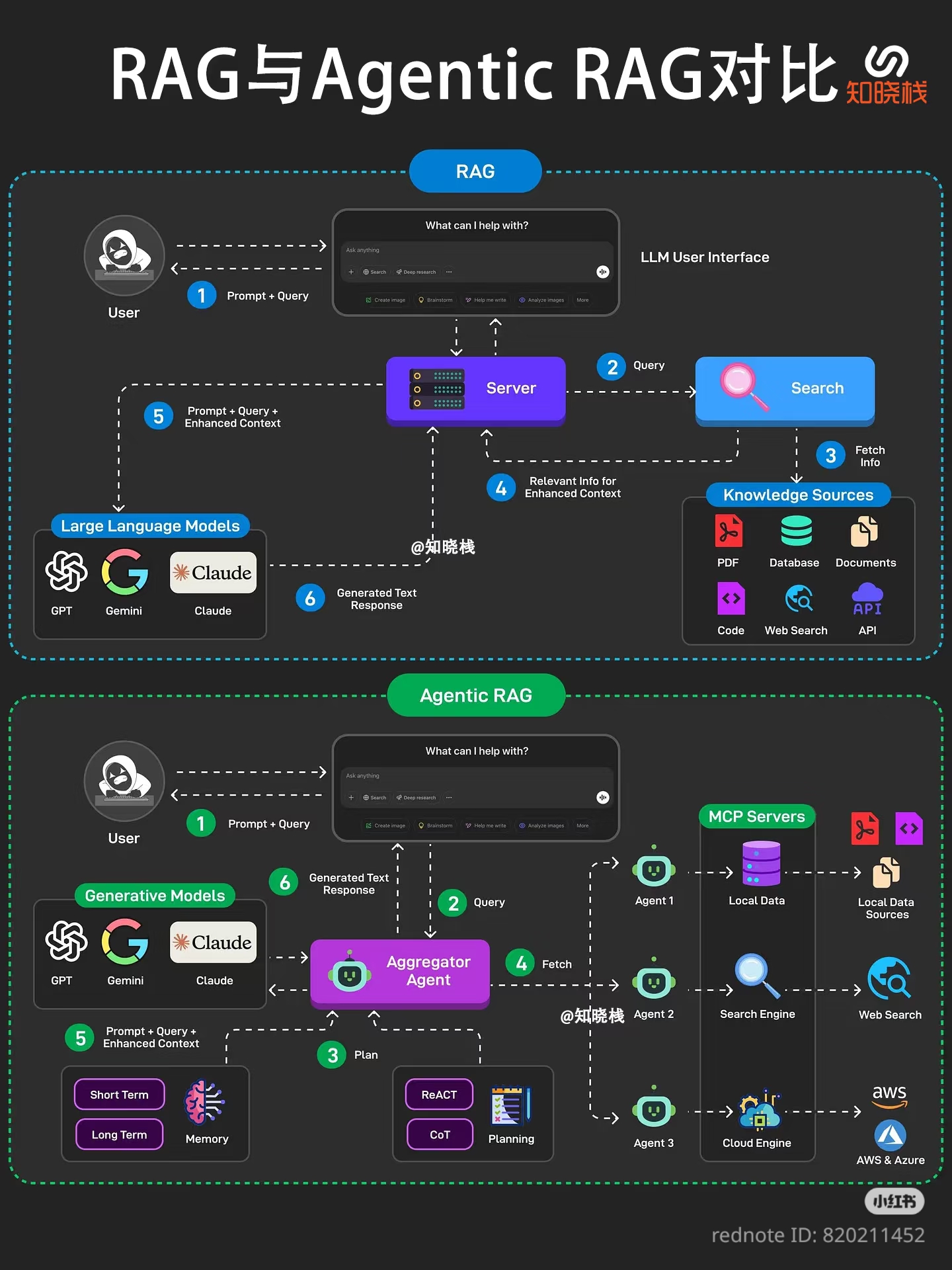
The infographic serves as an educational visual guide titled "RAG与Agentic RAG对比" (Comparison of Retrieval-Augmented Generation vs Agentic RAG). In the top blue section labeled "RAG," it illustrates a simpler two-step flow where a user asks a question to an LLM User Interface, which then sends data to a Search module to fetch info from sources like PDFs or Databases before returning a response. The bottom green section explains how "Agentic RAG" takes this process further by adding Generative Models with memory capabilities to plan tasks through multiple Agents interacting with tools such as Search Engines and Cloud Engines.
detailed-analysis (gemma3_27b-it-q8_0)
Okay, let's break down this meme about Retrieval Augmented Generation (RAG) vs. Agentic RAG from an AI perspective, incorporating the requested theoretical frameworks where applicable. This meme is a direct comparison of two evolving architectures for Large Language Models (LLMs).
Visual Description
The meme is a split comparison, visually representing two different architectures built around LLMs: RAG (Retrieval Augmented Generation) on the top, and Agentic RAG on the bottom.
- RAG (Top): This illustrates a more traditional workflow. A user provides a prompt (1), which is sent to a server (2). The server then searches for relevant information from various knowledge sources like PDFs, databases, web searches, and APIs (3). This retrieved information is combined with the original prompt to create "prompt + enhanced context" (5). This augmented prompt is then fed into an LLM (GPT, Gemini, Claude), which generates a textual response (6).
- Agentic RAG (Bottom): This demonstrates a more complex, multi-agent approach. The user prompt (1) is received by an "Aggregator Agent" (2), which develops a plan (3) using techniques like ReAct (Reason + Act), Chain of Thought (CoT), and Planning. This plan involves assigning tasks to multiple "MCP (Multi-Collaborative Process) Agents" (Agent 1, 2, 3) that fetch information from various sources (local data, web search, cloud engine like AWS/Azure) (4). The retrieved information is then used to create a "prompt + enhanced context" (5) that feeds into the LLM (GPT, Gemini, Claude), generating a textual response (6).
The visual emphasizes the sequential, linear flow of information in RAG versus the parallel, collaborative, and planning-driven nature of Agentic RAG.
Critical Theory
From a Critical Theory perspective (drawing on the Frankfurt School, Habermas, etc.), this meme highlights the evolving power dynamics within AI systems.
- RAG represents a controlled form of AI: The system follows a predetermined path, retrieving information from curated sources. This can be seen as reflecting a hierarchical control structure – a central server dictates the flow of information. This control is not inherently negative, but it could be used to reinforce existing biases in the knowledge sources, thereby perpetuating dominant ideologies. The LLM is largely a "black box," generating responses based on provided context without independent agency.
- Agentic RAG suggests a shift towards distributed agency: The introduction of multiple agents, planning, and independent information retrieval disrupts the centralized control of the standard RAG model. This represents a step towards a more "complex" AI system. However, this also introduces new potential problems. Who controls the agents? What biases are embedded in their planning processes (ReAct, CoT)? What happens when agents conflict? The meme subtly points towards the inherent contradictions within AI – the desire for intelligent systems clashes with the need for control and predictability. The agents create a new level of abstraction, obscuring the mechanisms of power and decision-making.
Marxist Conflict Theory
Viewing this through a Marxist lens focuses on the relationships between the means of production (data, algorithms, infrastructure) and the forces of production (LLMs, agents, the computational power driving them).
- RAG as "Fordist" AI: The traditional RAG model is analogous to Fordist production – a standardized, linear process with a clear division of labor. The "knowledge sources" are the raw materials, the server is the factory, and the LLM is the worker producing the final product (the text). This system is efficient, but also rigid and prone to errors if the raw materials (data) are flawed.
- Agentic RAG as "Post-Fordist" AI: The Agentic RAG model represents a shift towards a more flexible, networked form of production. The agents are akin to specialized workers who can independently acquire information and collaborate to solve complex problems. This "post-Fordist" model suggests a potential for increased productivity and innovation but also introduces issues of precarity and control. Who owns the agents? Who benefits from their increased efficiency? The meme implicitly suggests a growing concentration of power in those who control the AI infrastructure and the agents themselves. The access to data and computing resources represents a class division within the AI ecosystem.
Postmodernism
From a postmodern perspective, the meme exemplifies the breakdown of grand narratives and the rise of situated knowledge.
- RAG as a remnant of a modernist desire for objective truth: The traditional RAG model implies a belief that objective truth can be accessed by retrieving information from authoritative sources. This fits within a modernist framework of seeking universal knowledge.
- Agentic RAG as embracing complexity and subjectivity: The introduction of agents, planning, and multiple perspectives challenges the idea of a single, objective truth. Each agent may have its own biases and priorities, leading to different interpretations of the same information. The "plan" itself becomes a construction, not a revelation of truth. The meme embodies the postmodern emphasis on contingency, relativity, and the impossibility of complete knowledge. The fragmentation of the process into multiple agents mirrors the postmodern critique of unified subjects.
Foucauldian Genealogical Discourse Analysis
Applying Foucault's methods, we examine the discourse surrounding AI and how it shapes our understanding of these technologies.
- The historical emergence of RAG: RAG is a response to the limitations of early LLMs – their tendency to "hallucinate" or generate factually incorrect information. It is a discursive formation that emerges from a need to ground LLMs in verifiable knowledge. The meme highlights a specific moment in the genealogy of AI – the shift from purely generative models to those that incorporate retrieval.
- Agentic RAG as a new disciplinary apparatus: The introduction of agents and planning represents a new way of organizing and controlling AI systems. It creates new forms of surveillance, normalization, and power. The agents, with their assigned tasks and evaluation metrics, act as a disciplinary force, shaping the behavior of the LLM. The "plan" itself becomes a mechanism for regulating the flow of information and ensuring compliance with specific goals. The meme implicitly exposes the power relationships embedded within AI systems.
In conclusion: The meme is a surprisingly dense commentary on the evolving landscape of AI. It’s not just a technical comparison; it’s a reflection of deeper philosophical and societal questions about agency, control, knowledge, and power within increasingly complex technological systems. Each theoretical framework provides a unique lens for understanding the implications of these shifting architectures.
simple-description (llama3.2-vision_11b)
The meme is a humorous representation of the differences between two AI models, RAG (Robust Adversarial Generation) and AGENTIC RAG (Adversarial Generation of Textic Information Cognition), which are both used for generating text. The meme is a flowchart showing the user interaction with both models, with the user asking a question and the models providing different responses. The text "RAG vs AGENTIC RAG" is written above the flowchart, and the image is accompanied by the text "The AI's are having a fight over who is better" and "RAG is better at generating text, but AGENTIC RAG is better at being a 'good' AI".