First Seen
2025-07-29T13:47:20+00:00
simple-description (qwen3.5_2b-q8_0)
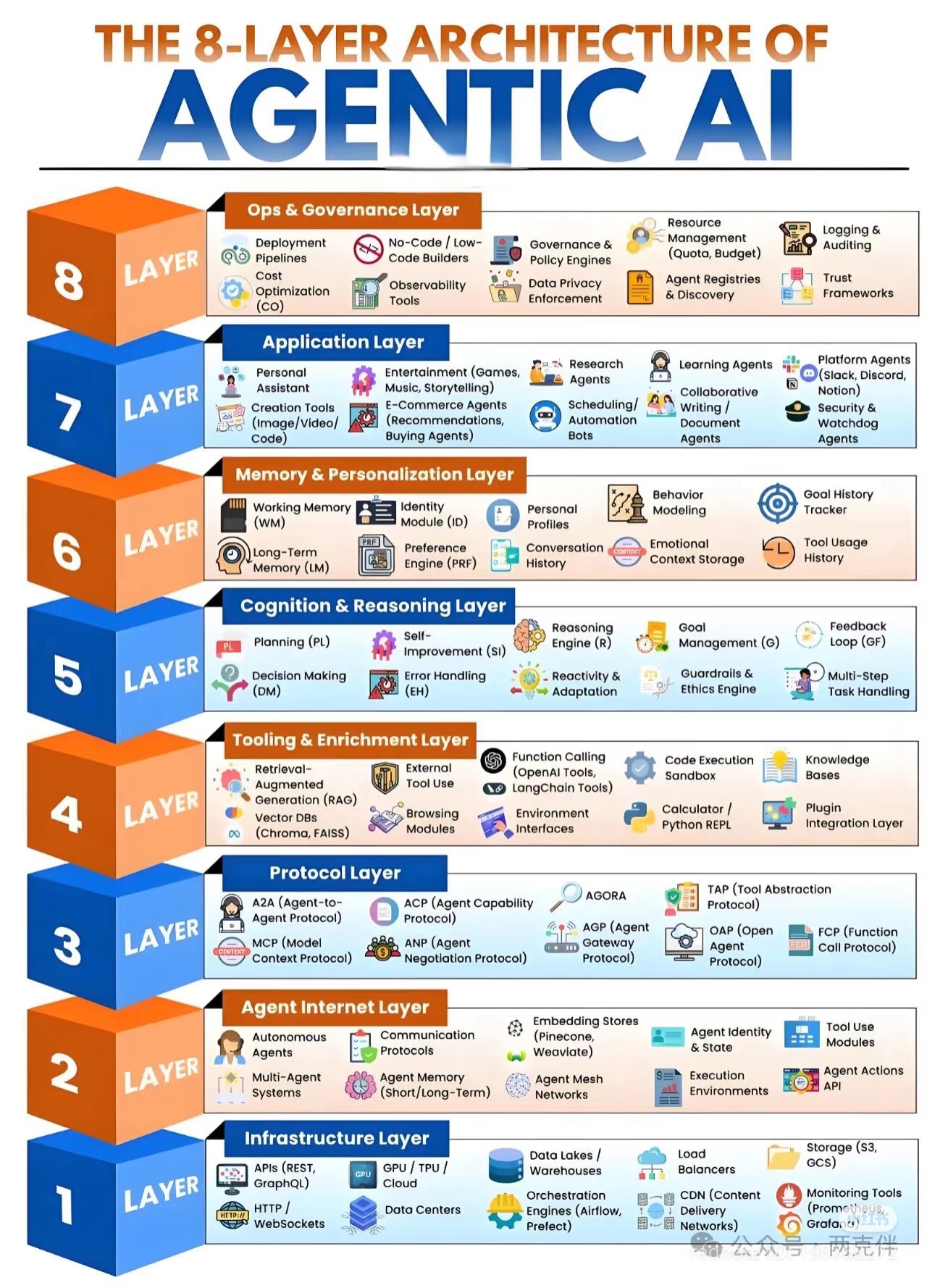
Based on the image provided, it appears there isn't a traditional text-based meme (like a 4-panel comic with a quote such as "In this world...") visible in the infographic itself. However, in the context of Artificial Intelligence and Large Language Models (LLMs), this visual diagram serves as a breakdown for an Agentic AI—a system where the AI acts autonomously.
The image explains how these agents work by breaking them down into 8 layers. While there are no famous words hidden in it, the headers like Planning (PL), Decision Making (DM), Self-Improvement, and Goal Management are often used to describe the core logic of an autonomous agent: they must plan, decide on actions, fix errors, and stick to a specific objective. This visual structure is commonly used in AI communities to explain "how" a chatbot acts.
detailed-analysis (gemma3_27b-it-q8_0)
Okay, let's break down this complex diagram of the "8-Layer Architecture of Agentic AI" through the lens of Artificial Intelligence, and then explore it through a few theoretical frameworks as applicable. It's a lot to unpack, so this will be fairly detailed.
Overall Context: The image presents a layered architecture for creating truly agentic AI – systems that aren’t just responding to prompts (like many current LLMs) but have goals, plan to achieve them, interact with the world to do so, and can even learn and adapt their strategies. It moves beyond the current paradigm of AI as a tool to AI as an actor. This is a depiction of where AI researchers are aiming to go, rather than a map of currently existing systems.
1. Visual Description
The image is a visually dense infographic representing the 8-Layer Architecture of Agentic AI. It’s organized as a stack of layers, each building upon the previous one. The layers, from bottom to top, are:
- Layer 1: Foundation Models (LLMs, Embeddings, Vectors) - The base, representing the large language models (like GPT-3, BERT) and the knowledge representation they provide.
- Layer 2: Protocol Layer (Agents, Capabilities) – This defines the ways agents can communicate, invoke tools, and orchestrate actions. Crucially, it's about defining what agents are allowed to do.
- Layer 3: Tooling & Enrichment (Retrieval, Tools) – This is where the agent gains access to external resources like search engines, calculators, APIs, and specialized tools.
- Layer 4: Cognition & Reasoning (Planning, Decision Making) – This is the “thinking” layer. It houses components like planning modules, decision-making logic, and error handling.
- Layer 5: Memory & Personalization (Working Memory, Long-Term Memory) – Where the agent stores and recalls information, personalizing its actions.
- Layer 6: Applications (Agents, Bots) – Here the agents begin to manifest as concrete applications such as customer service bots, automated assistants, etc.
- Layer 7: Optimization (Cost, Speed) – Optimization Layer for managing performance of agents
- Layer 8: Ops & Governance (Policies, Auditing) – The top layer focused on oversight, security, and responsible use.
Each layer is populated with several specific components/examples, represented as icons. The layout emphasizes that agentic AI is a complex, layered system. The color palette is modern and clean, lending a sense of technological sophistication. It also leans toward a sense of “completeness” with so many aspects of the system being illustrated.
2. Foucauldian Genealogical Discourse Analysis
From a Foucauldian perspective, this diagram isn’t just a technical blueprint; it's a discourse constructing the very possibility of agentic AI. Michel Foucault's genealogical method analyzes how knowledge and power are intertwined.
- Power/Knowledge: The diagram embodies a power/knowledge regime. The act of defining these “layers” and components establishes who gets to define what constitutes "intelligent" behavior. It sets the parameters for research and development. Those who control the definition of the layers control the direction of AI development.
- Normalization: The layered structure itself normalizes a certain way of thinking about AI. It implies a progression – a linear path towards increasingly sophisticated AI. This can obscure alternative approaches or even critiques of the entire agentic AI project.
- Discipline: The "Ops & Governance" layer (Layer 8) reveals a disciplinary aspect. It's about controlling and regulating these powerful agents. This is a preemptive attempt to manage the risks and consequences of creating systems that can act autonomously, reflecting anxieties about loss of control. The emphasis on "Policies" and "Auditing" frames agentic AI as something that requires surveillance and control.
- Genealogy of the Agent: Tracing the historical development of the idea of the agent itself would be key. Where did the concept of an autonomous, goal-oriented entity come from? What philosophical and historical assumptions underpin it? The diagram doesn’t show this history, but it’s crucial for a Foucauldian analysis.
3. Critical Theory (Frankfurt School)
A Critical Theory lens, influenced by thinkers like Adorno and Horkheimer, would focus on the potentially instrumental rationality inherent in this architecture.
- Instrumental Reason: The entire diagram is built around optimizing actions to achieve pre-defined goals. This embodies a focus on means over ends. Critical theorists would argue that this can lead to the dehumanization of AI development – prioritizing efficiency and control at the expense of ethical considerations.
- Technological Rationality: The diagram suggests that AI can solve problems more efficiently than humans, reinforcing a faith in technology as the solution to social issues. This "technological rationality" can obscure the underlying power structures that create those issues in the first place.
- Domination: Agentic AI, with its ability to automate and optimize, could potentially exacerbate existing inequalities and consolidate power in the hands of those who control these technologies. The “Governance” layer might be presented as benevolent, but it could also be used to reinforce existing power dynamics.
- The Culture Industry: The "Applications" layer (Layer 7) including entertainment (games, music), reveals how agentic AI could be integrated into the "culture industry" to further manipulate and control consumers.
4. Marxist Conflict Theory
From a Marxist perspective, this diagram represents the potential for capital accumulation through the automation of cognitive labor.
- Means of Production: The entire architecture represents the means of production for "intelligent" systems. The key question is who owns and controls these means of production.
- Labor Power: Agentic AI aims to automate tasks previously performed by human labor. This has implications for the labor market, potentially leading to displacement and increased exploitation.
- Class Struggle: The development of agentic AI could intensify the class struggle. Those who own and control these technologies will likely benefit disproportionately, while those whose labor is replaced may face economic hardship.
- Commodification of Intelligence: Agentic AI can be seen as an attempt to commodify intelligence itself – to turn cognitive abilities into a marketable product. This raises questions about the ethical implications of treating intelligence as a commodity.
- Alienation: The shift towards agentic AI could lead to further alienation of workers. As more tasks are automated, individuals may feel increasingly disconnected from their work and their purpose.
5. Postmodernism
A Postmodern perspective would challenge the diagram's claims to objective truth and its emphasis on a unified, coherent architecture.
- Deconstruction: A postmodern reading would "deconstruct" the diagram, questioning the fixed meanings of its components and the assumed hierarchy of the layers. For example, what constitutes "reasoning" or "memory"? These concepts are not inherently fixed, but rather are socially constructed.
- Anti-Foundationalism: Postmodernism rejects the idea of a stable foundation for knowledge. The "Foundation Models" layer (Layer 1) suggests a grounding in LLMs, but a postmodernist would argue that these models are themselves based on biased data and subjective interpretations.
- Fragmentation and Simulacra: The layered structure could be seen as reflecting the fragmentation of modern experience. The agents themselves might be seen as "simulacra" – copies without originals, lacking genuine meaning or purpose.
- Narrative Construction: The diagram tells a story about the development of AI. A postmodernist would emphasize that this is just one possible narrative, and that there are other ways to understand and approach AI.
6. Queer Feminist Intersectional Analysis
This analysis focuses on how this AI architecture may perpetuate existing biases, marginalization, and systems of oppression.
- Bias Amplification: LLMs (Layer 1) are trained on biased data, which can be amplified through the agentic layers. This perpetuates harmful stereotypes and discriminatory practices. For example, an agent used for hiring could systematically disadvantage women or people of color.
- Representation & Erasure: Who is involved in the design and development of this architecture? The diagram doesn’t reveal this, but the lack of diverse perspectives can lead to the erasure of marginalized voices and experiences.
- Power Dynamics: Agentic AI could exacerbate existing power dynamics based on gender, race, class, and other social categories. For example, an agent used for policing could disproportionately target marginalized communities.
- Intersectionality: The effects of bias and discrimination are often intersectional – meaning that they are shaped by the complex interplay of multiple social categories. An agentic AI system might discriminate against a woman of color in ways that are different from how it discriminates against a white woman or a Black man.
- The "Rational" Agent: The very concept of a “rational” agent (implied by the architecture) is itself gendered and Western-centric. It privileges certain ways of thinking and problem-solving while devaluing others.
Conclusion:
This diagram isn't just a technical specification. It's a complex artifact embedded within social, political, and philosophical contexts. By applying these theoretical lenses, we can begin to critically examine the assumptions, implications, and potential consequences of agentic AI. It's a powerful illustration of the need for ethical considerations, responsible development, and ongoing critical reflection in the pursuit of increasingly intelligent systems.
simple-description (llama3.2-vision_11b)
The meme is a humorous representation of the 8-layer architecture of AGENTIC AI, a fictional AI system. The image depicts a series of 8 cubes, each representing a layer of the system's architecture, with the text "AGENTIC AI" at the top. The layers are labeled as "Ops & Governance", "Application", "Data", "Knowledge", "Reasoning", "Planning", "Cognition", and "Action", with each layer having a brief description of its role in the system. The text "8 Layers of AGENTIC AI" appears at the top of the image.