First Seen
2025-07-30T16:44:37+00:00
simple-description (qwen3.5_2b-q8_0)
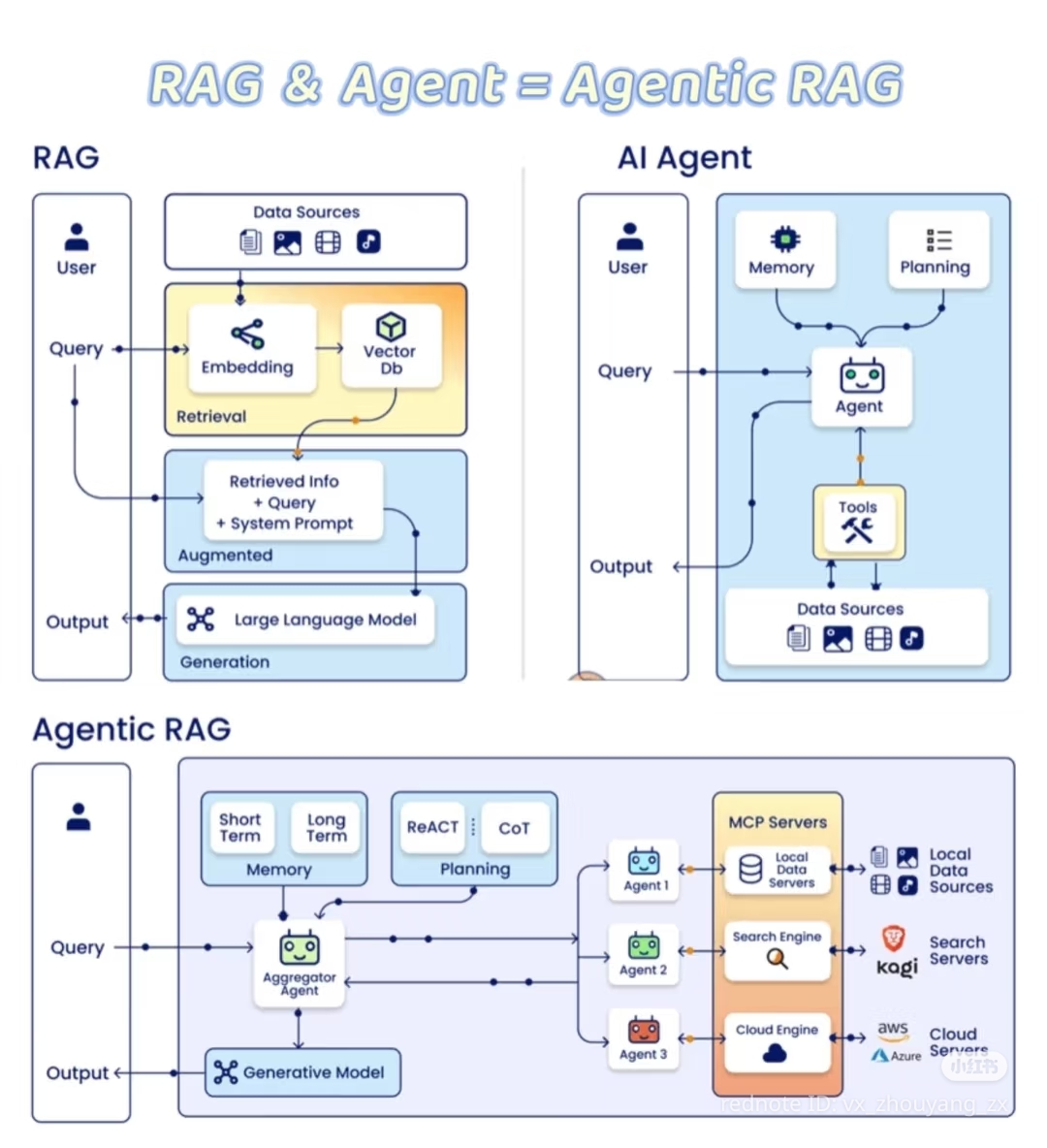
This infographic visualizes a major shift in Artificial Intelligence where systems move from simple information retrieval (RAG) to autonomous, multi-step task execution (AI Agents). It contrasts the traditional Retrieval-Augmented Generation workflow with modern architectures that introduce Autonomous Agents capable of planning, using tools like MCP Servers, and managing memory. The diagram illustrates this by showing how Agentic RAG combines these capabilities to coordinate multiple sub-Agents for complex data synthesis.
detailed-analysis (gemma3_27b-it-q8_0)
Okay, let's break down this meme from an Artificial Intelligence (AI) perspective, incorporating the requested theoretical frameworks where applicable. It's centered around the evolution of Retrieval-Augmented Generation (RAG) in the context of Large Language Models (LLMs).
Visual Description
The meme presents three diagrams, comparing three methods for using LLMs: “RAG”, “AI Agent”, and "Agentic RAG." Each diagram illustrates the flow of information from a user query, through various processing steps, to a final output.
- RAG: A relatively simple architecture. User queries go through embedding, which indexes info into a vector database. Retrieved information is then augmented with the original query and sent as a prompt to a Large Language Model for generation.
- AI Agent: A more complex system. The user query interacts with a central “Agent” component which has access to “Tools” (presumably various APIs, data connectors, etc.) and external “Data Sources”. The Agent utilizes memory and a planning component, then delivers an output.
- Agentic RAG: This is the most advanced system, incorporating aspects of both. It has short-term and long-term memory, a planning step, and multiple specialized agents (“Agent 1”, “Agent 2”, “Agent 3”) that interface with a diverse array of data sources, including MCP servers, local servers, search engines, and cloud servers, finally aggregating and using a generative model.
The overall visual progression demonstrates increasing complexity and autonomy in the AI systems. The meme’s title "RAG = Agentic RAG" suggests a merging or evolution of these approaches.
Critical Theory
From a Critical Theory perspective, the meme reveals the escalating rationalization and instrumentalization of information access and processing.
- Rationalization: Each stage (RAG -> Agent -> Agentic RAG) represents an increased drive for efficiency and predictability. RAG is a comparatively “irrational” method, relying on simple retrieval. Agents introduce planning and tool use, increasing efficiency. Agentic RAG further optimizes through specialized agents, distributed data access, and memory systems. The goal is to create a more completely controlled and predictable system.
- Instrumentalization: The user query is becoming increasingly abstracted from the actual source of knowledge and the processes that deliver it. The user interacts with a simplified interface (the query box), but behind it lies a network of power (data sources, agents, servers). Critical theorists would argue that this obscures the inherent biases, power dynamics, and hidden agendas within these systems.
- Control & Dominance: The progression towards Agentic RAG suggests an attempt to completely control the flow of information. The system strives to preemptively address all potential information needs through sophisticated retrieval, planning, and agent coordination.
Postmodernism
A postmodern reading focuses on the deconstruction of fixed meanings and the blurring of boundaries.
- The Death of the Author: The original "author" of information (the source of the data) becomes increasingly irrelevant. The LLM, the agents, and the retrieval mechanisms all contribute to a "text" that is not tied to a single originator. Meaning emerges from the relationships between the different components rather than from a definitive source.
- Simulacra and Simulation: The agents and the system as a whole begin to simulate intelligence and agency. The lines between genuine understanding and algorithmic processing become blurred. Are the agents "thinking" or simply executing predetermined rules based on the data they are provided? The meme suggests we are approaching a level of simulation where this distinction becomes difficult to discern.
- Decentering of Subjectivity: The user's role is decreasingly active and creative. RAG requires more explicit prompts and is more reliant on the user to frame the inquiry. Agentic RAG promises to proactively provide information, reducing the user's agency in defining the information need.
Marxist Conflict Theory
From a Marxist lens, the meme highlights the control of information as a form of power and the potential for exploitation.
- Means of Production: The "Data Sources", "Servers", and “Tools” represent the means of information production. Ownership of these resources determines who controls access to knowledge and the ability to generate value from it.
- Class Struggle (of Algorithms): The various "Agents" could be seen as representing different factions within the AI system, each vying for control of information flow and the ability to influence the final output. This could be related to the struggle between companies (Microsoft/Azure, Google/Search Servers) for dominance in the AI landscape.
- Alienation: The user is increasingly alienated from the process of knowledge discovery. The complexity of Agentic RAG obscures the underlying mechanisms and reduces the user’s ability to understand and critique the information they receive. The LLM becomes a black box.
Foucauldian Genealogical Discourse Analysis
A Foucault-inspired analysis would examine how the concept of "intelligence" itself is being constructed through these technologies.
- Discourse of Efficiency: The meme exemplifies a discourse of constant optimization and efficiency. The progression from RAG to Agentic RAG isn’t merely about better results; it’s about a specific way of knowing that prioritizes speed, automation, and control.
- Power/Knowledge: The meme illustrates how power and knowledge are inextricably linked. Those who control the data sources, algorithms, and infrastructure have the power to shape the narratives that are generated by these systems. The increasing sophistication of Agentic RAG amplifies this power dynamic.
- Panopticism: The monitoring and processing of data by agents and servers can be likened to a panoptic system. The system has the potential to observe and track user queries and behaviors, which can influence how the AI responds.
Queer Feminist Intersectional Analysis
This is the most challenging framework to apply directly, but relevant points can be made.
- Bias Amplification: The data sources used in these systems likely contain inherent biases based on historical and social inequalities. Agentic RAG, with its reliance on extensive data sets, risks amplifying these biases, leading to discriminatory outcomes. The different Agents may reflect biased perspectives based on the datasets they are trained on.
- Erasure & Exclusion: If the data sources are not diverse and representative, certain voices and perspectives may be marginalized or excluded from the information produced by these systems. This can perpetuate existing power imbalances. (Consider who owns and controls these data sources.)
- The Construction of "Intelligence": The very concept of “intelligence” in AI is often rooted in Western, patriarchal, and ableist norms. Agentic RAG, by attempting to emulate this form of intelligence, can reinforce these problematic assumptions. It perpetuates the idea that there is a single, dominant way of knowing.
In conclusion, the meme, though seemingly technical, is deeply embedded within broader social, political, and philosophical contexts. It reflects the ongoing quest to automate knowledge, the increasing centralization of power in the hands of those who control information technology, and the need for critical reflection on the ethical implications of these advancements.
simple-description (llama3.2-vision_11b)
The meme is a humorous comparison between two AI tools, RAG (Retrieval-And-Generation) and LLaMA (Large Language Model) or another AI model, highlighting their differences in how they approach and provide information. The text "RAG & Agent = Agentic RAG" implies that the two tools have merged to create a more advanced and capable AI system.