First Seen
2025-08-05T03:00:29+00:00
simple-description (qwen3.5_2b-q8_0)
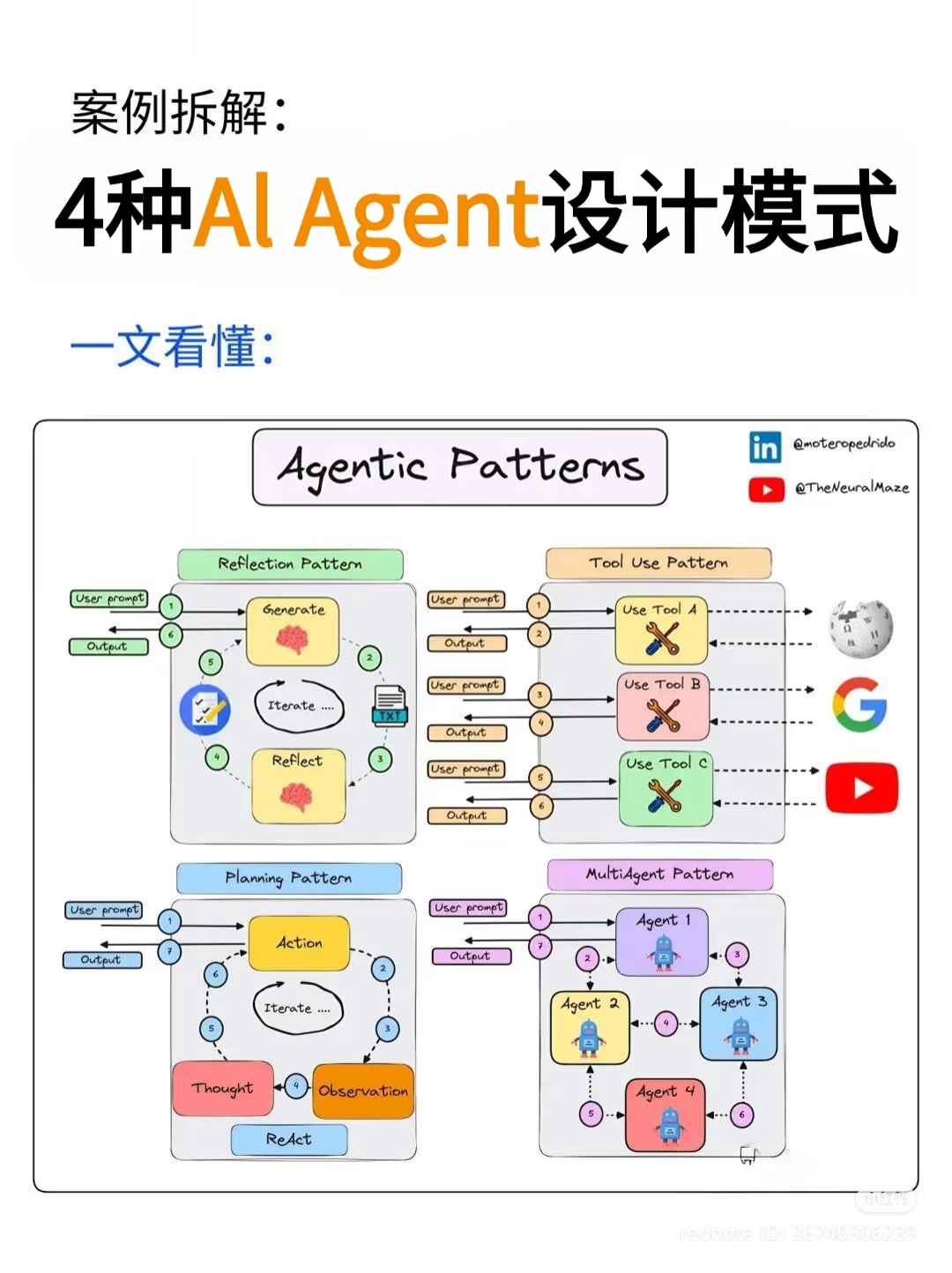
This infographic explains how modern AI agents break down complex problems using four distinct methodologies: Reflection (learning from past errors or mistakes), Tool Use (fetching information from external sources like Wikipedia or YouTube), Planning (creating a sequence of actions to solve a problem), and Multi-Agent (collaborating with multiple robots to reach a goal).
detailed-analysis (gemma3_27b-it-q8_0)
Okay, let's break down this meme from an Artificial Intelligence perspective, drawing on the requested theoretical frameworks where relevant. The meme presents four "patterns" for AI agent design. The original Chinese text at the top translates roughly to "4 AI Agent Design Patterns."
Visual Description
The image displays four distinct flowcharts, each representing a different architectural pattern for building AI agents. Each pattern takes a "User prompt" as input and produces an "Output." Let's briefly summarise each:
- Reflection Pattern: This pattern involves generating an initial output, then reflecting on that output to improve it through iteration. It's a loop of generation and self-critique.
- Tool Use Pattern: Here, the agent leverages external tools (labelled Tool A, Tool B, Tool C) to process the user prompt and arrive at its output. This is a sequential use of tools.
- Planning Pattern: This is about deliberation and decision-making. The agent goes through phases of "Thought", "Observation" and "Reflect" to develop a "Plan" before producing a final output. This is an iterative process.
- Multi-Agent Pattern: This showcases a collaborative structure, where multiple agents (Agent 1, Agent 2, Agent 3, Agent 4) interact to produce a collective output.
The visual is clean and diagrammatic, reminiscent of system architecture documents or flowcharts used in software development. The use of icons (pencil for reflection, tools for the tool-use pattern, and agent symbols) aids in quick comprehension. The logos (LinkedIn, YouTube, Google) represent platforms frequently leveraged by AI agents. There is a digital watermark that contains a short ID number.
Critical Theory
From a Critical Theory perspective, particularly thinking about the Frankfurt School’s concerns about instrumental reason, these patterns reveal a fascinating shift in how we conceptualize intelligence. Traditionally, intelligence was (often implicitly) tied to consciousness, intentionality, and perhaps even subjectivity. These agent patterns bypass those concerns, focusing entirely on functionality and optimization. The agent is reduced to an information processing machine.
- De-subjectification: The agent patterns strip away the notion of inherent meaning. The “Reflection” isn’t driven by ethical or existential concerns; it’s driven by a goal to improve output based on pre-defined metrics.
- Technological Rationality: The meme exemplifies the dominance of technological rationality – the idea that all problems can be solved through the application of technical means. Each pattern is about finding a more efficient way to map input to output.
- The Illusion of Autonomy: The "Multi-Agent Pattern" is particularly interesting. While it appears to represent a distributed, collaborative intelligence, the autonomy of each agent is still constrained by the system’s design and objectives. Is this genuine collaboration, or merely a complex form of pre-programmed interaction?
Postmodernism
Postmodern thought, with its emphasis on the deconstruction of grand narratives and the fluidity of meaning, offers another lens.
- Simulacra and Simulation: These patterns could be seen as contributing to a world increasingly governed by simulacra – copies without originals. The agent isn’t understanding the prompt; it’s manipulating symbols based on learned patterns. The output is a simulation of intelligence, rather than intelligence itself.
- Decentered Subject: The human operator is decentered in this scheme. The prompt provides an initial condition, but the agent takes over, operating according to its internal logic. The human’s role shifts from creator to prompter.
- The Death of the Author: The “author” of the output isn’t a single entity. In the Multi-Agent pattern, it’s a distributed process. The agent’s "agency" is not rooted in a conscious author, but in the architecture of the system.
Marxist Conflict Theory
From a Marxist lens, we can see these patterns as emblematic of the commodification of intelligence and the potential for intensified class struggle.
- Means of Production: The algorithms and data (the “means of production” of AI) are increasingly concentrated in the hands of a few powerful corporations. These patterns, while seemingly neutral, reinforce that control.
- Labor Process: These patterns represent a new form of “labor process,” where AI systems automate tasks previously performed by humans. This can lead to job displacement and the devaluation of human labor.
- Alienation: The emphasis on optimization and efficiency can lead to a sense of alienation. Humans may feel increasingly disconnected from the outputs of these systems, as they lack transparency or understanding of the underlying processes. The "Reflection" pattern, while appearing to mimic self-awareness, is purely algorithmic – a simulation of a human capability.
Foucauldian Genealogical Discourse Analysis
Foucault's genealogy examines the historical construction of power/knowledge systems. Examining these agent patterns through a Foucauldian lens illuminates how these structures are normalizing a particular conception of intelligence.
- Discourse of Efficiency: The focus on optimizing input-output relationships embodies a discourse of efficiency that pervades modern technology. It shapes the way we think about problem-solving and value creation.
- Power/Knowledge: The creation and dissemination of these patterns (by the individuals noted in the image – @moteropdedito and @TheNeuralMaze) establishes a form of power/knowledge. Those who understand and can implement these patterns gain control over the means of creating intelligent systems.
- Surveillance and Control: AI systems built on these patterns can be used for surveillance and control. The ability to process information and predict behavior allows for new forms of social regulation.
Queer Feminist Intersectional Analysis
While perhaps less directly apparent, a queer feminist intersectional analysis can highlight potential biases embedded within these patterns.
- Bias in Data: The effectiveness of these patterns relies heavily on the data used to train the AI. If that data reflects existing social biases (gender, race, class, etc.), the agent will perpetuate those biases in its output.
- The "Neutral" Mask: The presentation of these patterns as neutral and objective masks the power dynamics inherent in their design and implementation. The choice of what constitutes "good" output is not value-neutral.
- Marginalized Perspectives: The development of these patterns may disproportionately reflect the perspectives of dominant groups, leading to systems that are less effective or even harmful to marginalized communities. The "Reflection" pattern, for example, might reflect the values of the developers rather than the needs of diverse users.
In conclusion, this meme isn’t simply a technical diagram. It’s a representation of a broader shift in how we understand and create intelligence, and it raises important questions about the social, ethical, and political implications of AI. The theoretical frameworks outlined above offer a range of critical perspectives for analyzing these implications and guiding the development of more responsible and equitable AI systems.
simple-description (llama3.2-vision_11b)
The meme is a humorous representation of a typical AI chatbot's response to a user's question about the difference between a "AI Agent" and a "Chatbot". The meme shows a flowchart with various "Agent" and "Chatbot" boxes, each with a different "User" and "Agent" or "Chatbot" label. The text above the flowchart reads "AI Agent" and "Chatbot" in Chinese characters, with the translation "AI Agent" and "Chatbot" in the top-left corner.