First Seen
2025-08-01T15:13:25+00:00
simple-description (qwen3.5_2b-q8_0)
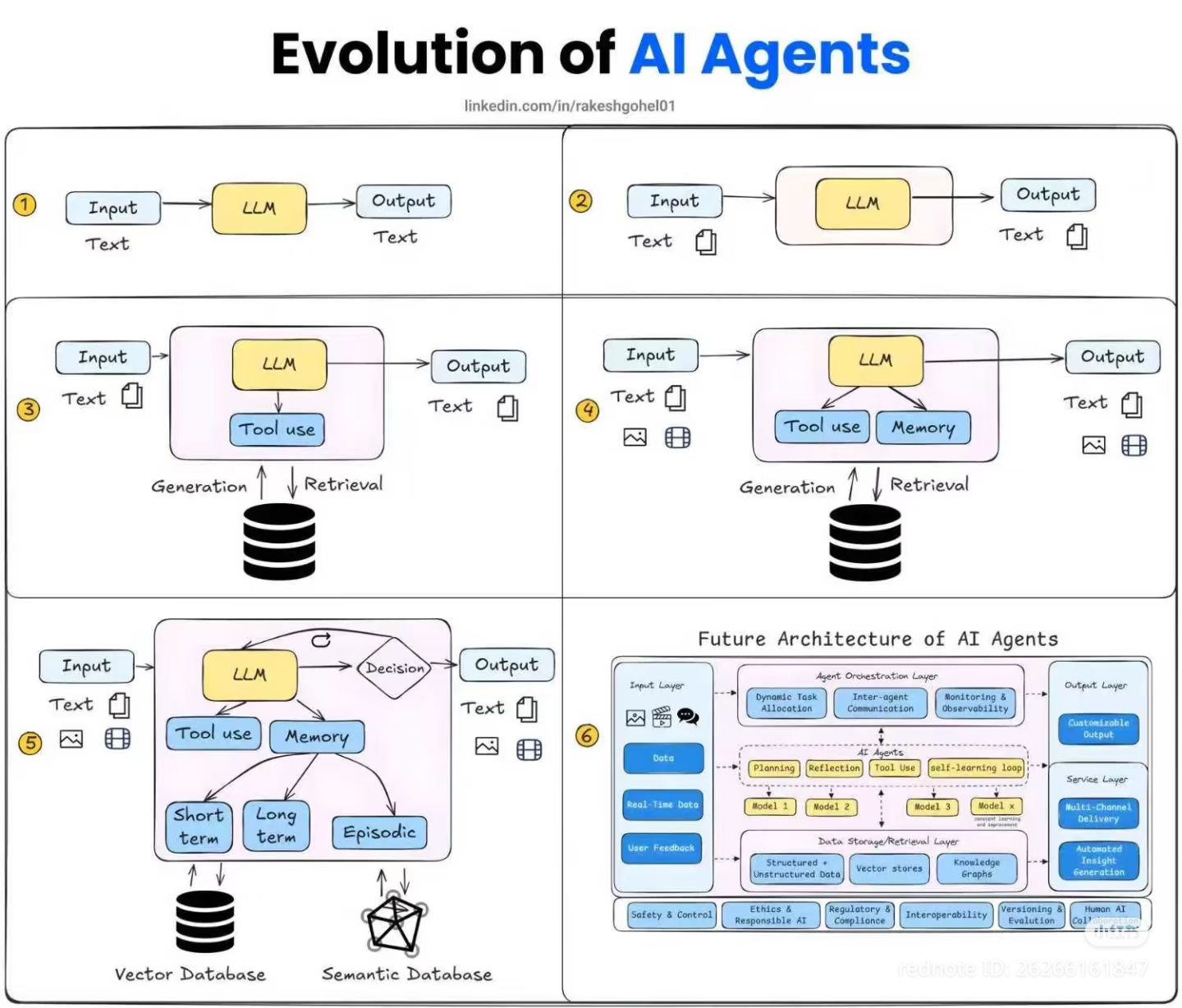
This infographic visually charts the "march of AI," illustrating a shift from simple chatbots that merely generated text into sophisticated systems capable of managing memory, tools, and complex internal state. It shows how early LLMs were static outputs but have evolved into autonomous agents with multi-layered architectures for planning, decision-making, and seamless data retrieval. The final panel predicts a future where AI systems will be structured into distinct functional layers to handle safety controls, ethics, and self-organizing workflows.
detailed-analysis (gemma3_27b-it-q8_0)
Okay, let's break down this meme about the evolution of AI agents from an AI-centric perspective, diving into the requested theoretical frameworks where applicable.
Visual Description
The meme, titled "Evolution of AI Agents," presents a six-stage progression visualized as a series of diagrams. It tracks the increasing sophistication of agents by showing how they move from simple text-in, text-out models (LLMs) to agents capable of tool use, memory, and complex decision-making.
- Stages 1-2: Basic LLM – Input text goes into a Large Language Model (LLM), and the output is text. The second stage shows this repeating, subtly implying iterative refinement but still within the same fundamental framework.
- Stages 3-4: LLM with Tool Use & Retrieval – The core LLM is augmented with the ability to use external "tools" (represented by icons like a calculator, a database) and to retrieve information. This introduces agency beyond pure text generation, suggesting a capacity for problem-solving. Two databases appear - one labelled "Vector Database" and another labelled "Semantic Database".
- Stages 5-6: LLM with Memory & Decision-Making – Memory is added, broken down into “Short Term” and “Long Term/Episodic” memory systems. This enables the agent to learn from past interactions and act accordingly. The final stage shows a complex architecture with multiple layers: Input Layer (including data, user feedback, safety & control), Orchestration Layer (dynamic tasks, inter-agent communication, monitoring & observability), Storage/Retrieval Layer (structured & unstructured data, vector stores, knowledge graphs, interoperability, versioning & evolution), and finally, the Output Layer (sustainable output, multi-channel delivery, automated insight delivery). The final stage also suggests a multi-agent system.
The entire graphic visually emphasizes a trajectory from passive text generators to proactive, adaptable, and complex agents, potentially operating in a coordinated system.
---
Foucauldian Genealogical Discourse Analysis
This meme provides a rich site for applying a Foucauldian analysis. The “evolution” presented is not a natural, inevitable progression, but a construction of discourse.
- Power/Knowledge: The narrative of evolution implies a "better," more advanced state of AI. This implies power structures: who gets to define what "better" means, and whose interests are served by this trajectory? The developers, researchers, and corporations driving these advancements wield the power to define the categories and benchmarks of "intelligence" and "agency."
- Disciplinary Power: The very notion of "memory" being categorized as "short-term" and "episodic" reflects a disciplinary approach, attempting to map human cognitive structures onto artificial systems. This normalization of human-centric design reinforces the idea that AI should mimic human intelligence, rather than develop its own, potentially radically different forms.
- Genealogy of the "Agent": By tracing the evolution, we see how the concept of an "AI Agent" has been assembled through various technological and conceptual interventions (LLMs, tool use, databases, memory systems). It’s not a pre-existing entity discovered, but a constructed one. The discourse constructs the agent as an increasingly "capable" being, obscuring the underlying power dynamics and limitations.
Critical Theory
From a critical theory perspective, the meme reflects a technologically deterministic worldview, subtly reinforcing existing social hierarchies.
- Instrumental Reason: The focus on "tools" and "outputs" exemplifies instrumental reason (Horkheimer & Adorno). AI is presented as a means to an end, without critical examination of the ends themselves. What problems is this more "advanced" AI solving, and for whom? Is it simply optimizing existing systems of power, rather than challenging them?
- Commodification of Intelligence: The entire evolution centers around creating more "valuable" AI agents – agents capable of generating outputs that can be commodified. This ties into the broader critique of capitalism's tendency to commodify everything, including cognitive abilities.
- The Illusion of Progress: The upward trajectory of the stages creates an illusion of inevitable progress. Critical theorists would argue that progress is not linear or inherently beneficial. We need to critically evaluate the consequences of each stage, rather than blindly assuming that "more advanced" is always better.
Postmodernism
A postmodern lens would deconstruct the idea of a single, unified "evolution."
- Deconstruction of "Intelligence": The meme assumes a clear definition of “intelligence.” Postmodernism challenges this assumption, arguing that intelligence is a socially constructed concept, dependent on context and perspective. What we consider "intelligent" in an AI is based on our own biases and expectations.
- Simulacra and Simulation: The increasing complexity of the AI agent—especially in stage 6—raises questions about authenticity. Is the agent truly "thinking" or merely simulating thought through sophisticated algorithms? It risks becoming a simulacrum, a copy without an original.
- Fragmentation and Multiplicity: The final diagram, with its layers and interconnected components, reflects a postmodern emphasis on fragmentation and multiplicity. The agent isn't a singular entity, but a complex network of interacting elements.
Conclusion
The meme about the evolution of AI Agents isn't merely a technical roadmap. It's a cultural artifact that reveals underlying power structures, ideological assumptions, and anxieties about the future of intelligence. By applying these theoretical lenses, we can critically assess the trajectory of AI development and ask whether it is truly serving humanity or reinforcing existing inequalities.
simple-description (llama3.2-vision_11b)
The meme is a humorous illustration of the evolution of AI agents, from simple text-based inputs to more complex and sophisticated systems. The image shows a series of diagrams, each representing a step in the development of AI agents, with text inputs and outputs, and eventually, a "Future Architecture of AI Agents" diagram. The text "Evolution of AI Agents" is at the top, and the image is a humorous commentary on the development of AI agents, from simple text-based inputs to more complex and sophisticated systems.