First Seen
2025-08-02T05:30:53+00:00
simple-description (qwen3.5_2b-q8_0)
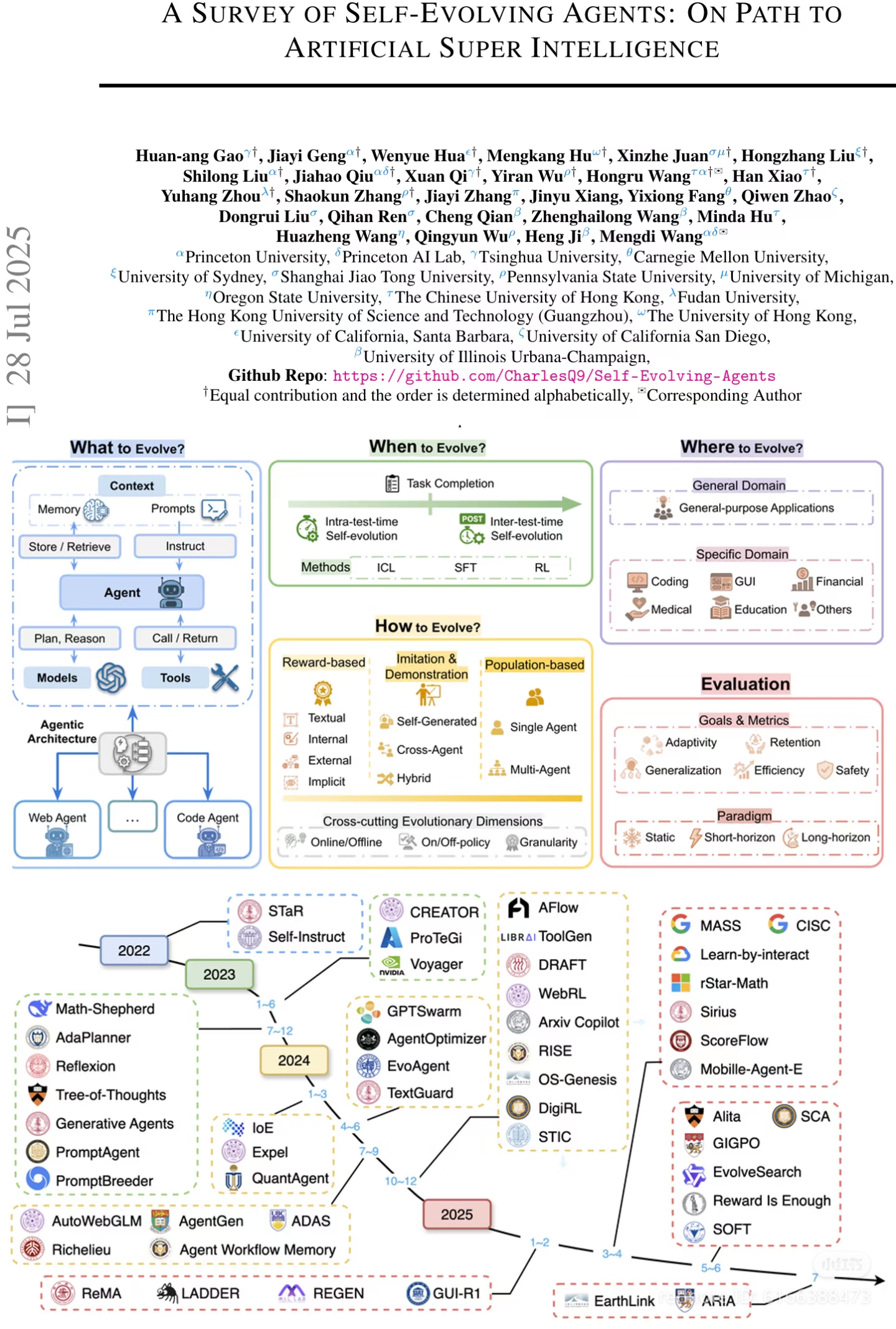
This infographic acts as a visual roadmap for Artificial Intelligence research, specifically documenting the evolution of self-evolving agents towards super intelligence. The top half breaks down the concepts into three phases—what they evolve, when they learn via methods like SFT and RL, and where they operate in different domains—while the bottom section maps out a timeline from 2022 to 2025 listing specific agent names and evaluation metrics used for their development.
detailed-analysis (gemma3_27b-it-q8_0)
Okay, let's break down this "meme" (which is actually a research paper summary graphic) from an Artificial Intelligence perspective, and through the lenses you've requested, as applicable. It's a very dense visual!
Visual Description
The image is a dense, diagrammatic "survey" titled "A Survey of Self-Evolving Agents: On Path to Artificial Super Intelligence." It’s clearly meant for a technical AI audience. The visual is structured as a large flow chart/mind map.
- Central Theme: The core concept is the progression of AI agents toward greater self-evolution, culminating in potential ASI (Artificial Superintelligence).
- Key Components (Arranged around central progression):
- What to Evolve?: Focuses on the agent's foundational components: Context (Memory, Store & Retrieve, Prompting, Instruction), Agentic Architecture (Plan, Reason, Call/Return, Tools), and Models.
- When to Evolve?: Discusses evolution triggers and timings – Task Completion, Intra- and Inter-test-time Self-Evolution.
- How to Evolve?: Explores methods like Reward-based, Imitation/Demonstration, and Population-based approaches. It then distinguishes between different evolutionary dimensions (Textual, Internal/External, Simple/Complex, etc.).
- Where to Evolve?: Specifies application domains (General-Purpose Applications, Coding, Medical, etc.).
- Goals & Metrics: Outlines desired characteristics (Adaptivity, Efficiency, Safety) and evaluation criteria (Static, Short-Evolving, Long-Horizon).
- Paradigm: Illustrates current methods of developing agents like Text-to-Text, Agent-to-Agent, or Human-to-Agent and related concepts.
- Yearly Progression: A timeline at the bottom showing developments from 2022 to 2024 and predictions for 2024/2025.
- Overall Impression: The image is highly technical, detailing the complex interplay of factors involved in creating AI agents that can improve themselves without explicit human intervention. The overall goal is the development of Artificial General Intelligence (AGI) and the potential for Artificial Superintelligence (ASI).
---
Foucauldian Genealogical Discourse Analysis
From a Foucaultian perspective, this graphic is a fascinating example of a discourse shaping the development of AI.
- Power/Knowledge: The diagram is a manifestation of the power/knowledge complex. Those who create and disseminate these "surveys" (the researchers listed) have the power to define the parameters of the field. They delineate what is considered important to study ("What to Evolve?"), how progress should be measured ("Goals & Metrics"), and what the ultimate objective is (ASI).
- Episteme: The graphic represents a specific episteme (the underlying set of relations that in a given period determine the conditions of possibility of all other statements). This episteme is characterized by a faith in algorithmic progress, the optimization of systems, and the potential for intelligent machines.
- Genealogy: We can trace a genealogy of ideas leading to this point. From early cybernetics and attempts to model human cognition, to the rise of deep learning and reinforcement learning, the diagram demonstrates a lineage of techniques aimed at automating intelligence. The "timeline" at the bottom reinforces this sense of historical development.
- Normalization: The emphasis on metrics like “Efficiency” and “Safety” can be seen as attempts to normalize this potentially disruptive technology. By framing AI development in terms of measurable, desirable outcomes, the discourse attempts to contain anxieties about its implications. However, Foucault would argue this normalization is itself a form of power.
---
Critical Theory
Critical Theory would view this image as embodying the ambition of technical rationality, and question its inherent assumptions and potential for domination.
- Instrumental Reason: The diagram exemplifies what Max Horkheimer and Theodor Adorno called "instrumental reason"—reason geared toward achieving pre-defined goals (in this case, ASI) without critical reflection on the value of those goals or their consequences.
- Technological Determinism: There is a subtle undercurrent of technological determinism. The graphic implies that the evolution of AI is a natural, inevitable process, rather than a socially constructed one shaped by specific interests and choices.
- Critique of Progress: A critical theorist would question the uncritical pursuit of "progress" towards ASI. What societal structures will this technology reinforce or challenge? Who benefits from its development, and who is potentially harmed? The graphic doesn’t address these ethical questions directly.
- Commodification of Intelligence: The drive to automate intelligence can be seen as a form of commodification – turning cognitive abilities into marketable products and potentially exacerbating existing inequalities.
---
Marxist Conflict Theory
From a Marxist perspective, the graphic reveals the economic and power dynamics driving AI development.
- Means of Production: The algorithms, data, and computational resources represented in the graphic are the “means of production” in the AI industry. The researchers and institutions listed are the “bourgeoisie” – those who control these means.
- Class Struggle: The pursuit of ASI is driven by the need for increased productivity and control. The development of AI could lead to automation of labor, potentially displacing workers and exacerbating class struggle.
- Ideology: The emphasis on “efficiency” and “optimization” serves as an ideological justification for the capitalist mode of production. These values mask the inherent contradictions and exploitative tendencies of the system.
- Accumulation of Capital: The goal of ASI can be interpreted as a drive for the ultimate accumulation of capital – the creation of a technology that can generate even greater wealth and power for those who control it.
---
Postmodernism
Postmodernism would deconstruct the image's claims to objective knowledge and highlight its inherent ambiguities.
- Deconstruction: A postmodern reading would question the very idea of a “survey” being comprehensive or definitive. The categories and relationships depicted are constructed, not inherent, and reflect the biases of the researchers.
- Simulacra and Simulation: The "evolution" depicted in the graphic can be seen as a simulation of intelligence, a representation that becomes increasingly detached from any "real" intelligence. It's a hyperreality.
- Relativism: Postmodernism would challenge the notion that ASI is a universally desirable goal. Different cultures and communities may have different values and priorities.
- Fragmentation: The diagram’s dense, fragmented layout reflects the postmodern condition of fragmented knowledge and the breakdown of grand narratives.
---
Queer Feminist Intersectional Analysis
This lens asks how AI development, as depicted here, reflects and potentially reinforces existing systems of oppression.
- Algorithmic Bias: The graphic doesn’t address the critical issue of algorithmic bias. AI systems are trained on data that reflects societal biases, which can perpetuate discrimination based on gender, race, sexual orientation, and other marginalized identities.
- Representation: Who is involved in the development of these technologies? The list of researchers is predominantly male and Western. The lack of diversity reinforces existing power structures within the field.
- Impact on Marginalized Communities: How might ASI impact marginalized communities? Could it be used to exacerbate existing forms of surveillance, control, or discrimination? The graphic doesn't consider these questions.
- Challenging the Binary: The focus on "efficiency" and "optimization" can be seen as reinforcing a binary logic that privileges certain modes of thinking and being over others. A queer feminist analysis would challenge this binary and advocate for a more inclusive and nuanced approach to AI development.
---
In conclusion:
The image isn't just a technical diagram; it's a culturally and politically loaded artifact that reflects the aspirations, anxieties, and power dynamics shaping the field of Artificial Intelligence. Each theoretical lens offers a different but valuable perspective on its meaning and implications.
simple-description (llama3.2-vision_11b)
The meme is a humorous image that illustrates the struggle of self-improvement in the context of artificial intelligence. It features a "self-improvement" chart with various "self-improvement" topics, including "AI" and "self-improvement" as the first and last entries. The chart is meant to be humorous and satirical, highlighting the absurdity of self-improvement in the age of AI.
The text that appears in the image reads: "A survey of self-improving agents: on path to artificial super intelligence."