First Seen
2026-03-27T18:01:31+00:00
simple-description (qwen3.5_2b-q8_0)
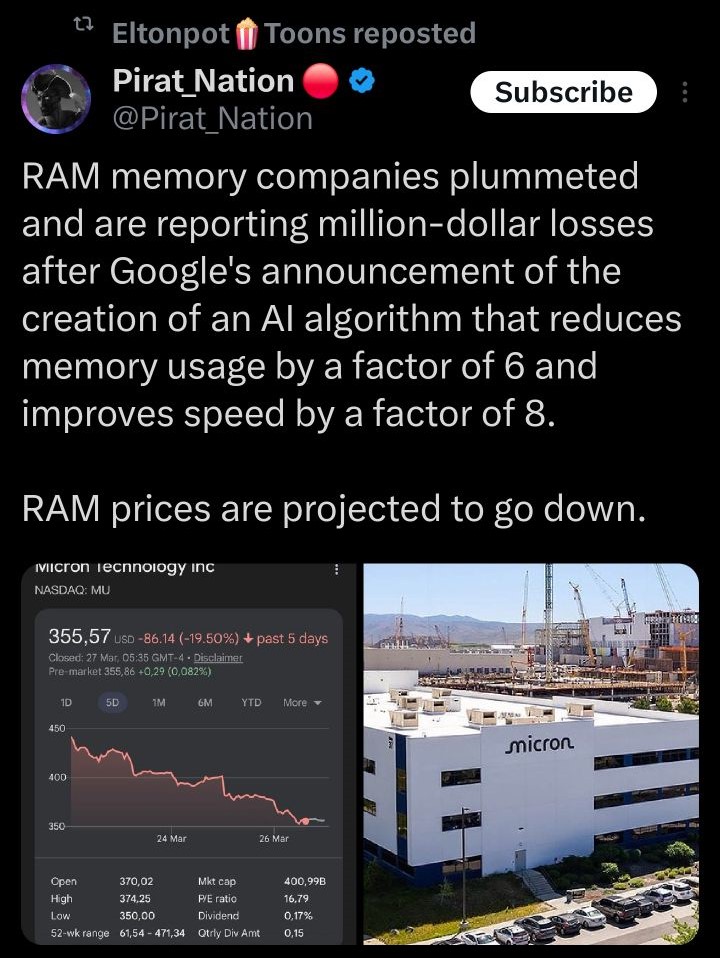
This humorous post suggests that Google's new AI algorithm is making traditional memory technology obsolete, causing panic among companies like Micron who are already seeing massive financial losses. It points to a stock plummeting from $355 with construction cranes in the background, implying the next generation of tech will render these products completely useless all over again.
detailed-analysis (gemma3_27b-it-q8_0)
Okay, let's break down this post from the perspective of Artificial Intelligence, using the requested theoretical frameworks where applicable. It's a multifaceted situation, so we'll need to cover quite a bit of ground.
Overall Context: The post discusses a significant development in AI—specifically, an algorithm developed by Google that dramatically improves memory efficiency and processing speed. This advancement has a direct, and negative, economic impact on companies manufacturing RAM (Random Access Memory). This is a key indicator of how AI development can disrupt established industries.
1. Visual Description
The image shows a stock chart for Micron Technology Inc. (a major RAM manufacturer) alongside a photo of one of its large-scale manufacturing facilities. The chart reveals a sharp downturn in the stock price, a -19.50% drop in the past 5 days. The visual immediately communicates economic loss. The imposing scale of the factory in the background emphasizes the physical infrastructure and economic weight that's potentially threatened. Key metrics like open, high, low, market cap, P/E ratio, dividend, and 52wk range are listed below the chart.
2. Foucauldian Genealogical Discourse Analysis
This situation is a powerful illustration of how discourses around technology and efficiency evolve and exert power.
- Historical Context: The demand for RAM has been historically tied to the increasing computational demands of software and operating systems, and, latterly, AI models. RAM was understood as a necessary bottleneck in processing power, something that always needed to be improved through hardware advances.
- The Shift in Discourse: Google's algorithm shifts this discourse. It isn't relying on more RAM, but on smarter RAM use through software/algorithmic innovation. This represents a shift in power from hardware manufacturers (like Micron) to software/algorithmic developers (like Google). The discourse around “performance” is being redefined – it’s no longer solely about more physical components.
- Power/Knowledge: This demonstrates Foucault’s idea of power/knowledge. The knowledge of how to efficiently manage memory, held and deployed by Google, grants them power to potentially reshape an entire industry. The discourse, now driven by algorithmic efficiency, disadvantages those reliant on the old discourse of hardware sales. The "plummeting" stock price is the visible effect of this discursive shift.
3. Marxist Conflict Theory
This event is a classic example of technological disruption causing class conflict and shifts in capital accumulation.
- Capital and Labor: Micron (and other RAM manufacturers) represent capital invested in a specific mode of production – physical hardware. Google, as the creator of the algorithm, represents a new form of capital – intellectual capital, or the means of algorithmic production.
- Class Struggle: The algorithm effectively devalues the capital invested in RAM production. The "million-dollar losses" represent a direct transfer of wealth from the RAM manufacturers (the 'bourgeoisie' in this context) to Google (and those who benefit from its software). The workers in the RAM factories are also vulnerable to job losses or wage stagnation.
- Technological Unemployment: The improvement in memory efficiency might ultimately reduce the need for RAM production, leading to technological unemployment – a core concern within Marxist analysis.
- Concentration of Capital: This reinforces the trend of capital concentrating in the hands of those who control the most advanced technologies. Google is further solidifying its position as a dominant force.
4. Postmodernism
This event exemplifies aspects of postmodern thought:
- The Erosion of Metanarratives: The traditional narrative of technological progress being always about “more” – more speed, more memory, more processing power – is being challenged. Google’s algorithm disrupts this linear, progressive narrative. It highlights a different pathway to improvement: optimization and efficiency.
- Simulacra and Simulation: The demand for RAM itself can be seen as a simulated need – a demand created and maintained by the expectation of needing more memory. The algorithm “unmasks” this simulation, demonstrating that the need wasn’t as fundamental as believed.
- Deconstruction of Binary Oppositions: The traditional opposition between hardware and software is destabilized. The algorithm demonstrates that software can supersede hardware limitations, challenging the perceived hierarchy.
5. Critical Theory
From a Critical Theory perspective, this event raises questions about the purpose and control of technology.
- Instrumental Reason: The algorithm, while technically impressive, represents the application of "instrumental reason" – using technology solely for efficiency and profit, without considering broader social consequences (e.g., job losses, economic disruption).
- The Culture Industry: The pursuit of technological "advancement" (in this case, algorithmic efficiency) can be seen as part of a broader cultural system driven by the logic of capital. The algorithm isn't created to improve the human condition per se, but to enhance Google’s market position and profitability.
- Domination and Control: The algorithm represents a form of technological control, as Google exerts influence over the demand for a critical hardware component, and, by extension, the industries that rely on it.
6. Queer Feminist Intersectional Analysis
While not immediately apparent, a Queer Feminist Intersectional analysis can still be applied:
- Technological Bias and Exclusion: The development and deployment of this technology may reflect existing biases within the tech industry. The underrepresentation of women, people of color, and LGBTQ+ individuals in AI development could lead to algorithms that fail to address the needs of diverse populations.
- Labor Exploitation: The data collection and algorithmic training processes that underpin AI often rely on precarious labor, disproportionately affecting marginalized communities. The algorithm's impact on RAM factory workers (mentioned in the Marxist analysis) could exacerbate these inequalities.
- The Myth of Neutrality: The algorithm is presented as a neutral technological solution, but this masks the power dynamics and social biases that shape its development and deployment. A Queer Feminist lens would question the notion of technological neutrality and highlight the ways in which technology can reinforce existing systems of oppression.
In Conclusion:
This situation is far more than a simple stock market dip. It's a microcosm of the broader dynamics of AI, power, capital, and the evolving relationship between hardware and software. It exemplifies how AI is not just a technological force but a social and economic one, with the potential to disrupt industries, reshape labor markets, and redefine our understanding of progress. The event provides ample material for critical analysis from a variety of theoretical perspectives.
simple-description (llama3.2-vision_11b)
The meme is a satirical take on the announcement of Google's AI algorithm, which is expected to reduce memory usage by a factor of 6 and improve speed by a factor of 8. The meme humorously suggests that RAM prices are projected to go down, implying that the algorithm's benefits will be so significant that it will lead to a decrease in RAM prices. The text "RAM prices are projected to go down" is presented in a serious tone, adding to the humor. The image of a building with the word "Micron" on it is likely included to represent the company that would be affected by the algorithm's impact on RAM prices. Overall, the meme pokes fun at the idea that a single announcement can have such a significant impact on the market.