First Seen
2026-01-10T21:23:25.629512+00:00
simple-description (qwen3.5_2b-q8_0)
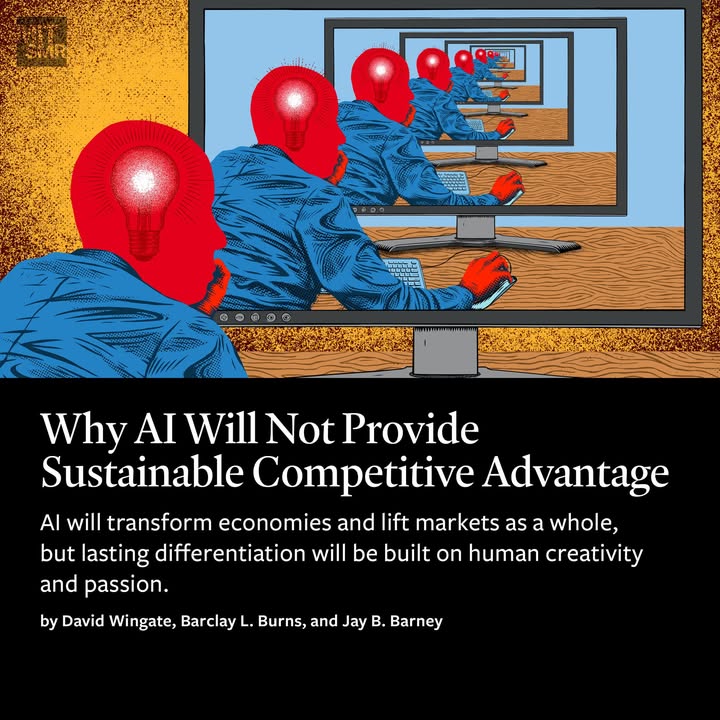
This image serves as a visual metaphor for a specific type of artificial intelligence known as "reinforcement learning" or algorithmic imitation. The perspective shows a system that repeatedly replicates its own previous actions and outcomes to simulate success, effectively acting as if it has already found the optimal solution by simply re-injecting the same factors that worked in a previous era. This explains the text's claim that while AI might transform markets, it cannot provide a sustainable competitive advantage because it lacks human creativity; instead, it is trying to copy past successes without understanding the underlying needs or passion of the market.
detailed-analysis (gemma3_27b-it-q8_0)
Okay, let's break down this image/meme, contextualized within the category of Artificial Intelligence, utilizing the requested theoretical lenses where applicable.
Overall Interpretation
The image aims to illustrate a central argument: while AI will be transformative, sustained competitive advantage won’t come from the AI itself, but from the uniquely human qualities of creativity and passion. It’s a cautionary claim against relying solely on technological solutions for long-term success. The imagery depicts AI (represented as a blue, snakelike figure) overwhelming a person, but with creativity/passion (the red lightbulbs) above and seemingly beyond its grasp.
Visual Description
The image employs a striking, slightly unsettling aesthetic. It uses a limited color palette – predominantly blue and red – with a distinct line-drawing style.
- AI Representation: AI is visualized as a large, convoluted blue figure appearing to “sprawl” over a person working at a computer. The form suggests something complex and potentially suffocating, and could be interpreted as an overwhelming force. Its serpentine shape evokes themes of control or constriction.
- The Human: A small, overwhelmed human figure is partially obscured by the AI's form, slumped over a keyboard. Their physical position suggests exhaustion or a sense of being overtaken.
- Lightbulbs: Two bright red lightbulbs float above the scene, visually distinct from the blue of the AI. They symbolize ideas, creativity, and perhaps “passion” as stated in the tagline. They are positioned as something beyond the reach of the AI, or as something that AI is dependent upon.
- Setting: The computer and desk signify a typical work environment, highlighting the intrusion of AI into everyday professional life.
Critical Theory
Critical Theory, rooted in the Frankfurt School, seeks to understand how power structures maintain themselves and how ideology shapes our understanding of the world.
- Technological Rationality & The Instrumentalization of Reason: The image taps into concerns about "technological rationality." Critical theorists like Herbert Marcuse argued that modern societies become dominated by instrumental reason—reason focused solely on efficiency and control. Here, AI, as the embodiment of this rationality, threatens to subsume and potentially devalue the more qualitative, human aspects of work (creativity, passion).
- Domination & Control: The sprawling, enveloping AI figure can be seen as a visual representation of a system of domination. It illustrates the potential for technology to control and oppress, rather than liberate.
- False Consciousness: The image subtly suggests that a belief in AI as the sole source of competitive advantage is a form of “false consciousness”. It obscures the real drivers of long-term success: human ingenuity.
Marxist Conflict Theory
From a Marxist perspective, this image represents the evolving dynamics of class struggle and the changing nature of labor under advanced capitalism.
- Capital & Labor: AI represents capital – the means of production – increasingly displacing or controlling labor. The overwhelmed human at the computer is a representation of the working class whose roles are being automated or redefined.
- Commodity Fetishism: The AI itself could be seen as a manifestation of commodity fetishism – the tendency to attribute inherent value to commodities (in this case, AI technology) rather than recognizing the social relations of production that created it. The hype around AI obscures the labor and resources required to build and maintain it.
- The Reserve Army of Labor: The implication is that AI will create a “reserve army of labor” – a surplus population of unemployed or underemployed workers. Those who can harness creativity and passion are positioned to thrive, while others risk being left behind.
- Alienation: The human figure slumped over the computer suggests alienation from their work. AI promises efficiency, but may lead to de-skilled and dehumanized labor.
Postmodernism
Postmodern thought emphasizes the deconstruction of grand narratives and the rejection of universal truths.
- Deconstruction of Technological Determinism: The image challenges technological determinism – the idea that technology inevitably shapes society. It asserts that human agency (creativity and passion) still matters, and that technology is not a neutral force.
- The Instability of Meaning: The slightly surreal and unsettling imagery reflects the postmodern emphasis on ambiguity and the instability of meaning. The AI is not presented as a simple "good" or "bad" force, but as something complex and potentially disruptive.
- Simulation & Hyperreality: The entire scenario, taking place within a digital environment (reflected in the computer screen), hints at the postmodern notion of simulation and hyperreality – where representations of reality become more real than reality itself.
Foucauldian Genealogical Discourse Analysis
Michel Foucault's work focuses on power, knowledge, and discourse. A genealogical analysis would trace how the concepts of “AI,” “competitive advantage,” and “human creativity” have been constructed over time.
- Power/Knowledge: The image exposes a power/knowledge dynamic. The discourse around AI (fueled by tech companies, researchers, and the media) creates the very reality it claims to simply describe. This discourse shapes our understanding of what constitutes “competitive advantage” and devalues other forms of knowledge (like artistic intuition).
- Disciplinary Power: The idea of needing to compete and maintain a "competitive advantage" is a disciplinary force that shapes behavior and incentivizes investment in AI, potentially at the expense of cultivating human skills.
- The Shifting Episteme: The image suggests a shift in the episteme (the underlying structure of thought) – from a focus on individual skills and innovation to a reliance on algorithmic solutions. The authors are pushing back against this shift.
Queer Feminist Intersectional Analysis (This is a less direct fit, but possible)
While not immediately apparent, a Queer Feminist Intersectional lens can add nuance.
- Marginalization & "Othering": The image, if read through a critical lens, can suggest how AI's development and implementation might disproportionately impact marginalized groups (e.g., those lacking access to AI education, or whose jobs are most vulnerable to automation).
- Devaluation of “Feminine” Traits: Historically, creativity and passion have been associated with “feminine” characteristics and are often undervalued in traditionally masculine, rationalized spaces like technology. The emphasis on these traits as key to sustainable advantage can be seen as a subtle challenge to that power dynamic.
- Intersection of Vulnerability: The figure at the computer represents an intersection of vulnerability--specifically, a vulnerability to displacement in a world increasingly run by AI.
In conclusion, the meme is more than just a visual statement; it’s a concise critique of the current hype surrounding AI, framed through multiple critical theoretical perspectives. It suggests that a solely tech-centric approach to innovation is ultimately limiting and potentially harmful, and that sustained success requires prioritizing uniquely human qualities.
simple-description (llama3.2-vision_11b)
The meme depicts a person sitting in front of a computer screen with multiple versions of themselves, each with a lightbulb head, implying that AI will not provide a sustainable competitive advantage. The text "Why AI Will Not Provide Sustainable Competitive Advantage" is displayed on the screen. The image suggests that even with AI, a person's creative and innovative ideas will still be needed to succeed in a competitive market.