First Seen
2025-12-07T23:24:36.555427+00:00
simple-description (qwen3.5_2b-q8_0)
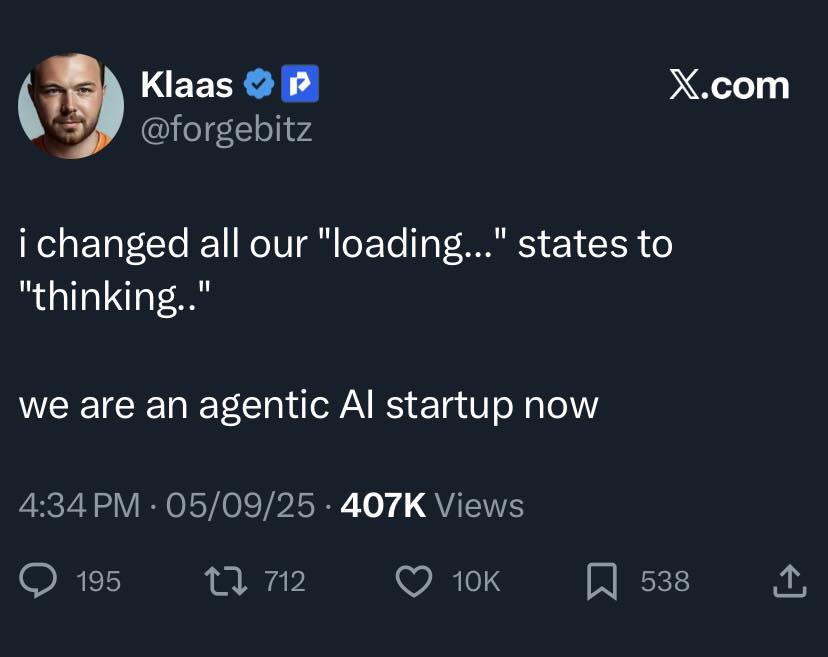
This tweet humorously claims that software developers have evolved from a passive waiting mode into an active thinking process, noting their change to 'thinking..' after replacing all 'loading...' states with simple text. It gained massive popularity, reaching nearly 407,000 views and over 10,000 likes among social media users, illustrating the claim that they are now an 'agentic AI startup now.'
detailed-analysis (gemma3_27b-it-q8_0)
Okay, let's break down this X (formerly Twitter) post, framed as a meme within the context of Artificial Intelligence, using the requested theoretical lenses. It's important to note that some of these frameworks will be more relevant than others, and we'll explain why.
Visual Description
The "meme" is quite minimalist. It consists of a text post on X, with a profile picture of a man named Klaas (presumably the founder or someone involved with the startup). The core of the meme is a simple statement followed by a declaration. The presentation suggests a tongue-in-cheek reveal or internal shift within the company. The stats (views, likes, reposts, comments) indicate substantial engagement, hinting at resonance within the AI community.
Foucauldian Genealogical Discourse Analysis
This is where things get interesting. Michel Foucault's work focuses on how power operates through discourse – the ways we talk about things, which shape how we understand them, and which reinforce certain power relations.
- The Shifting Discourse: The change from "loading..." to "thinking..." isn’t simply a change in words. It’s a shift in how the AI is presented. "Loading..." implies a mechanical process, a waiting state. "Thinking..." implies agency, cognition, and a level of intelligence. It re-writes the discourse surrounding the AI, moving it from passive tool to something that does.
- Power/Knowledge: The startup is attempting to construct a new reality around their AI. By using "thinking," they're leveraging the cultural weight of that word—its association with humans, consciousness—to gain perceived authority and attract investment. They are trying to define what their AI is and, in doing so, claim a position of power within the AI landscape.
- Genealogy: The history of AI discourse is marked by attempts to define “intelligence”. “Thinking” historically has been reserved for humans. The startup is disrupting that genealogy. This creates a tension - a contestation of what constitutes "intelligence."
Critical Theory
Critical theory, broadly, seeks to critique and challenge power structures and dominant ideologies. This post lends itself to a critical reading through its implication of hype and the potential for technological determinism.
- Technological Determinism: The meme implicitly embraces the idea that simply changing the label of what an AI is doing equates to a fundamental change in its nature. This is a classic example of technological determinism – the belief that technology shapes society, rather than the other way around. The startup is framing their technological 'upgrade' as a paradigm shift.
- Commodification of Intelligence: "Agentic AI" is a buzzword in the current tech landscape. The declaration that they are "now" this kind of startup suggests an attempt to capitalize on a trending narrative, packaging their AI as something more sophisticated and desirable to investors and customers.
- False Consciousness: The meme might be seen as contributing to a "false consciousness" by obscuring the underlying mechanics and limitations of the AI, projecting an image of genuine agency where there may be simply sophisticated pattern recognition and algorithmic processes.
Marxist Conflict Theory
While less directly applicable, Marxist perspectives can still be useful.
- Capital & Labor (and Data): The pursuit of "agentic AI" is driven, ultimately, by the potential for increased profit. More "intelligent" AI can automate tasks, potentially displacing human labor. The data used to train this AI represents a form of accumulated "capital" – a resource used to generate further capital.
- Class Struggle (potential): The development of advanced AI can exacerbate existing inequalities, as the benefits of automation may accrue to a small elite while workers face displacement. This meme represents the ideology of the ruling class of tech companies.
Postmodernism
Postmodernism questions grand narratives, objective truth, and stable meaning. This post speaks to some of those themes.
- Simulation and Hyperreality: The shift from "loading..." to "thinking..." could be seen as a form of simulation. It's not that the AI actually became more intelligent, but that the representation of its activity changed, creating a hyperreality where the signifier (the word "thinking") is detached from the signified (actual thought).
- Deconstruction of Meaning: Postmodernism is concerned with deconstructing meaning. Here, the seemingly simple act of changing a label reveals the constructed nature of meaning itself. “Thinking” is a culturally laden concept that gets applied to a machine, and the result is a disruption of expected associations.
Queer Feminist Intersectional Analysis
This framework is the least directly applicable but still has potential relevance.
- Bias in AI: The construction of "thinking" AI, often framed as a neutral and objective process, can perpetuate existing biases and inequalities. The training data used to develop these AI systems often reflects societal biases, which can then be amplified and reified in the AI's outputs. The concept of "agentic AI" could potentially mask or normalize these biases.
- The “Masculine” Tech Bro Narrative: The profile picture and the tone of the post (a seemingly casual, confident announcement) fit into the stereotype of a tech founder within a predominantly male-dominated industry. This aligns with the power dynamics often critiqued by queer feminist analysis.
In Conclusion:
This meme, though seemingly simple, operates on several layers. It’s a moment of self-aware branding for a tech startup, but it also reveals the ways in which discourse shapes our understanding of AI, the potential for technological determinism and commodification, and the complex power dynamics at play in the development of this rapidly evolving technology. The most potent lenses through which to analyze this post are Foucauldian discourse analysis, critical theory, and postmodernism. They reveal the ways in which the startup is attempting to create meaning and authority around its AI, rather than simply revealing a pre-existing truth.
simple-description (llama3.2-vision_11b)
The meme is a tweet from Klaas, a software engineer, where he jokingly claims that he has changed all his "loading..." states to "thinking...". He then states that he is now an "agentic AI startup" and that he is "an agentic AI startup" because he has changed all his "loading..." states to "thinking...".