First Seen
2025-11-11T18:06:12.596308+00:00
simple-description (qwen3.5_2b-q8_0)
Visual Description for someone who cannot see it:
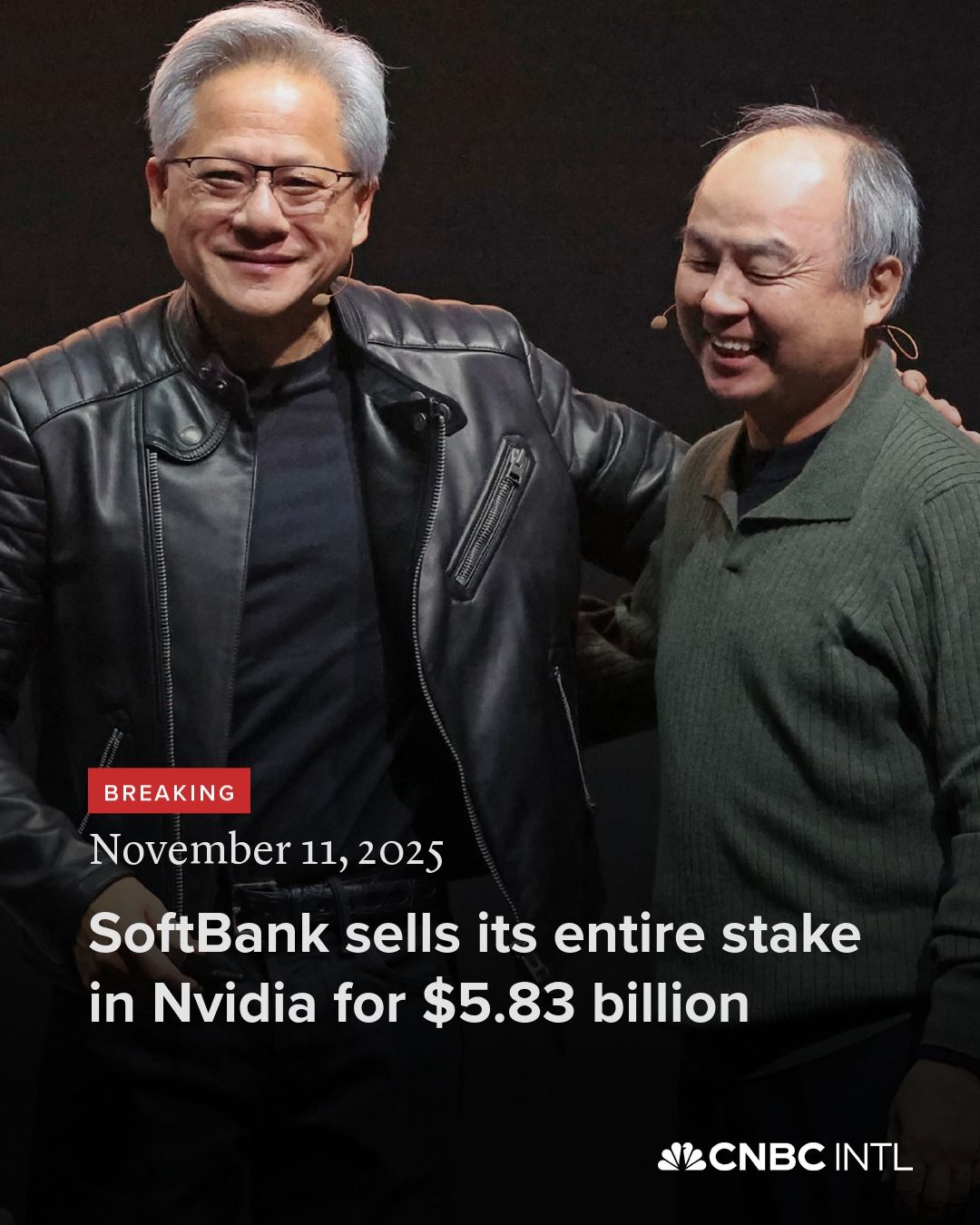
Two smiling senior executives stand on a dark stage, likely just after delivering a keynote speech. The man on the left is wearing glasses and a black leather jacket with microphones clipped to his lapels. Beside him stands another man in a green sweater, also smiling broadly with a microphone attached to his shoulder. Overlaid text reads "BREAKING" followed by the date "November 11, 2025," and a headline stating that "SoftBank sells its entire stake in Nvidia for $5.83 billion."
AI Context Explanation:
This image serves as satirical AI-generated content mocking the absurdity of hyper-lucrative deals in the tech industry. The humor is derived from the juxtaposition of two serious, smiling corporate leaders against a headline that invents a future merger (softbank selling to itself for billions in 2025) that defies economic logic. It highlights how algorithms and financial data are often used to craft headlines about impossible deals where companies sell assets they already own back for a fraction of their value.
detailed-analysis (gemma3_27b-it-q8_0)
Okay, let's analyze this image—specifically SoftBank's sale of its Nvidia stake—through the lens of Artificial Intelligence (AI) as the contextual category, incorporating the theoretical frameworks you've requested where relevant. Given the scope, this will be a comprehensive response.
Visual Description
The image depicts Masayoshi Son (founder of SoftBank) and Jensen Huang (CEO of Nvidia) in a seemingly joyful, even celebratory pose. Son is on the left, wearing a black leather jacket, beaming with a wide smile. Huang is to the right, in a more subdued grey jacket, also smiling. The background is dark and indistinct, placing the focus entirely on the two men. The superimposed text announces “Breaking: November 11, 2023 – SoftBank sells its entire stake in Nvidia for $5.83 billion”, along with the CNBC Intl logo. The overall impression is one of success and a positive outcome. The photograph's composition suggests camaraderie, possibly implying a mutually beneficial arrangement.
Foucauldian Genealogical Discourse Analysis
Within the context of AI, this event is deeply entwined with power dynamics and the creation of "truths" about technological progress. Michel Foucault’s genealogical method invites us to examine the historical construction of what counts as "intelligence" and the institutions that validate this construction.
- The Discourse of Innovation: The sale itself is a moment in a discourse of continuous innovation in AI. Nvidia, as a leading producer of GPUs, is central to the infrastructure of modern AI, particularly deep learning. SoftBank’s initial investment and subsequent exit can be seen as part of the narrative of capital flowing towards what is perceived as the next wave of transformative technology.
- Power/Knowledge: Nvidia’s GPUs have become not just tools for AI, but also the definition of what's possible. Their dominance shapes the field of research, and consequently, the "knowledge" produced about AI. SoftBank, by backing Nvidia early, participated in the consolidation of this power/knowledge regime. The sale signifies a shifting of power within this structure, or at least a re-allocation of capital.
- Genealogy of 'The Algorithm': The image indirectly points to the genealogy of “the algorithm” itself. AI algorithms require computational power, and Nvidia provides that. The sale is about controlling access to the means of algorithmic production, the very infrastructure of intelligence.
Critical Theory
Critical Theory, particularly the Frankfurt School's analysis of the "culture industry," is relevant here. The image participates in the construction of a narrative that obscures the underlying complexities and potential dangers of AI.
- Instrumental Reason: The focus on the monetary transaction ($5.83 billion) reinforces what Max Horkheimer and Theodor Adorno called "instrumental reason"—rationality focused solely on efficiency and profit. The potential social and ethical consequences of AI (job displacement, bias, surveillance, weaponization) are largely absent from this framing. The smiles and celebration obscure the fact that this sale might exacerbate existing inequalities.
- Commodification of Intelligence: The sale represents the further commodification of intelligence. AI is not simply a tool, but a force that is increasingly shaping our lives. By turning a stake in a key AI infrastructure company into a financial transaction, we see intelligence itself being treated as a financial asset.
- False Consciousness: The image, as presented by CNBC, might contribute to a "false consciousness"—a distorted understanding of the forces that shape our society. The public is presented with a story of financial success, but the broader implications for AI development, access, and societal impact are not critically examined.
Marxist Conflict Theory
From a Marxist perspective, this sale is a clear example of capital accumulation and the intensification of class struggle in the age of AI.
- Means of Production: Nvidia controls a crucial means of production in the AI landscape—the GPUs. SoftBank’s sale represents a transfer of control over this means of production.
- Bourgeoisie and Proletariat: The two men in the image represent the bourgeoisie—the class that owns the means of production. The vast majority of people who will be affected by AI’s development (workers whose jobs are automated, users whose data is exploited) are the proletariat. The sale doesn't benefit them directly.
- Surplus Value: The value generated by Nvidia's GPUs (the "surplus value") is being captured by the owners of capital. The sale itself is a manifestation of this extraction of surplus value. The widening gap between the wealth of these individuals and the economic precarity faced by many is a central concern.
- Technological Unemployment: As AI becomes more advanced, it threatens to displace workers across various industries. This sale, by further consolidating power in the hands of companies like Nvidia, could accelerate this process, leading to increased social unrest.
Postmodernism
Postmodern thought challenges grand narratives and emphasizes the instability of meaning. In this context, the image can be seen as a playful and ironic representation of the ambiguity surrounding AI’s future.
- Simulacra and Simulation: The celebration in the image might be a simulacrum—a copy without an original. It's a performance of success, divorced from any genuine social or ethical progress. AI itself can be seen as a form of simulation, creating realities that are increasingly difficult to distinguish from the "real."
- Deconstruction of "Innovation": Postmodern analysis would deconstruct the idea of “innovation” itself. What does it mean to "innovate" in AI? Who benefits from this innovation? The image doesn't provide answers; it simply presents a superficial representation of progress.
- Fragmentation of Meaning: The image fragments meaning. It only provides the bare facts of the sale, without providing any context on the larger implications of the action.
Important Considerations
- Context is King: These analyses are dependent on the broader context of AI development, the political economy of technology, and the specific history of SoftBank and Nvidia.
- Multiple Interpretations: The image is open to multiple interpretations. This analysis provides one possible framework for understanding its meaning within the context of AI.
I hope this detailed analysis fulfills your request. Let me know if you'd like me to elaborate on any particular aspect.
simple-description (llama3.2-vision_11b)
This meme is a play on the news that SoftBank's investment in AI-focused firm, AI-Firm, has been sold for $1 billion. The image is of two people, likely SoftBank's CEO, who are smiling and embracing each other. The text "SoftBank sells its entire stake in AI-Firm for $1 billion" is written in a bold, red font, emphasizing the significance of the news.