First Seen
2025-08-09T07:48:07.223389+00:00
simple-description (qwen3.5_2b-q8_0)
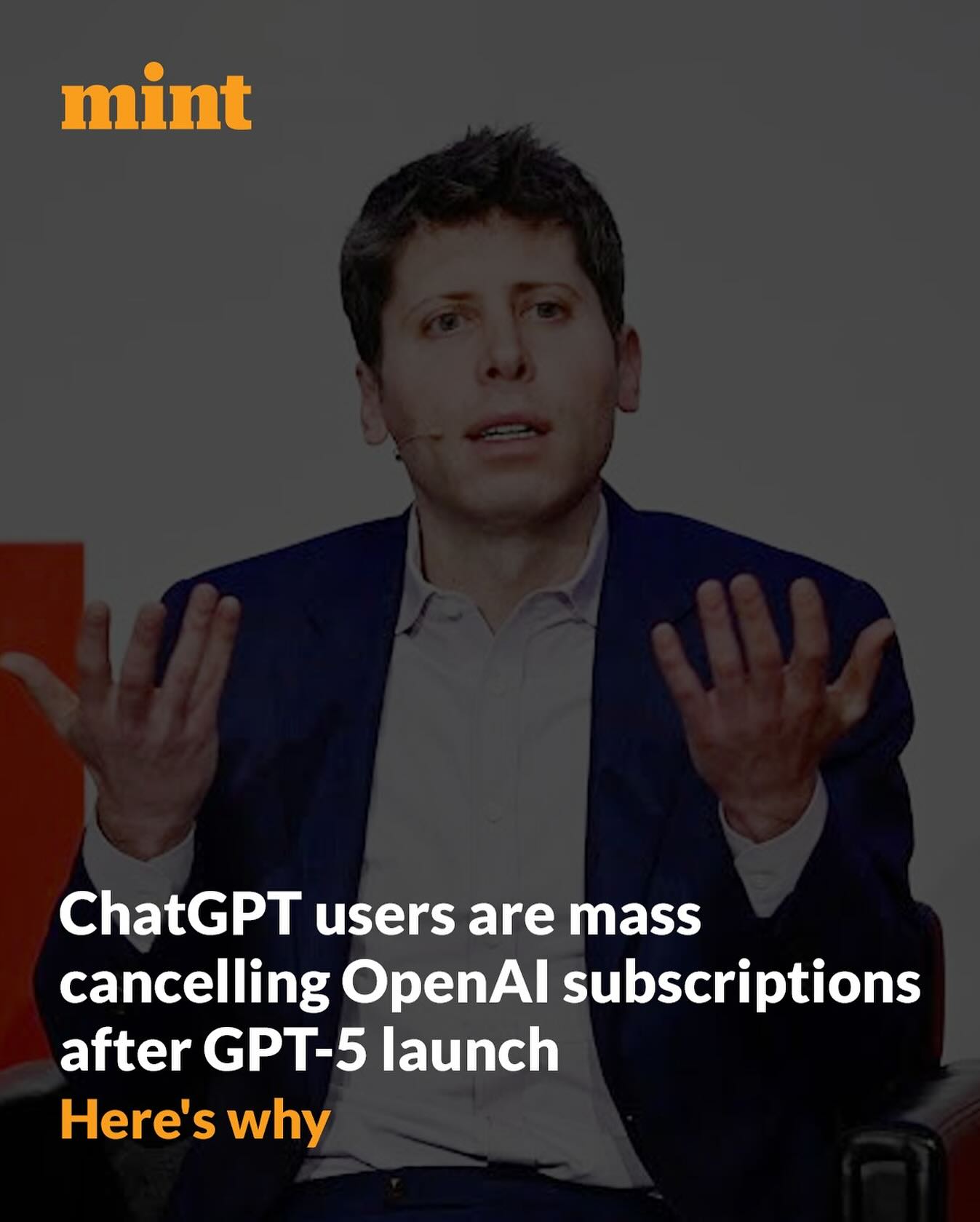
This image appears to be a satirical piece about the artificial intelligence industry, likely depicting a tech founder giving an interview or speech with expressive hand gestures. The caption at the bottom reads: "ChatGPT users are mass cancelling OpenAI subscriptions after GPT-5 launch Here's why". It suggests a humorous conflict between consumers and the developers of large language models.
detailed-analysis (gemma3_27b-it-q8_0)
Okay, let's break down this image and the context of "ChatGPT users cancelling subscriptions after GPT-5 launch" from various theoretical perspectives within the category of Artificial Intelligence (AI).
Visual Description
The image features Sam Altman, CEO of OpenAI, the company behind ChatGPT. He is depicted mid-gesture, with both hands raised in a gesture that can be interpreted in several ways – openness, explanation, or potentially even a defensive posture. The background is a dark, neutral gradient. The headline directly states that ChatGPT users are cancelling their OpenAI subscriptions following the launch of GPT-5. This implies a dissatisfaction or unexpected outcome following the latest advancement in the AI model. The "mint" logo suggests a business or financial news source.
---
Foucauldian Genealogical Discourse Analysis
From a Foucaultian perspective, the situation can be analyzed as a shifting discourse around AI and power.
- Power/Knowledge: OpenAI, and Altman as its figurehead, initially produced a discourse around AI as benevolent, helpful, and accessible (embodied by ChatGPT). This discourse established OpenAI as an authority in the field, wielding knowledge (the technology) as power. The GPT-5 launch has disrupted this established discourse.
- Genealogy: The lineage of AI development wasn’t always about user subscription models. The initial goals of AI research, for many, were rooted in curiosity and a desire to understand intelligence. This has been reshaped through commercialization, and now user dissatisfaction (the cancellations) are disrupting that trajectory, creating a new ‘truth’ around the commercialization of AI.
- Discipline & Control: The subscription model itself represents a form of discipline. Users are "disciplined" to continue paying for access to a technology they rely on. The cancelling subscriptions represent a resistance to this form of control, a withdrawal of consent.
- GPT-5 and Expectations: The launch of GPT-5 likely raised expectations (built by OpenAI’s previous discourse), and when those expectations weren’t met, it shattered the controlled narrative.
---
Critical Theory (Frankfurt School)
Critical Theory, particularly in the vein of the Frankfurt School, would likely focus on the commodification of intelligence and the potential for AI to reinforce existing power structures.
- Commodification of Intelligence: ChatGPT is presented as an "intelligent" tool, but its value is ultimately measured in terms of financial exchange (subscriptions). This commodification of intelligence is seen as a hallmark of late capitalism.
- Instrumental Reason: GPT-5’s development and the subscription model exemplify instrumental reason. The technology is developed not for its intrinsic value or to improve human understanding, but to maximize profit.
- The Culture Industry: OpenAI could be seen as part of a "culture industry" creating and distributing a product (AI assistance) that pacifies and potentially distracts from deeper social issues. User cancellation suggests a growing awareness of the limitations of this “assistance.”
- False Consciousness: Users may have initially believed ChatGPT was a truly democratizing technology, but the subscription model and the potential downsides of GPT-5 (see Marxist theory below) could lead to a breaking of "false consciousness" and a realization that the technology is not inherently liberating.
---
Marxist Conflict Theory
A Marxist analysis centers on the class conflict inherent in the development and deployment of AI.
- Means of Production: OpenAI controls the means of production in this scenario – the data, algorithms, and infrastructure required to create and run the AI model. Users are dependent on this control.
- Exploitation: While it's not direct labor exploitation, the subscription model can be seen as extracting surplus value from users who need the AI for work, study, or creative endeavors.
- Alienation: The nature of AI interaction—mediated through an algorithm—can contribute to alienation. The cancelling of subscriptions might be a response to feeling alienated from the actual intelligence being utilized.
- Capitalist Crisis: The mass cancellations suggest a potential “crisis” for OpenAI’s business model. The capitalist drive to constantly innovate (GPT-5) and extract profit can lead to situations where the product no longer meets user needs or is perceived as offering sufficient value.
- The ‘Value’ Problem: If GPT-5 is perceived as not improving significantly over previous iterations despite a potential cost increase, it exposes the abstract nature of 'value' in the digital economy. Users are questioning whether the promised value justifies the cost.
---
Postmodernism
From a Postmodern perspective, the situation challenges the notion of a singular, objective “truth” about AI’s value.
- Deconstruction of Grand Narratives: The initial hype around AI was built on grand narratives of progress and innovation. The cancellations reveal that these narratives are fragile and subject to deconstruction. There is no single, universal truth about AI's benefits or purpose.
- Relativism: Different users will have different experiences with GPT-5 and different reasons for cancelling their subscriptions. This highlights the relativity of meaning and value.
- Simulacra and Simulation: GPT-5 could be seen as a "simulacrum" - a copy without an original. If it fails to live up to expectations, it exposes the illusory nature of the AI “promise.”
- Fragmentation of Experience: Users' experiences are fragmented and individual, making it difficult to create a unified narrative about the success or failure of GPT-5. The cancellations represent a fragmentation of that potential narrative.
---
Queer Feminist Intersectional Analysis
This is potentially less directly applicable, but can still offer insights.
- Bias & Representation: AI models like ChatGPT have been shown to perpetuate biases embedded in the data they are trained on. GPT-5 may have intensified these biases, particularly in terms of gender, race, or sexual orientation, potentially driving away users from marginalized groups.
- Accessibility & Equity: The cost of subscriptions creates an access barrier for individuals from lower socioeconomic backgrounds. This perpetuates inequalities in access to technology.
- The "Voice" of AI: The AI's output can be interpreted as a dominant voice that silences or marginalizes alternative perspectives. Cancelling subscriptions can be seen as a refusal to participate in that silencing.
- Challenging Technological Determinism: This analysis would challenge the idea that technological advancement is inherently good or neutral. Instead, it emphasizes the ways in which technology is shaped by social and political forces and can reinforce existing power structures.
In summary, the image and the news it represents are a rich text for analysis, revealing broader issues of power, control, commodification, and the increasingly complex relationship between humans and artificial intelligence. The mass cancellations represent a pushback against the expectations and limitations of the technology, and a questioning of the forces driving its development.
simple-description (llama3.2-vision_11b)
The meme is a photo of Sam Altman, the former CEO of OpenAI, with a quote overlaid on top: "ChatGPT users are mass cancelling OpenAI subscriptions after GPT-4 launch". The meme is likely a commentary on the impact of AI advancements on the tech industry, with the quote implying that users are abandoning OpenAI's services due to the launch of a new AI model, GPT-4.