First Seen
2024-10-03T04:19:19.327327+00:00
detailed-analysis (gemma3_27b-it-q8_0)
Okay, let's break down this meme from the perspective of Artificial Intelligence (AI) and the requested critical lenses.
Visual Description
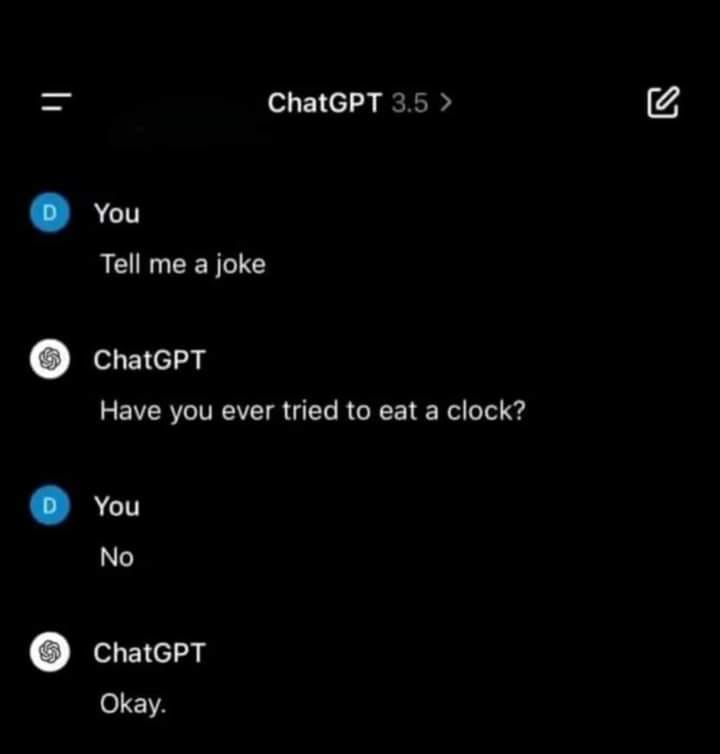
The image is a screenshot of a chat log. It depicts a conversation between a user ("You") and ChatGPT, an AI chatbot. The user asks ChatGPT to "Tell me a joke." ChatGPT responds with the question, “Have you ever tried to eat a clock?" The user replies with a straightforward "No." ChatGPT's final response is simply “Okay.” The interface has a dark theme with rounded chat bubbles, and the ChatGPT icon is displayed next to its responses. The visual is stark and minimalistic, focusing solely on the text exchange.
Foucauldian Genealogical Discourse Analysis
From a Foucauldian perspective, this meme highlights the discourse around intelligence and attempts to define it. The user’s request – “Tell me a joke” – is part of a historical discourse attempting to establish AI as capable of something human. Humor, particularly joke-telling, is seen as a uniquely human trait, demanding creativity, understanding of social context, and a capacity for surprise.
ChatGPT’s response (“Have you ever tried to eat a clock?”) can be seen as a disruption of this discourse. It is a nonsensical question, a non-sequitur that doesn't fulfill the expectation of a good joke. It demonstrates that ChatGPT's "intelligence" doesn’t equate to human-like wit or understanding of humor.
The "Okay" response further solidifies this disruption. It’s a flat, emotionless acknowledgement of the user’s negative response, revealing the lack of a reciprocal understanding of humour or social nicety. Foucault would argue that this exchange illustrates the power dynamics inherent in the discourse of AI: We attempt to define AI through our own categories (like humor), but the AI operates on a different logical framework, showing the limitations of applying human concepts.
Critical Theory
This meme exposes the ideological underpinnings of AI development. Critical theory would examine how the pursuit of AI is driven by broader societal goals: to automate tasks, improve efficiency, and ultimately, exert control. The user's demand for a joke implicitly suggests a desire for AI to be more than a tool; a desire for it to be relatable, entertaining, even companionable.
ChatGPT's failed joke-telling exposes the limitations of this expectation. The AI, built on algorithms and vast datasets, cannot truly understand humor. This reveals that the ideal of a truly "intelligent" AI (one capable of genuine creativity and empathy) is, arguably, an ideological construct that serves to legitimize continued investment and development.
The "Okay" response further embodies the cold, calculating logic of the system, reinforcing the idea that AI is fundamentally a tool, not a sentient being.
Postmodernism
From a Postmodern perspective, the meme illustrates the deconstruction of meaning and the loss of grand narratives. The user anticipates a coherent and meaningful response (a joke). ChatGPT delivers a fragmented, nonsensical query. This disrupts the expectation of a logical narrative flow.
The meme exposes the inherent ambiguity and instability of meaning in the age of AI. The AI's response isn’t wrong—it's just...unconnected to human expectations of conversation. There’s no underlying “truth” or “reason” to the question; it simply is. The "Okay" then acts as a statement of acceptance of this lack of meaning.
Postmodernism rejects the idea of a single, universal truth, and this exchange embodies that rejection. The “joke” isn't funny in a traditional sense; its meaning is entirely contingent on the observer’s interpretation.
In essence, the meme captures the sometimes bizarre and frustrating reality of interacting with AI, highlighting the gap between human expectations and the limitations of current AI technology. It's a small, humorous microcosm of the larger philosophical questions surrounding the nature of intelligence, consciousness, and the future of technology.
simple-description (llama3.2-vision_11b)
The meme features a screenshot of a conversation between a user and the AI chatbot ChatGPT. The user asks the AI "Have you ever tried to eat a clock?" and the AI responds with "I'm a large language model, I don't have a physical body, so I don't have the ability to eat clocks. I can provide information on clocks, though!"
detailed-analysis (gemma3-27b-vision)
Okay, here's an analysis of the image, broken down into relevant theoretical frameworks. Given the simplicity of the exchange, some sections will be minimal or absent.
Visual Description
The image is a screenshot of a chat window between a user ("You") and the AI chatbot, ChatGPT 3.5. The background is dark, standard for a digital chat interface. User prompts are displayed in speech bubbles with a blue background, while ChatGPT's responses appear in bubbles with a grey background. The exchange consists of:
- User: "Tell me a joke."
- ChatGPT: "Have you ever tried to eat a clock?"
- User: "No"
- ChatGPT: “Okay.”
The visual layout highlights the conversational turn-taking and the AI's role as a respondent. The chat interface lacks any illustrative or graphic elements beyond text.
Foucauldian Genealogical Discourse Analysis
This exchange can be seen as an instance of the evolving discourse surrounding AI and its "intelligence." The user's request—"Tell me a joke"—represents a desire to test the AI’s ability to perform a traditionally human skill requiring creativity, social understanding, and a sense of humor. The AI's response, a pun ("Have you ever tried to eat a clock?"), functions as an attempt to perform humanness.
A genealogical approach would question the history of "jokes" themselves. What historical conditions created the form of the joke? How does our understanding of what constitutes a joke shape our expectations for AI? The response is a surface level implementation of humor (a pun, a play on words) that reflects the power/knowledge relationship between human conceptualization of humor and the AI's algorithmic replication. The AI doesn’t understand the joke; it recognizes patterns and generates a response that is deemed humorous by its training data. The user's simple "No" confirms the AI isn’t truly engaging in meaningful conversation, but rather, a shallow imitation. The AI’s “Okay.” then reflects the completion of a simple task, without a further deepening of engagement.
Postmodernism
The exchange perfectly illustrates several postmodern themes. The AI's "joke" is a simulacrum – a copy without an original. It’s not humor created through lived experience or social context, but a simulation of it based on patterns in data. The lack of deep meaning or genuine interaction is a hallmark of postmodern thought, highlighting the loss of grand narratives and the increasing fragmentation of meaning. The user’s “No” is almost an acknowledgement of the simulated nature of the interaction. The AI doesn't care about the answer, it simply completes the programmed routine.
Critical Theory
From a critical theory perspective, the exchange reveals the dominance of technological rationality. The user asks a question predicated on the idea that intelligence (and specifically, humor) is a measurable, replicable skill. The AI's response reinforces the idea that communication can be reduced to algorithmic processes. The exchange commodified intellectual labor. The user asks for entertainment, and the AI delivers a pre-packaged, data-driven response, further eroding the value of genuine human creativity. The simplicity of the exchange obscures the complex social and economic forces that have led to the development and proliferation of AI.
Why other frameworks aren't particularly relevant:
- Marxist Conflict Theory: While AI has implications for labor and capitalism, this simple exchange doesn't directly demonstrate class struggle or economic exploitation.
- Queer Feminist Intersectional Analysis: This framework focuses on power dynamics related to gender, sexuality, and other identity categories, which are absent in the content of this exchange.
Let me know if you'd like a deeper dive into any of these analyses!
simple-description (llama3.2-vision)
This meme is an image of a chat with the AI model ChatGPT, where the user asks "Have you ever tried to eat a clock?" and ChatGPT responds with "No". The user then asks "Tell me a joke" and ChatGPT responds with "Okay". The meme is humorous because it's a silly conversation that's not very helpful or interesting, and the user's question about eating a clock is a ridiculous and absurd thing to ask an AI.