First Seen
2024-02-22T04:47:26.140851+00:00
simple-description (llama3.2-vision_11b)
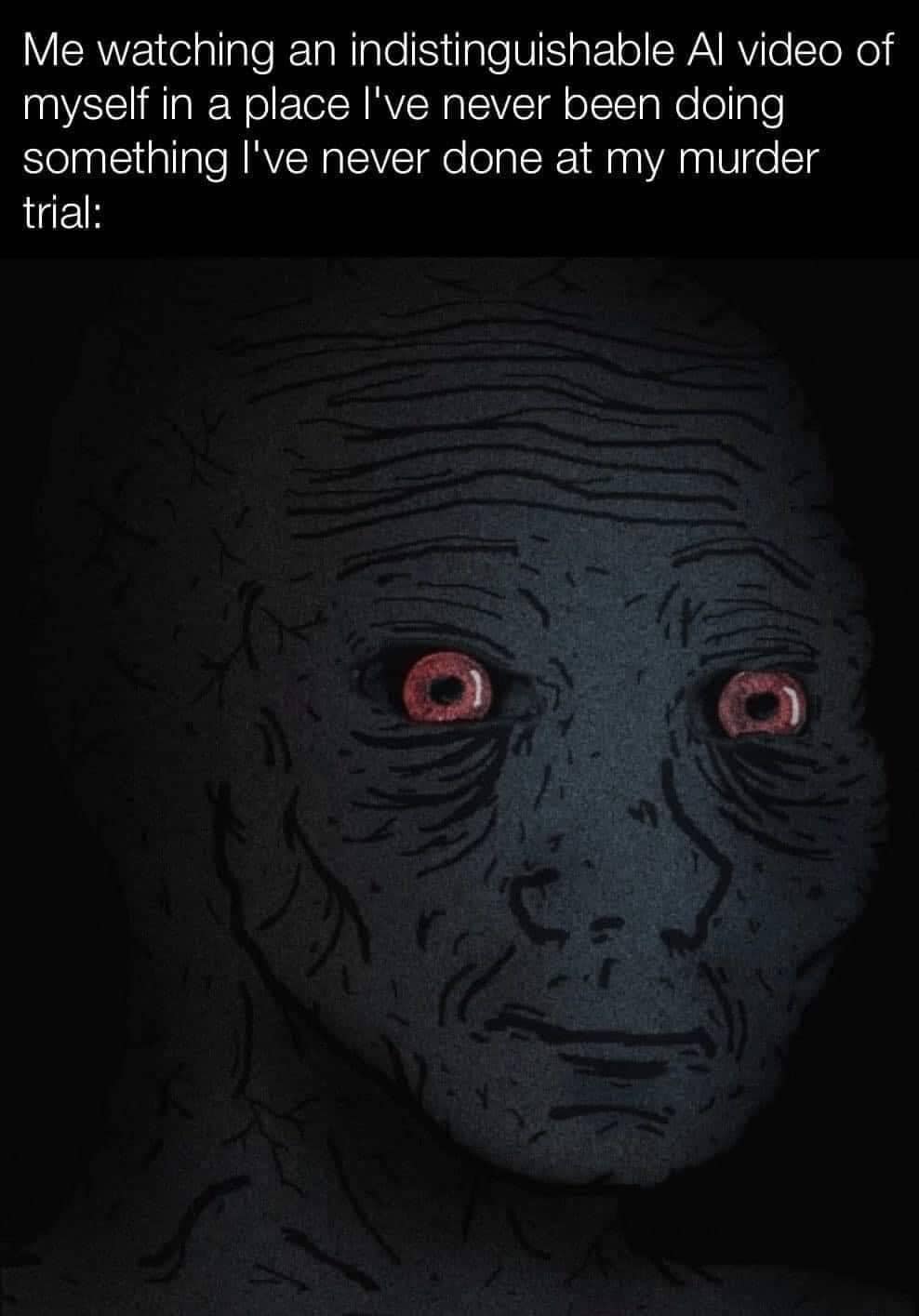
The meme is a humorous take on the concept of artificial intelligence (AI) surpassing human intelligence. The image is a play on the idea of a person watching an AI-generated video of themselves, but with a dark and unsettling twist. The text "I just watched an AI video of myself and I'm not sure if it's me or my dark twin" is a commentary on the uncanny valley of AI-generated content, where the AI's attempt to replicate human-like behavior can be unsettling and even disturbing.
detailed-analysis (gemma3-27b-vision)
Okay, here's an analysis of the image, broken down into the requested theoretical frameworks. Given the specific imagery and caption, some frameworks will be more relevant than others.
Visual Description
The image is a tightly cropped, highly stylized portrait of a face in extreme darkness. The primary features are intensely red, glowing eyes set within deep-set sockets. The face itself is largely obscured by shadow, but textured with what appears to be rough, almost bark-like lines and wrinkles, suggesting age, decay, or perhaps a monstrous quality. There is a suggestion of a smile, however it looks unsettling. The overall aesthetic is nightmarish and unsettling, leaning heavily into horror tropes. The lack of context besides the eyes and minimal facial features is key to its impact. The composition emphasizes the gaze, creating a sense of being watched or confronted.
Foucauldian Genealogical Discourse Analysis
This image, combined with the caption "Me watching an AI video of myself doing something I’ve never done at my trial," is incredibly fertile ground for Foucauldian analysis.
Power/Knowledge: The situation described – watching an AI recreation of oneself doing something never done – illustrates the growing power of surveillance technologies and algorithmic truth. The “AI video” becomes evidence, a form of knowledge accepted by the legal system (the trial). This knowledge isn't necessarily true*—it's a constructed simulation—but it wields power in the courtroom.
Discipline and Panopticism: The trial itself is a disciplinary institution. The AI video acts as a modern version of the panopticon: even if the subject doesn’t know how the AI created the simulation, the possibility* of being watched and reconstructed into evidence creates a self-regulating effect.
* Genealogy of the Self: The image and caption suggest a fragmentation of the self. The subject is confronted with a digital double, an AI recreation. This challenges the notion of a coherent, stable self. The genealogy of the “self” becomes fractured—what constitutes “me” when an AI can fabricate actions in my name? What is the origin of the 'self' when it can be reconstituted by technology?
Discourse and Truth: The caption highlights how discourse shapes "truth". The AI video isn't necessarily true, but the fact it is presented* as evidence within the discourse of the trial lends it an air of legitimacy. It's a constructed "reality" that becomes intertwined with legal judgments.
Critical Theory
This image and caption resonate deeply with themes explored by the Frankfurt School’s Critical Theory.
Commodification of the Self: The AI video represents the ultimate commodification of the self. Our actions, identities, and even potential* actions can be digitized, processed, and used against us. The subject is reduced to data, a resource to be manipulated by the legal system.
* Loss of Authenticity: The AI recreation undermines the concept of authenticity. If an AI can convincingly fabricate actions, how can one be sure of anyone's (or one's own) genuine behavior? The image evokes a sense of existential unease and the erosion of trust.
* Instrumental Reason: The legal system's acceptance of the AI video as evidence demonstrates the dominance of instrumental reason. The focus is on efficiency and “proof”, rather than ethical considerations or the potential for manipulation.
Postmodernism
The image and caption are strongly aligned with postmodern sensibilities.
* Simulation & Hyperreality: The AI video is a prime example of simulation. It’s a copy without an original, a representation that may obscure or replace the "real" event. This contributes to a sense of hyperreality, where the line between reality and simulation becomes blurred.
* Deconstruction of Identity: The image questions the notion of a stable, unified self. The AI double disrupts the idea of a consistent identity. The caption implies a loss of control over one's own narrative.
* Loss of Grand Narratives: The situation rejects traditional "truth" claims within the legal system. The emphasis on an AI-generated "reality" disrupts the legal system's reliance on objective truth and traditional modes of evidence.
In conclusion:
The image and caption present a chillingly relevant commentary on the anxieties of the digital age. It speaks to the erosion of privacy, the commodification of identity, and the challenges of establishing truth in a world increasingly mediated by technology. The combination of visual horror and conceptual weight makes it a powerful statement about the future of surveillance, justice, and the self.
tesseract-ocr
Me watching an indistinguishable Al video of myself in a place I've never been doing something I've never done at my murder tree ‘aol °
simple-description (llama3.2-vision)
This meme is a humorous take on the concept of AI-generated videos. The image features a creepy, old, and worn-out face with a caption that reads: "Me watching an AI-generated video of myself in a place I've never been doing something I've never done." The text is a tongue-in-cheek commentary on the idea of AI technology being able to create realistic, but unsettling, simulations of oneself.