First Seen
2026-04-02T05:28:14+00:00
simple-description (qwen3.5_2b-q8_0)
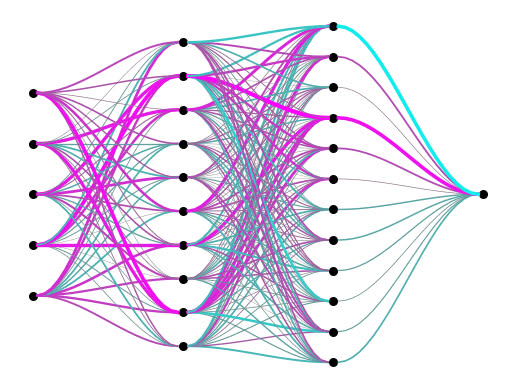
This image is a visualization of a neural network, which serves as a primary architectural component for Artificial Intelligence systems. It illustrates how data moves through interconnected layers (represented by the connecting lines), where artificial "brains" process information and make predictions, ultimately transforming input signals into a final output based on learned patterns.
detailed-analysis (gemma3_27b-it-q8_0)
Okay, let's break down this image, which is a visualization often found in discussions surrounding artificial intelligence, through several theoretical lenses.
Visual Description
The image depicts a complex network of interconnected nodes (black circles) and connections (curved lines, colored turquoise and magenta). It resembles a heavily connected artificial neural network (ANN). There’s a distinct, visible difference between the connections. The lines are very densely packed and overlapping in the central region, giving a sense of chaotic complexity. The arrangement suggests layers: a series of nodes on the left, a densely interconnected middle layer, and a smaller set of nodes on the right. This is very typical of the architecture of a deep neural network. The differing colors of the lines may represent different weights or pathways of information flow through the network. It is a clear visual metaphor for the 'black box' nature of many AI systems, showing complexity but not necessarily understanding.
Foucauldian Genealogical Discourse Analysis
From a Foucauldian perspective, the image can be seen as a visualization of the emerging discourse of Artificial Intelligence itself. The densely interconnected network represents the power/knowledge regime that's forming around AI.
- Power/Knowledge: The image highlights how "AI" isn't a neutral technology. It’s interwoven with power relations. The development, deployment, and understanding of AI are deeply tied to who controls the data, the algorithms, and the narratives surrounding it. The complexity of the network, while impressive, obscures its power dynamics. Who decides which connections are strengthened or weakened? Who benefits from the resulting outputs?
- Genealogy: The image can be analyzed genealogically by tracing the historical roots of neural networks—from early ideas about the brain to the computational advancements that made them possible. The image doesn't show the history of the ideas, but it captures the culmination of that history in a very modern form. It raises questions about what values and biases were embedded in the early stages of development that are now manifesting in these complex systems.
- Discipline/Normalization: The very act of trying to understand this network and optimize it contributes to a disciplinary process. We are compelled to rationalize and normalize AI, to fit it within existing frameworks of understanding, even when its complexity resists such categorization.
Critical Theory
The image lends itself well to a Critical Theory analysis, particularly around the concept of instrumental reason and the potential for technological domination.
- Instrumental Reason (Horkheimer & Adorno): The network is a prime example of instrumental reason – reason directed towards efficiency, control, and prediction. The focus is on how it works (information processing), rather than why it’s being built or what its ethical implications might be. This can lead to a reduction of human experience and values to quantifiable data points.
- Technological Rationality: The complexity of the network obscures the fact that it is still governed by a set of pre-defined rules (the algorithm). This creates an illusion of autonomy, while the system is still operating within a rationalized, controlled framework.
- The Black Box Problem: The visual representation of a dense network perfectly illustrates the “black box” problem in AI. It is difficult to understand the reasoning behind its decisions. This opaqueness limits accountability and trust, while further entrenching the power of those who build and control the system.
Postmodernism
From a postmodernist perspective, the image embodies a rejection of grand narratives and a celebration of complexity.
- Deconstruction: The image can be “deconstructed” to reveal the unstable foundation of the concept of "intelligence" itself. The network mimics the brain, but is it truly intelligent? What does “intelligence” even mean in this context? The image highlights the arbitrary nature of categorization and meaning.
- Simulation & Hyperreality (Baudrillard): The network is a simulation of intelligence, a hyperreal representation that may come to replace the “real” thing. We increasingly interact with systems like these, leading to a blurring of boundaries between the real and the simulated.
- Fragmented Knowledge: The image suggests that knowledge is not unified, but fragmented and dispersed throughout the network. There is no single, overarching truth, but rather a multitude of connections and perspectives.
In Summary
The image of the neural network is not just a technical diagram. It's a visual metaphor for the complex social, political, and philosophical issues surrounding AI. It encapsulates concerns about power, control, rationality, the nature of knowledge, and the erosion of traditional boundaries between the human and the technological. Its visual complexity mirrors the difficulty of grappling with the ethical and societal implications of increasingly powerful AI systems.
Disclaimer: The interpretations offered above are not exhaustive, and different theorists might offer different readings. The image is open to multiple interpretations, depending on the theoretical framework employed.
simple-description (llama3.2-vision_11b)
The meme is a visual representation of a neural network, specifically a neural network graph. It shows a web-like structure with nodes and connections, symbolizing the interplay of nodes and their relationships in a neural network. The meme is likely used to represent the complex, interconnected nature of AI systems.