First Seen
2025-10-27T14:39:19+00:00
simple-description (qwen3.5_2b-q8_0)
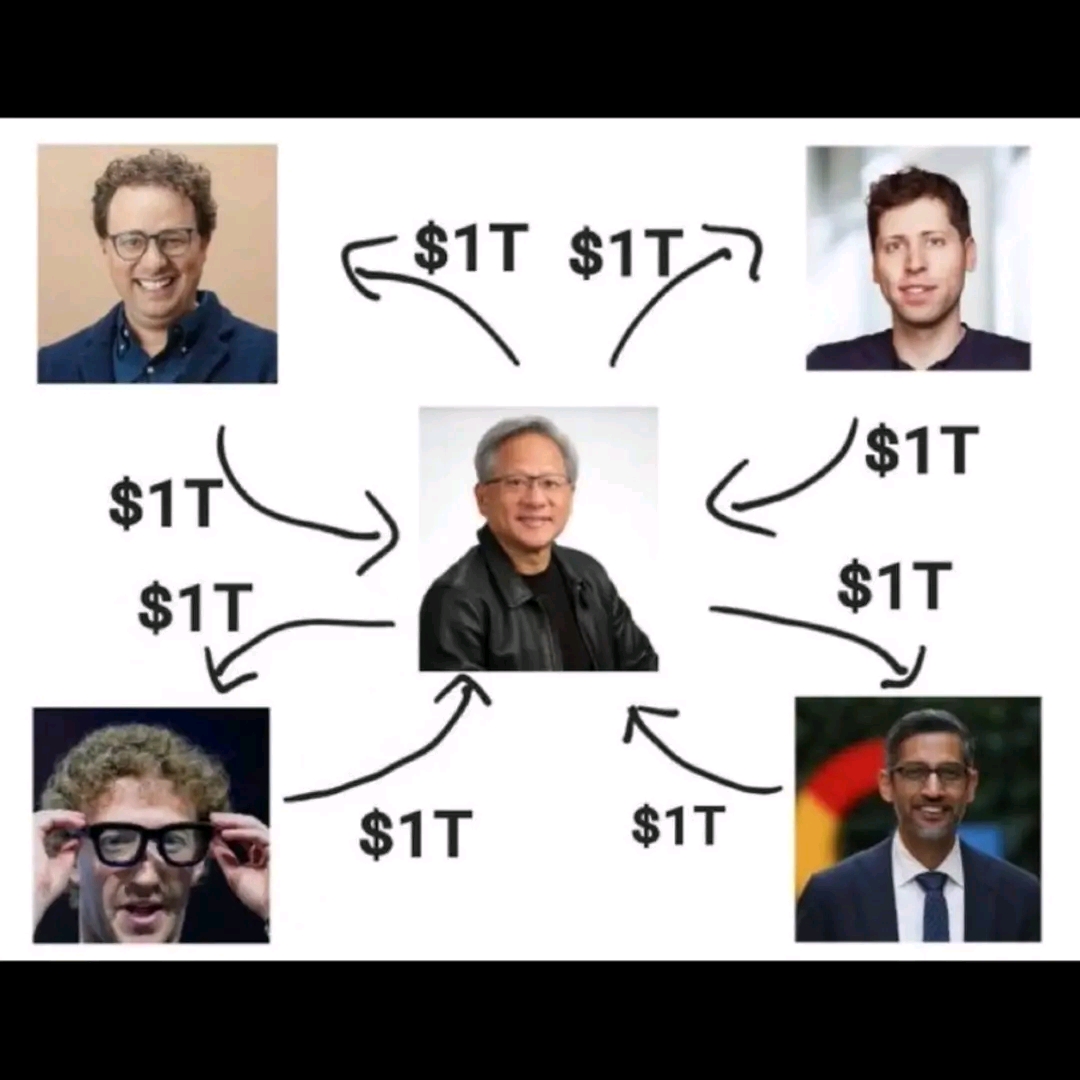
This meme humorously satirizes the idea that influential technology executives and investors are pouring trillions of dollars into NVIDIA, a pivotal player in the artificial intelligence market. The "$1T" text labels suggest these figures—likely including Sam Altman, Mark Zuckerberg, and Grigore Roşca—are allegedly funding this chip giant with massive sums, often jokingly exaggerated to imply their financial power or potential returns on AI infrastructure investments. In this context, it reflects the intense bet tech giants are making on NVIDIA's GPU architecture to dominate future computing trends and hardware ecosystems.
detailed-analysis (gemma3_27b-it-q8_0)
Okay, let's break down this meme from the perspective of Artificial Intelligence, using the provided framework of theoretical lenses. It's a complex image, so a multi-layered analysis is appropriate.
Visual Description
The image depicts a network of prominent figures within the AI landscape, centrally positioned is Geoffrey Hinton, a pioneer in deep learning. Surrounding him are images of Sam Altman (OpenAI), Mark Zuckerberg (Meta), Sundar Pichai (Google), and Ilya Sutskever (OpenAI). Each connection to Hinton is labeled with "$1T," suggesting massive financial stakes or investment involved with each. The layout implies a hub-and-spoke model, with Hinton as the core innovator whose work has enabled or influenced the advancements and investments associated with each of the other figures. The arrows indicate flow or influence from Hinton to these individuals and their respective companies. The images are portraits, mostly headshots, giving the impression of authority or leadership.
---
Foucauldian Genealogical Discourse Analysis
This meme is deeply embedded in a discourse of power, knowledge, and technology. Michel Foucault's work allows us to trace the genealogy of how AI has come to be structured as a field dominated by a select few.
- Discourse of Innovation & Progress: The “$1T” labels are not simply about money; they represent a discourse around exponential technological progress, the “next big thing”, and the allure of transformative potential. This discourse shapes funding, research priorities, and public perception.
- Power/Knowledge: Hinton, in the center, exemplifies the power/knowledge nexus. His intellectual work (deep learning) has become inextricably linked to significant economic power. The others aren’t just benefitting from the knowledge, they’re also actively shaping its development through commercial application and deployment.
- Biopower & Data: AI is fundamentally about the processing of data, and data is intimately tied to human lives, behaviors, and bodies. The figures in the meme control or have access to immense amounts of data, effectively wielding a form of "biopower" – the ability to regulate and influence life itself through technological means.
- Genealogy of AI Leadership: Tracing the lineage of these individuals reveals a network often originating in elite universities, primarily in the United States. This shows how knowledge production is concentrated in specific institutional and geographical contexts.
---
Critical Theory
From a Critical Theory perspective (drawing on thinkers like Adorno and Horkheimer), the meme represents the instrumentalization of reason.
- The Enlightenment Project & Its Discontents: AI is often presented as the ultimate fulfillment of the Enlightenment's project – using reason to solve problems and improve human life. However, the meme reveals that this "reason" is not neutral; it’s heavily mediated by capitalist interests.
- The Culture Industry: These individuals aren’t simply developing technology; they are shaping a “culture industry” that increasingly relies on AI for everything from entertainment to social interaction. This industry commodifies attention, reinforces existing power structures, and potentially stifles critical thinking.
- Domination & Control: The concentration of power in the hands of a few (Hinton and his "spokes") raises concerns about the potential for AI to be used for social control and domination. The "$1T" is a symbol of this concentrated power.
- Loss of Autonomy: The pervasive influence of AI, driven by these figures, can lead to a loss of individual autonomy and critical thinking as algorithms increasingly mediate our experiences.
---
Marxist Conflict Theory
Applying a Marxist lens, the meme highlights the class struggle inherent in the development and deployment of AI.
- Means of Production & Capital: The figures represent the owners of the "means of production" in the AI space – the algorithms, data, infrastructure, and intellectual property. The "$1T" represents accumulated capital derived from this control.
- Labor Exploitation: The development of AI relies on significant (often invisible) labor – from data labeling and annotation to the engineering and maintenance of complex systems. This labor is often precarious, poorly compensated, and outsourced to developing countries.
- Alienation: The control of AI by a small elite exacerbates the alienation of workers from the products of their labor. AI-driven automation threatens jobs and further concentrates wealth in the hands of the capitalist class.
- Class Struggle: The meme implicitly raises questions about who benefits from AI and who bears the costs. The distribution of wealth and power embodied by the "$1T" labels is inherently unequal and fuels class conflict.
---
Postmodernism
A postmodern reading might focus on the deconstruction of narratives surrounding AI.
- Meta-Narratives & Technological Determinism: The idea that AI is a neutral, progressive force ("inevitable") is a meta-narrative that the meme challenges. By highlighting the economic and personal interests at play, it undermines the notion of technological determinism – the idea that technology dictates social outcomes.
- Simulacra & Simulation: AI-generated content and virtual realities increasingly blur the lines between the real and the simulated. These figures are at the forefront of creating these simulacra, raising questions about authenticity, identity, and the nature of reality.
- Decentering the Subject: AI challenges the traditional notion of the human subject as autonomous and rational. Algorithms make decisions, shape our preferences, and even influence our beliefs, potentially decentering the human subject.
- Fragmentation & Pluralism: Postmodernism recognizes the multiplicity of perspectives and the breakdown of grand theories. The meme itself can be seen as a fragmented representation of a complex field, resisting any single, coherent interpretation.
---
Queer Feminist Intersectional Analysis
This is perhaps the most challenging lens to apply directly, but important.
- Algorithmic Bias & Exclusion: AI systems are trained on data that often reflects existing social biases. This can lead to discriminatory outcomes for marginalized groups, particularly those based on gender, race, sexual orientation, and other intersecting identities. These figures have a responsibility to address these biases, but are incentivized to ignore them for profit.
- Representation & Power: The lack of diversity among the leaders in AI is a significant issue. The meme's focus on a predominantly white, male group reinforces the existing power structures within the field.
- Data Colonialism & Exploitation: The extraction of data from marginalized communities (often without informed consent) to train AI systems can be seen as a form of data colonialism. This mirrors historical patterns of exploitation and oppression.
- Challenging Normative Assumptions: Queer feminist theory encourages us to challenge normative assumptions about technology, rationality, and progress. The meme serves as a reminder that AI is not a neutral force, but a tool that can be used to reinforce or challenge existing inequalities.
In conclusion: This meme is a powerful visual metaphor for the current state of AI – a field driven by immense economic stakes and dominated by a small group of influential figures. It invites a critical examination of the power dynamics, ethical implications, and social consequences of this rapidly evolving technology. Each theoretical framework offers unique insights into how to understand and address the challenges posed by AI.
simple-description (llama3.2-vision_11b)
The meme is a visual representation of a "dumb" AI model's attempt to generate a list of "top" tech industry leaders. The image shows a central image of a man with multiple images of other men surrounding him, all with dollar signs and "1T" (one trillion) symbols. The text "1T" is repeated multiple times, implying that these individuals are worth one trillion dollars. The meme is likely poking fun at the idea that AI models can generate absurdly high valuations for individuals, highlighting the potential for AI-generated "top" lists to be utterly ridiculous.