First Seen
2025-10-09T12:42:23+00:00
simple-description (qwen3.5_2b-q8_0)
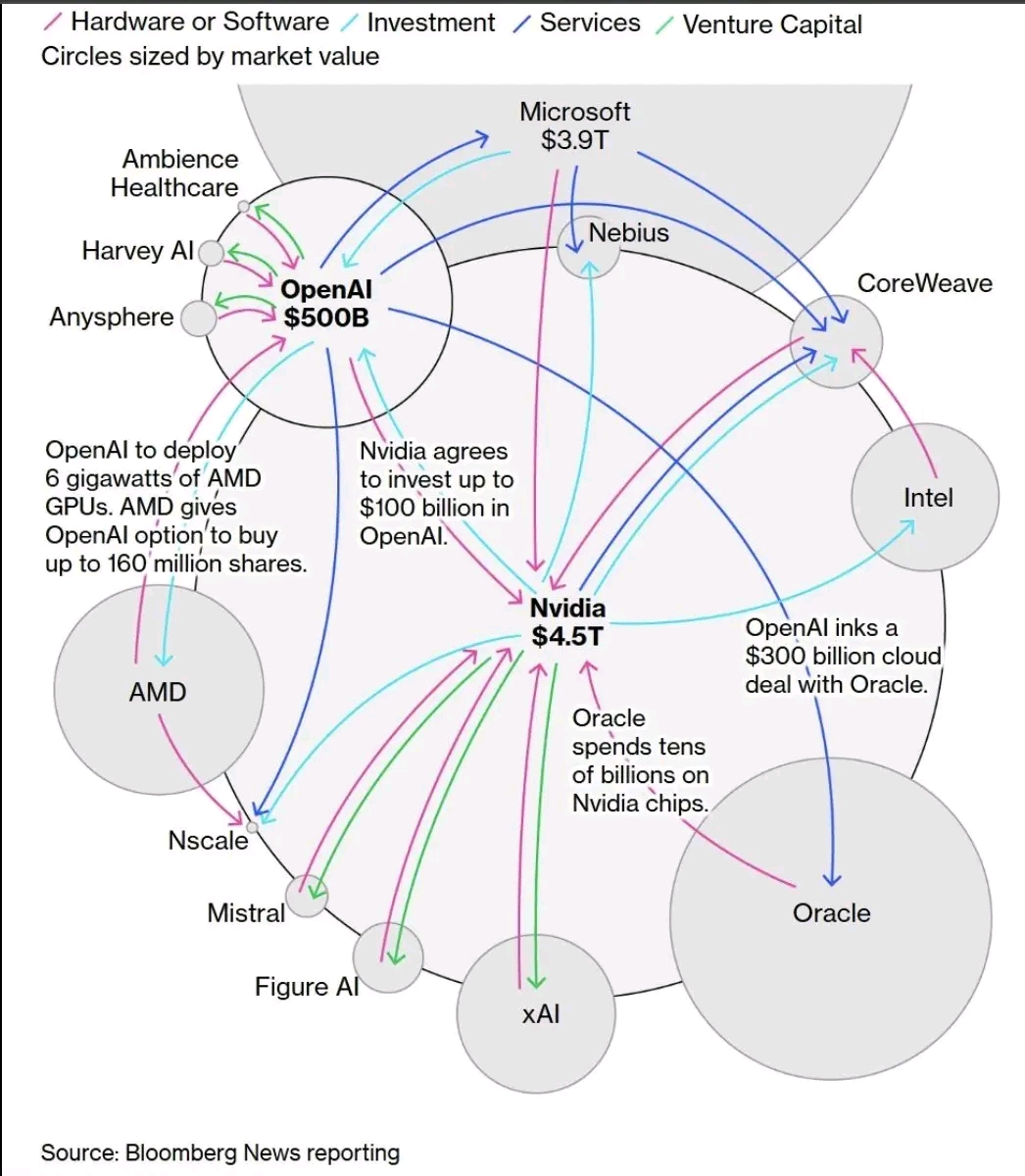
Acting as a chaotic infographic trying to explain how Artificial Intelligence has become so profitable that it involves massive financial deals between major tech firms. It uses text like "$500B" and "$4.5T" to describe the value of OpenAI and Nvidia, attempting to show billions in funding flowing from companies like Oracle and Microsoft into startups such as CoreWeave.
detailed-analysis (gemma3_27b-it-q8_0)
Okay, let's break down this Bloomberg News graphic representing the AI ecosystem, applying several theoretical lenses as requested. It's a very dense visual, so we'll go section by section. I'll only include the sections that are meaningfully applicable, as not every framework is going to be a perfect fit.
Visual Description
The image depicts a network of companies involved in the Artificial Intelligence landscape. The companies are represented by circles, with size corresponding to market value. Nvidia dominates, represented by a vastly larger circle ($4.5T) than any other, followed by Microsoft ($3.9T). OpenAI ($500B) is prominent, but significantly smaller. Arrows of varying colors (red, purple, blue, green) connect these companies, indicating financial relationships – investments, deals, and supply chains. The graphic is a visual articulation of how capital and data flows within the AI space. Key relationships highlighted include Nvidia's potential $100B investment into OpenAI, Oracle spending heavily on Nvidia chips, and OpenAI's significant cloud deal with Microsoft, Oracle, and AMD’s involvement with OpenAI through GPU deployment and stock options. The "xAI" circle, a relatively small player, is located at the bottom, implying a less central role, or a nascent one. Overall the graphic is not hierarchical, but a tangled web of connections.
Foucauldian Genealogical Discourse Analysis
This graphic is a perfect target for a Foucauldian analysis. Michel Foucault focused on how power operates not as a top-down repression, but through discourses—systems of thought, language, and practice that shape our understanding of the world. Here’s how it applies:
- The Discourse of “Innovation” & “Growth”: The image itself is a production of a discourse of endless technological innovation and capitalist growth. The constant emphasis on market value, investment, and deals normalizes the idea that progress is measured in financial terms. "AI" is framed, not as a potential societal transformation, but as an investment opportunity.
- Discipline and Normalization: The standardization of visual representation – companies as circles, size as market cap, arrows as flows – creates a regime of truth. This presentation disciplines how we see the AI landscape. It implies that success is quantifiable through economic metrics, normalizing that value system.
- Power/Knowledge: The graphic’s creator (Bloomberg) wields power through the selection and presentation of data. They know what metrics are important (market cap), know what relationships to highlight, and thus shape our understanding of AI's power dynamics. This isn’t necessarily malicious, but demonstrates how knowledge is inextricably linked to power.
- Genealogy of “AI”: Tracing the historical development of the term "AI" shows it's been constantly reshaped to fit economic needs. Originally a research field concerned with replicating intelligence, it's now largely synonymous with large language models and commercially-driven applications, the graphic shows.
Marxist Conflict Theory
A Marxist perspective immediately highlights the inherent class struggle embedded within this network.
- Capital Accumulation: The graphic is a representation of capital accumulation, with Nvidia as the most prominent accumulator. The immense wealth concentrated in Nvidia and Microsoft (and to a lesser extent Oracle) represents the concentration of capital in the hands of a few.
- Means of Production: Nvidia controls a key "means of production" in the AI era – the GPUs. This gives them significant power over who can participate in, and profit from, AI development. The reliance of other companies (like OpenAI, Oracle) on Nvidia’s chips represents their economic dependence.
- Exploitation: While the graphic doesn't directly show labor relations, it’s important to remember the labor involved in producing these chips, developing the algorithms, and maintaining the infrastructure. This labor is often hidden, and potentially exploitative. The focus on financial flows obscures the human cost of AI.
- False Consciousness: The discourse of "innovation" can function as a form of “false consciousness,” obscuring the underlying power imbalances and the exploitative nature of the system.
- Concentration of Power: The graphic visually demonstrates the increasing concentration of power in the hands of a small number of corporations.
Postmodernism
Postmodernism deals with the breakdown of grand narratives, the rejection of objective truth, and the emphasis on subjectivity and fragmentation. The graphic somewhat resonates with this:
- Deconstruction of a "Unified" AI: The graphic doesn’t present a single, coherent vision of AI. It's a messy, fragmented network. There isn't a grand narrative of AI progress—just a series of interconnected transactions.
- Simulation & Hyperreality: The emphasis on market value and financial flows can be seen as a kind of simulation—a representation of value that is increasingly detached from material reality. The graphic itself is a simulation of the AI landscape.
- Emphasis on Relations: The image emphasizes relationships between entities rather than inherent qualities. This aligns with the postmodern idea that meaning is constructed through difference and relation.
In Summary
This Bloomberg News graphic is a powerful visual depiction of the AI ecosystem, but it’s far more than just a neutral portrayal of market dynamics. It's a product of specific discourses, a site of capital accumulation and potential exploitation, and a representation of a fragmented, increasingly simulated reality. Analyzing it through the frameworks of Foucault, Marx, and postmodernism reveals the complex power relations and underlying ideologies that shape this transformative technology.
simple-description (llama3.2-vision_11b)
The meme is a humorous representation of the complex web of connections between various companies and their AI-related investments. The image shows a network of interconnected circles, each representing a company or entity, with lines connecting them to indicate their relationships and investments in the AI industry. The text in the image reads: "The AI industry is a web of relationships and investments, where everyone is connected and everyone is a ... " followed by a series of dots, implying that the connections between companies and their investments in the AI industry are so complex and interconnected that they are all connected and every company is a ... " dot".