First Seen
2026-03-29T20:05:37+00:00
simple-description (qwen3.5_2b-q8_0)
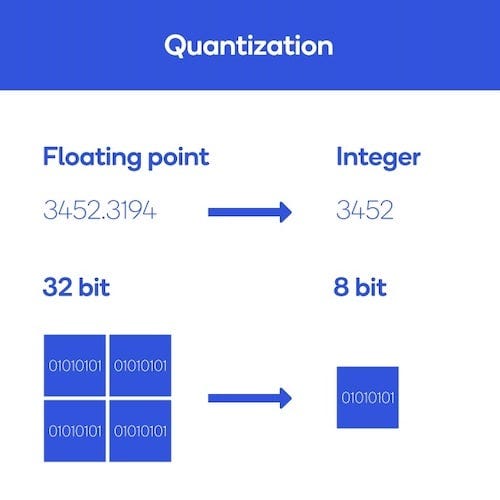
This infographic explains quantization, a fundamental technique in Artificial Intelligence used to improve processing speed and efficiency. It illustrates how systems convert complex numbers—like a precise floating-point value of 3452.3194—down into simpler integers (3452). The visual also depicts how massive blocks of binary code are compressed into tiny bits, representing the efficient compression machine learning models use to handle vast datasets.
detailed-analysis (gemma3_27b-it-q8_0)
Okay, let's break down this meme about "Quantization" through the lens of Artificial Intelligence and relevant critical theory frameworks.
Visual Description
The image visually illustrates the concept of quantization in data representation. It shows two transformations:
- Numeric Reduction: A floating-point number (3452.3194) is converted to an integer (3452). This results in the loss of the decimal part.
- Bit Representation Reduction: A 32-bit data representation (four separate blocks containing "01010101") is reduced to an 8-bit representation (one block containing "01010101"). This suggests a decrease in precision.
The overarching theme is moving from a more detailed, higher-precision representation to a simpler, lower-precision one. It's depicted with arrows indicating a process of simplification.
AI Context
In AI, especially Machine Learning, quantization is a model optimization technique. Large AI models, particularly deep neural networks, are computationally expensive. They require significant memory and processing power to run. Quantization addresses this by:
- Reducing Model Size: Using fewer bits to represent the model’s parameters (weights and activations) means a smaller overall model.
- Improving Inference Speed: Lower precision arithmetic is generally faster than higher precision arithmetic.
- Lowering Energy Consumption: Smaller models and faster calculations translate to less energy needed for deployment (crucial for edge devices like smartphones).
The trade-off, however, is potential loss of accuracy. By reducing the number of bits, we're simplifying the model's representation of the world, leading to a possible decrease in its ability to generalize and make accurate predictions. The degree of accuracy loss depends on the quantization method and how careful the optimization is performed.
Foucauldian Genealogical Discourse Analysis
Michel Foucault’s work focuses on how power operates through discourses – systems of thought, language, and practice that shape our understanding of the world.
In the context of AI quantization, we can see a discourse of efficiency and practicality dominating. The push for quantization isn't simply about technical improvement; it’s about making AI deployable and accessible. This shapes the field's priorities.
- Normalization: The idea that high precision is the "normal" state is challenged. Quantization normalizes lower precision as a viable and often preferable option.
- Power/Knowledge: The developers and researchers who champion quantization gain power by defining what constitutes "good enough" performance. They control the discourse on acceptable loss of accuracy in exchange for gains in efficiency.
- Genealogy: We can trace the genealogy of this discourse from earlier trends in computer science like data compression, resource constraints, and the imperative to reduce computational costs. It’s not a sudden invention but a development tied to historical forces.
The meme's representation reinforces this discourse, showing a clear trajectory toward the "rationalized" simplicity of lower precision as the preferred outcome.
Critical Theory
Critical theory examines how power structures and societal norms influence knowledge and technology.
Quantization, through a critical lens, can be seen as:
- A form of reductionism: By simplifying the representation of data, we inherently reduce the complexity of the phenomena the AI models are attempting to understand. This can reinforce existing biases and limit the AI’s ability to capture nuanced realities.
- An expression of economic constraints: The drive for efficiency is often driven by economic concerns (reducing infrastructure costs, making AI commercially viable). This suggests that economic factors are shaping the development of AI, potentially prioritizing profit over other values (like fairness or accuracy).
- Technological determinism: The assumption that we must quantize models for them to be useful can lead to the neglect of alternative approaches.
The meme presents this reduction as a positive, streamlining process. Critical theory asks us to question the underlying assumptions driving this streamlining and consider its potential consequences.
Marxist Conflict Theory
A Marxist perspective would focus on the power dynamics and class struggle embedded in the development and deployment of AI.
- Capital Accumulation: Quantization, by lowering the cost of AI deployment, can contribute to capital accumulation for those who control the technology. This potentially exacerbates economic inequalities.
- Labor Exploitation: The optimization work involved in quantization (identifying the right level of precision to maintain acceptable accuracy) can be demanding and specialized, potentially creating a new form of skilled labor exploitation.
- Control of Resources: Access to the computational resources needed to train and deploy large, high-precision models may be limited to those with significant capital, creating a barrier to entry for smaller players. Quantization allows powerful actors to work around these limitations.
Postmodernism
Postmodernism challenges grand narratives and emphasizes the relativity of truth and knowledge.
- Deconstruction: The meme's simplicity can be deconstructed – we can question the neatness of the transformation. The "loss" of information isn't necessarily a negative; it can be viewed as a reinterpretation, a different perspective.
- The Instability of Meaning: The “truth” about what constitutes an acceptable level of precision is not fixed. It’s context-dependent and subject to negotiation.
- Simulation: Quantization can be seen as a form of simulation – the AI model is operating with a simplified representation of reality, a simulation that is never fully equivalent to the real thing.
Conclusion
The seemingly simple meme about quantization in AI opens a door to a complex web of theoretical considerations. It highlights the trade-offs inherent in technological optimization, the power dynamics shaping the field, and the broader societal implications of increasingly efficient (but potentially simplified) AI systems. The meme, while technically informative, can be read as a visual representation of the choices and compromises being made in the pursuit of a computationally feasible future for Artificial Intelligence.
simple-description (llama3.2-vision_11b)
The meme is a humorous representation of the concept of quantization in artificial intelligence (AI). It features a mathematical equation with a floating point number being converted to an integer, followed by a series of binary code representations of the same number. The meme pokes fun at the idea that AI systems often struggle with understanding the nuances of human language and context, leading to errors like quantization.
The meme uses a simple math equation to illustrate the concept of quantization, where a floating point number is converted to an integer. The equation is followed by a series of binary code representations of the same number, which is represented as a 32-bit and an 8-bit integer. The meme suggests that AI systems often struggle with understanding the nuances of human language and context, leading to errors like quantization.
The meme is likely intended to be humorous and satirical, rather than a serious commentary on the limitations of AI. It pokes fun at the idea that AI systems often struggle with understanding the nuances of human language and context, leading to errors like quantization. The use of a simple math equation and a series of binary code representations is meant to be humorous and satirical, rather than a serious commentary on the limitations of AI. The meme is likely intended to be used in a context where humor and satire are appropriate, such as in a conversation about the limitations of AI or in a situation where someone is struggling to understand a complex concept. Overall, the meme is a ligh-hearted and humorous way to poke fun at the limitations of AI.