First Seen
2025-10-30T16:01:08.170758+00:00
simple-description (qwen3.5_2b-q8_0)
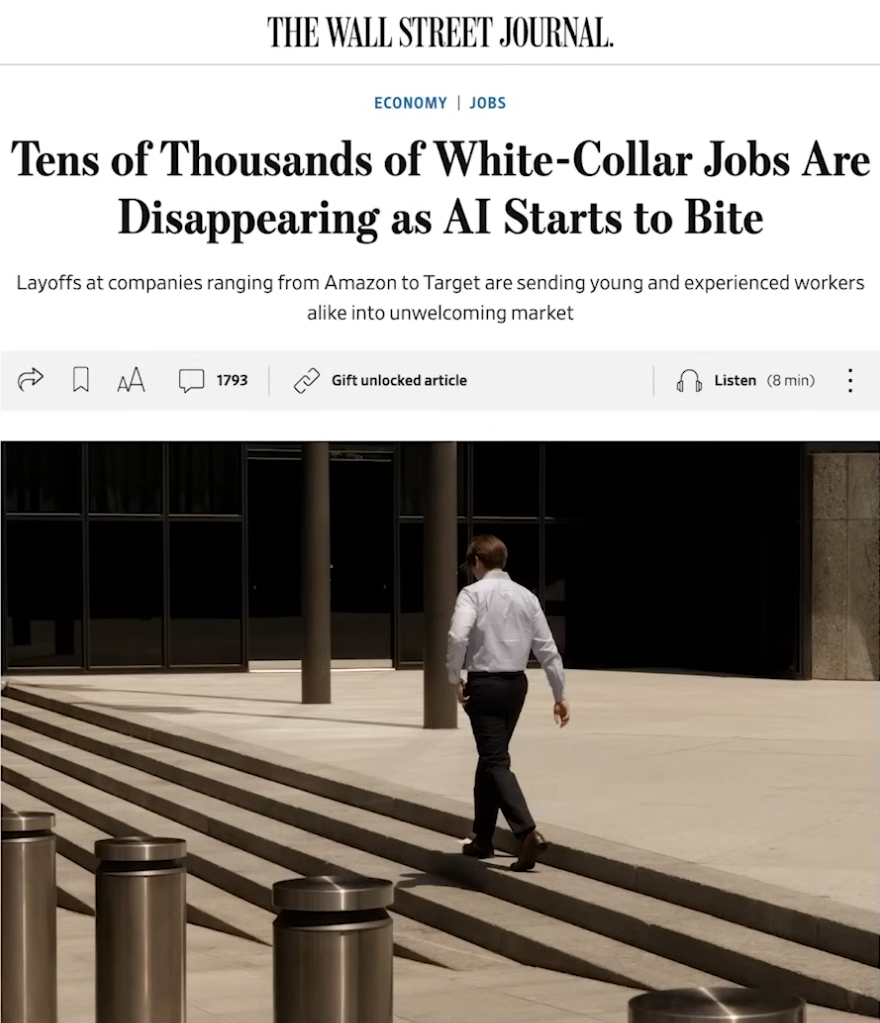
The meme humorously visualizes the growing crisis where artificial intelligence is being seen to replace human workers and consume their jobs. In light of the headline stating that "Layoffs at companies ranging from Amazon to Target are sending young and experienced workers alike into unwelcoming market," the figure walking away symbolizes a person being displaced or retired by automation technology.
detailed-analysis (gemma3_27b-it-q8_0)
Okay, let's break down this image and its implications through the lens of the "Artificial Intelligence - Jobs" category, applying the requested theoretical frameworks where relevant.
Image Context: The image accompanies a Wall Street Journal article titled “Tens of Thousands of White-Collar Jobs are Disappearing as AI Starts to Bite.” This points to a significant shift in the labor market, where previously "safe" office jobs are now being impacted by the rise of artificial intelligence and automation.
1. Visual Description
The image depicts a single person walking away from the camera and the entrance of a modern, imposing office building. The person is wearing a business suit, suggesting a white-collar worker. They are walking past shiny, metallic cylindrical bollards – physical barriers – which creates a feeling of separation and potentially, confinement. The background is a glass facade of the building, appearing cold and impersonal. The overall composition uses strong lines and a neutral color palette which evokes feelings of isolation, uncertainty, and a loss of direction. The person is framed centrally, but their back is turned, obscuring their face, symbolizing anonymity and lack of agency. The angle suggests a departure, a leaving behind.
2. Marxist Conflict Theory
This image is highly relevant to Marxist analysis. The core tenets of Marxism revolve around class struggle, the exploitation of labor, and the inherent conflicts arising from capitalism's drive for profit.
- Capital’s Automation: AI represents the latest phase in capitalism’s drive to increase efficiency and reduce labor costs. The “biting” of AI is, from a Marxist perspective, a direct assault on the working class (even the white-collar segment). AI is a tool for capitalists to automate processes previously performed by humans, maximizing profits by minimizing wage expenses.
- Alienation: The departing figure embodies alienation. They are no longer needed in the production process, reduced to a redundant element. They are alienated from their labor, from the means of production, and from the fruits of their labor.
- Reserve Army of Labor: The job losses due to AI contribute to a growing “reserve army of labor” – a pool of unemployed workers that keeps wages down and discipline up for those still employed. The article's sub-heading "sending young and experienced workers alike into unwelcome market" points to a glut in available labor.
- Class Polarization: This AI-driven displacement is likely to exacerbate existing class inequalities, concentrating wealth in the hands of those who own and control the technology while displacing workers.
3. Foucauldian Genealogical Discourse Analysis
Michel Foucault’s work focuses on power, knowledge, and discourse. Applying this framework reveals how the narrative around AI and job displacement is constructed.
- Discourse of Progress: The dominant discourse surrounding AI frames it as a force for "progress" and "innovation." However, this discourse simultaneously masks the power dynamics at play – the power of corporations to automate jobs and the power of technology to reshape the labor market.
- Normalization of Displacement: The article itself contributes to normalizing the idea of job displacement as an inevitable consequence of technological advancement. This normalization serves to diminish the ethical and social concerns surrounding these changes.
- Biopower and Control: Foucault's concept of "biopower" relates to the ways in which modern states manage and control populations. AI-driven job displacement can be seen as a form of control, regulating who has access to economic resources and, consequently, to a "good life."
- Genealogy of the "Efficient" Worker: The image’s backdrop of glass and metal suggests the type of worker the system is demanding, a “productive” worker. A genealogy could trace how the idea of the efficient worker became hegemonic, creating an expectation that workers will continually adopt new technologies and ways of working or become obsolete.
4. Postmodernism
Postmodern thought challenges grand narratives, embraces fragmentation, and emphasizes subjectivity.
- Deconstruction of the "Job": The image, alongside the article, implicitly deconstructs the traditional notion of a "job" as a stable, long-term career. AI is dissolving the boundaries between professions, challenging the idea of defined skillsets and career paths.
- The Hyperreality of Work: The “glass and steel” backdrop suggests a hyperreal work environment, one that is increasingly removed from tangible production and increasingly mediated by digital technologies.
- Loss of Meaning: Postmodernism often explores the loss of meaning in a rapidly changing world. The image evokes a sense of disorientation and a loss of purpose for the worker. The fact that we cannot see their face highlights the loss of individual identity.
5. Critical Theory
Critical Theory examines power structures and their impact on society.
- Instrumental Reason: The deployment of AI can be seen as an example of "instrumental reason" – reason used solely for achieving goals (profit) without regard for ethical or social consequences.
- Commodification of Labor: AI accelerates the commodification of labor, reducing human beings to mere inputs in a production process. The departing figure represents a unit of labor that has become "unprofitable" and, thus, discarded.
- The Culture Industry: The constant promotion of AI as innovative, disruptive, and essential to economic growth can be seen as part of a broader “culture industry” that reinforces existing power structures and maintains the status quo.
In Summary:
This image, within the context of the article, isn’t simply about job losses. It is a potent visual representation of the complex power dynamics, social changes, and ideological forces at play in the age of artificial intelligence. It reflects a restructuring of the labor market, the alienation of workers, the normalization of displacement, and the erosion of traditional notions of work and career. The theoretical lenses highlighted above offer varying, but interconnected, perspectives on these issues.
simple-description (llama3.2-vision_11b)
The meme is a screenshot from The Wall Street Journal article "Tens of Thousands of White-Collar Jobs Are Disappearing as AI Starts to Bite". The article discusses the impact of artificial intelligence on the job market, specifically highlighting the displacement of white-collar workers. The image is likely a photo of a person walking away from a building, symbolizing the transition of jobs to AI.