First Seen
2025-11-10T17:12:04.870373+00:00
simple-description (qwen3.5_2b-q8_0)
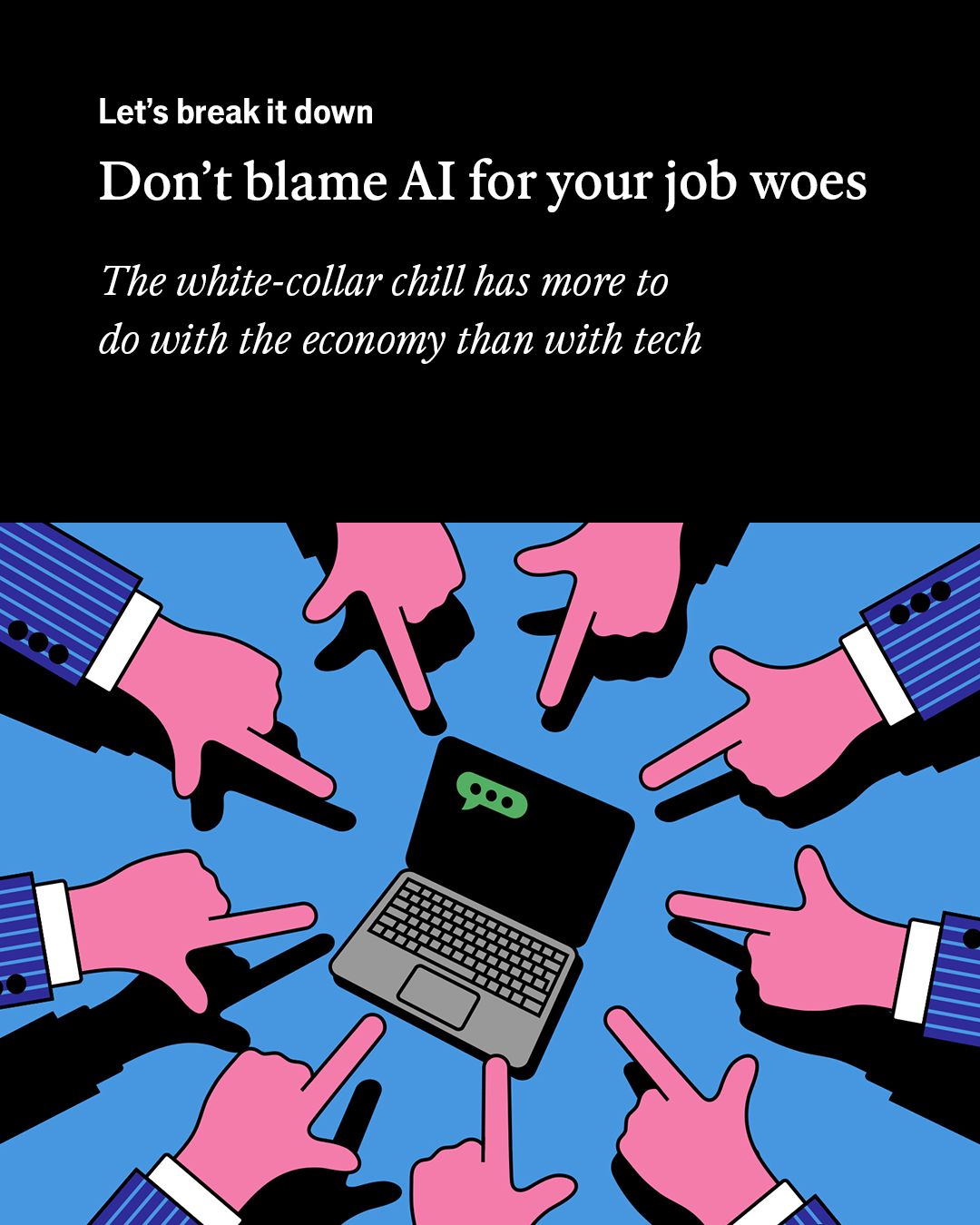
This meme features a cluster of pink hands wearing blue striped suit sleeves pointing at a central laptop computer with a green chat icon. The accompanying white text advises against simply blaming artificial intelligence for workplace struggles and suggests that the real driver of job loss is economic factors like the "white-collar chill" rather than just technology itself.
detailed-analysis (gemma3_27b-it-q8_0)
Okay, let's break down this meme within the context of "Artificial Intelligence - Jobs," utilizing the requested theoretical frameworks.
Visual Description
The image depicts a laptop computer centrally positioned against a bright blue background. Surrounding the laptop, multiple hands (varying skin tones, all in professional business attire – suits and shirts with cuffs) are pointing at the laptop. The visual immediately conveys a sense of blame or accusation directed towards the device. The pointing is somewhat frantic and overwhelming, suggesting a collective anxiety. The lack of faces focuses the attention entirely on the act of accusation and the object of that accusation: the laptop representing AI. The overall style is flat and graphic, lending it a somewhat stark, urgent feel.
Marxist Conflict Theory
This meme is deeply resonant with Marxist Conflict Theory. The core issue here is the alienation of labor and the resulting economic anxiety under capitalism.
- Class Struggle: The pointing hands can be interpreted as representatives of the working class (specifically white-collar workers) who feel threatened by the automation of their jobs, enabled by AI (represented by the laptop). This isn't a struggle against the technology itself, but against the capitalist system that deploys it to maximize profit and, potentially, displace labor.
- Means of Production: AI represents a new "means of production" under capitalist control. The owners of capital (those who control the AI technology and companies that implement it) benefit from increased efficiency and reduced labor costs, while the workers bear the risk of job loss or wage stagnation.
- False Consciousness: The meme’s message ("Don't blame AI for your woes") challenges a potential "false consciousness" – the idea that workers might misdirect their anger at the tool (AI) rather than the system (capitalism) that is wielding it. It suggests the real enemy isn’t technology, but the economic structures that prioritize profit over people.
- Exploitation: The use of AI to automate tasks can be viewed as a new form of exploitation, where the value created by labor is increasingly captured by capital, with less going to workers.
The meme subtly points to a situation where workers are feeling the pressure of economic anxieties (job losses, wage stagnation, precarious work) but may be incorrectly identifying the cause as AI rather than the broader systemic issues of capitalism.
Critical Theory
Critical Theory (particularly stemming from the Frankfurt School) focuses on the ways in which power structures maintain dominance through ideology. This meme fits that framework.
- Instrumental Reason: AI, in this view, is not a neutral tool but an expression of "instrumental reason"—the prioritization of efficiency and calculability above all other values. This instrumental reason, driven by capitalist logic, dehumanizes labor and reduces people to mere factors of production.
- Reification: The laptop (AI) becomes reified – treated as a thing in itself, divorced from the social and economic forces that created it and give it power. This allows the underlying systemic issues to be obscured.
- Ideology Critique: The meme offers a mini-ideology critique. It challenges the dominant narrative that AI is simply a technological advancement and suggests that it is a symptom of a larger, problematic system. By urging people not to blame AI, it encourages them to look deeper at the power structures that are shaping their economic realities.
- The Culture Industry: Critical theorists might argue that the widespread fear of AI-driven job loss is itself manufactured by the “culture industry” (media, advertising, etc.) to distract from deeper systemic problems.
Foucauldian Genealogical Discourse Analysis
Michel Foucault's work on power, knowledge, and discourse is relevant here.
- Discursive Formation: The very discourse around AI and jobs is a key issue. The way we talk about AI – as an inevitable force, a dispassionate tool, a source of progress – shapes our understanding of its impact. This discourse is not neutral; it is produced by and reinforces existing power relations.
- Power/Knowledge: The knowledge about AI is created and disseminated by those in power (tech companies, policymakers, etc.). This knowledge isn’t objective; it’s always linked to power. The narrative that AI is merely "disrupting" the job market obscures the fact that those in power actively shape that disruption for their own benefit.
- Genealogy: A Foucauldian genealogy would trace the historical development of the concept of “work” and “labor” to show how it has been constructed and redefined over time. Automation (and now AI) are not new phenomena; they are part of a long historical process of transforming the relationship between humans and labor.
- Subjectivation: The anxieties surrounding AI contribute to the subjectivation of workers – the ways in which they come to see themselves as replaceable or as needing to constantly upskill to remain “relevant” in the job market.
The meme challenges the dominant discourse by suggesting that the problem is not simply the advent of AI but the underlying social and economic arrangements that make workers vulnerable to its effects.
Postmodernism
The meme could be interpreted through a postmodern lens in the following ways:
- Deconstruction of Grand Narratives: Postmodernism challenges "grand narratives" (overarching explanations of the world). The belief that technological progress always leads to improvement is a grand narrative. The meme subtly deconstructs this narrative by suggesting that AI is not necessarily a positive force for all.
- Simulacra and Simulation: AI can be seen as a simulacrum – a copy without an original. It simulates intelligence, and in doing so, blurs the lines between the real and the simulated. This can contribute to a sense of disorientation and anxiety.
- Fragmentation: The many pointing hands signify a fragmented experience of labor, rather than a unified workforce.
- Rejection of Objectivity: Postmodernism rejects the idea of objective truth. There is no single, “correct” way to understand the impact of AI on jobs. Different perspectives and experiences are equally valid.
Queer Feminist Intersectional Analysis
This meme does not have a clear direct link to Queer Feminist Intersectional Analysis unless considered through the lens of pre-existing inequalities. However, we can explore it:
- Intersectional Vulnerability: The impact of AI-driven job displacement won’t be felt equally. Women, people of color, LGBTQ+ individuals, and people with disabilities are already disproportionately represented in precarious work and are more vulnerable to economic shocks. The meme doesn't explicitly address this, but an intersectional analysis would highlight the ways in which AI exacerbates existing inequalities.
- Care Work: Many jobs considered vulnerable to AI automation involve "care work" (healthcare, education, social work), which is historically undervalued and disproportionately performed by women. This highlights a gendered dimension to the impact of AI.
- Power Dynamics: The meme's image, with multiple hands pointing at a single laptop, can be read as a microcosm of power dynamics. Those with capital and control over technology (often men) exert power over those who are vulnerable to its effects.
In conclusion, this meme, while seemingly simple, is rich with theoretical implications, particularly within the context of Artificial Intelligence and Jobs. It provides a springboard to discuss larger systemic issues of capitalism, power, and the future of work. The core message challenges the simplistic narrative of AI as the problem and pushes viewers to consider the underlying social and economic forces at play.
simple-description (llama3.2-vision_11b)
The meme is a humorous take on the impact of AI on jobs. It shows a group of people pointing at a laptop with a speech bubble, implying that the AI is being blamed for job losses. The text "Don't blame AI for your job woes" is written above the image, suggesting that the AI is not responsible for the decline of jobs.