First Seen
2025-09-16T00:23:40+00:00
simple-description (qwen3.5_2b-q8_0)
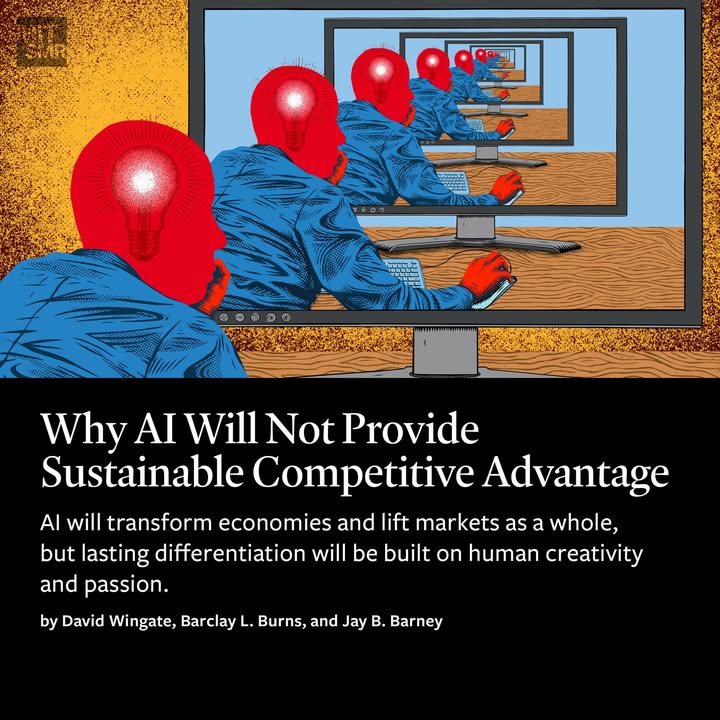
The image depicts a repeating series of people sitting at computer desks, each with a red head containing a bright, glowing lightbulb inside—symbolizing their work or ideas. This visual metaphor highlights how artificial intelligence creates an endless loop of repetitive tasks that can be performed by machines without human intervention. Combined with the text below, which argues that "lasting differentiation" will come from "human creativity and passion," it illustrates the warning that while AI can automate jobs, it cannot replace the unique skills needed for sustainable success in the workforce.
detailed-analysis (gemma3_27b-it-q8_0)
Here's an analysis of the image within the context of "Artificial Intelligence - Jobs," utilizing the requested theoretical frameworks where applicable.
Visual Description
The image is a striking, graphic illustration. A blue, stylized figure, reminiscent of a human form but with exaggerated, serpentine limbs, is sprawled across a desk and in front of a computer monitor. The figure seems to be becoming the technology, merging with its form. Two bright red, glowing lightbulbs float above the figure, positioned as if emanating from its head. The scene is deliberately abstract and unsettling. The overall color palette is dominated by blues, contrasting with the vibrant red of the lightbulbs. The computer monitor itself is showing what appears to be another image of a similar, but smaller, figure and computer.
The text overlay reads: "Why AI Will Not Provide Sustainable Competitive Advantage." A sub-heading elaborates: “AI will transform economies and lift markets as a whole, but lasting differentiation will be built on human creativity and passion." It’s credited to David Wingate, Barclay L. Burns, and Jay B. Barney.
Critical Theory
From a Critical Theory perspective, the image embodies anxieties surrounding the encroachment of technology on human agency and identity. The figure becoming the computer suggests a loss of self, a fear of being subsumed by the very tools we create. The text affirms the idea that AI is transformative rather than inherently emancipatory. It’s not leading to a better existence, just a different one.
The emphasis on "human creativity and passion" as the source of "lasting differentiation" can be read as a defensive assertion of what makes us uniquely human in a world increasingly dominated by automation. It critiques the assumption that technological advancement equates to progress, implying that true value lies in qualities that AI cannot replicate. The image highlights the potential for dehumanization inherent in the pursuit of efficiency and optimization. It’s a critique of a purely instrumental rationality.
Marxist Conflict Theory
Applying Marxist Conflict Theory, the image can be interpreted as illustrating the tension between labor and capital in the age of AI. The sprawling, almost exhausted figure could be viewed as representing the working class – a form of "proletariat" potentially made obsolete by automation. The AI (represented by the computer and the figure’s merging with it) represents the “means of production,” now increasingly detached from human control and possibly, ultimately, displacing the need for human labor.
The text, positioning "human creativity and passion" as the key to competitive advantage, suggests a potential path for the working class to maintain relevance, but also hints at the increasing value placed on these uniquely human qualities in a labor market where repetitive tasks are automated. This could lead to increased exploitation, as employers seek to extract maximum value from these “creative” skills. The red lightbulbs, visually prominent, could be symbolic of the “extraction of surplus value” – the profit gained by capital from the creative labor of individuals.
Postmodernism
From a Postmodern viewpoint, the image dismantles the notion of a clear distinction between humans and technology. The blurred boundaries between the figure and the computer reject the idea of a stable, unified self. The image embraces fragmentation and uncertainty.
The text’s claim that AI won’t provide sustainable advantage is inherently postmodern. It rejects the grand narratives of technological progress and linear advancement. The emphasis on "differentiation" suggests a proliferation of niches and specialized skills, rather than a universal solution. The art style itself—abstract, stylized, and rejecting realism—is also characteristic of postmodern aesthetics. The image isn’t about a clear message; it’s about the anxiety surrounding the message, the questioning of boundaries, and the instability of meaning.
It's important to note: The image is open to interpretation, and these are only a few perspectives offered through different theoretical lenses. The creators are explicitly making a claim about economic advantage and the future of work, but the powerful visual representation invites broader, more critical engagement.
simple-description (llama3.2-vision_11b)
The meme is a humorous illustration of a person sitting at a desk, surrounded by screens displaying various AI-related concepts, with a thought bubble above their head showing a lightbulb. The text in the image reads: "AI will not replace jobs with AI will make jobs." The meme pokes fun at the idea that AI will not replace human jobs, but rather make them more efficient and productive. The image is a lighthearted way to poke fun at the idea that AI will not replace human jobs, but rather make them more efficient and productive.