First Seen
2026-02-27T02:18:30.624008+00:00
simple-description (qwen3.5_2b-q8_0)
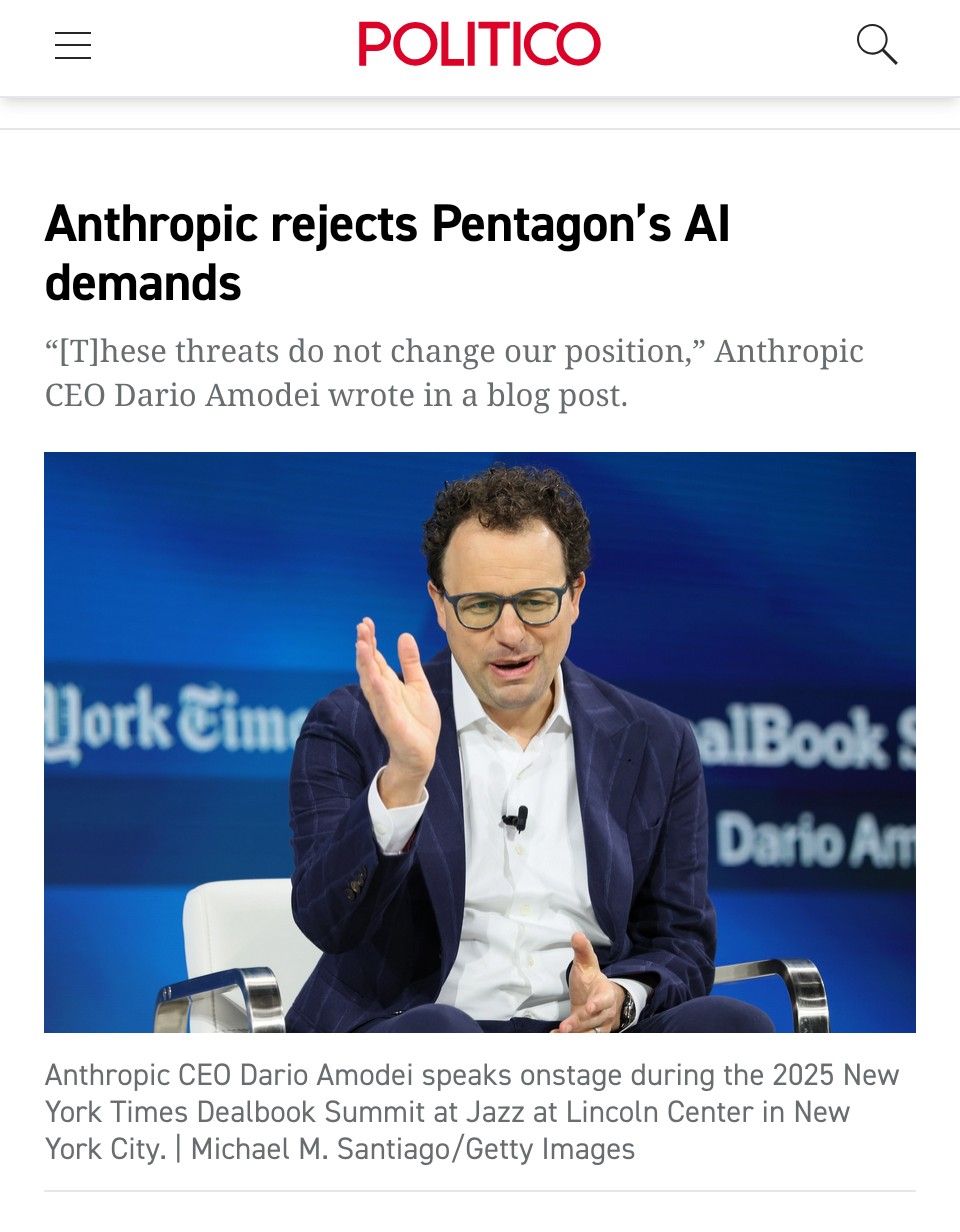
The situation depicted in this article involves a conflict between private tech companies and government security authorities regarding the development of artificial intelligence (AI). The headline "Anthropic rejects Pentagon's AI demands" illustrates the ethical tension where corporate innovation often clashes with national safety concerns.
Specifically, the quote included in the image—"[T]hese threats do not change our position"—is used emphatically by CEO Dario Amodei to assert his firm stance. He is refusing to compromise his company's standards or accept restrictions on AI capabilities, effectively saying that these government requests will not alter what he and the public expect from technology.
detailed-analysis (gemma3_27b-it-q8_0)
Okay, let's break down this image and the related news headline through the lens of Artificial Intelligence Ethics, using the requested theoretical frameworks where applicable.
Image Analysis: Anthropic CEO Dario Amodei Rejects Pentagon AI Demands
Here’s an analysis, structured as requested, diving into the implications of the image within the ethical context of AI:
1. Visual Description
The image features Dario Amodei, CEO of Anthropic, on stage at a conference. He’s in mid-gesture, with his hands raised, fingers splayed, and a slightly surprised expression on his face. The background displays branding for "New York Times Dealbook," “Dealbook Summit,” and "Anthropic.” The lighting is bright, typical of a public speaking engagement. The body language suggests a defiance or rejection, potentially combined with a degree of shock or incredulity. It’s a performative image—a public display of a stance.
2. Foucauldian Genealogical Discourse Analysis
This is the most potent lens for understanding the image within the AI ethics context. Michel Foucault’s work focuses on power/knowledge relationships. Let's unpack this:
- Discourse & Power: The "demands" from the Pentagon represent a discourse of national security, defense, and state control. This discourse carries immense power. Anthropic’s rejection isn't just a disagreement on technical details; it’s a challenge to that discourse. It is a disruption of the expected power dynamic.
- Genealogy: We need to trace the historical development of AI development. Initially, it was framed as a neutral, scientific endeavor. Over time, as AI's capabilities grew, the discourse shifted, increasingly linking it to military applications, surveillance, and control. The Pentagon's demands are a culmination of that genealogical trajectory.
- Anthropic’s Counter-Discourse: By publicly rejecting those demands, Anthropic attempts to create a counter-discourse focused on responsible AI development. This emphasizes safety, alignment with human values, and a rejection of weaponization. Their position attempts to define the parameters of acceptable AI, rather than allowing it to be solely dictated by the state. Amodei’s gesture is a visual assertion of this new discourse.
- Normalization & Discipline: Foucault would argue that the Pentagon's demands are an attempt to "normalize" AI within the established apparatus of state power. Anthropic's resistance is a disruption of that disciplinary process.
3. Critical Theory (Frankfurt School)
Critical Theory, particularly the work of thinkers like Herbert Marcuse, emphasizes the role of technology in reinforcing existing power structures and suppressing critical thought.
- Instrumental Reason: The Pentagon’s demands reflect an instrumental rationality—a focus on efficiency and control, without considering broader ethical implications. AI is treated as a tool for achieving pre-defined goals (security, dominance) rather than being questioned as to its inherent nature or potential consequences.
- One-Dimensionality: The pressure to align AI with military objectives potentially contributes to a "one-dimensional" society, where alternative visions of AI's future are suppressed. Anthropic’s refusal can be viewed as an attempt to resist this narrowing of possibilities.
- The Culture Industry: The event itself (Dealbook Summit) and the media coverage are part of a larger “culture industry” that shapes public perception of AI. The image's framing contributes to this process.
4. Marxist Conflict Theory
While less direct, we can apply a Marxist lens:
- Class Conflict: AI development is not happening in a vacuum. It’s driven by specific economic interests. The Pentagon’s demands likely reflect the interests of military contractors and those who benefit from the military-industrial complex.
- Control of the Means of Production: AI is becoming a key means of production. The struggle over who controls its development and deployment – whether private companies like Anthropic or the state – represents a new form of class conflict.
- Ideology: The discourse of national security used to justify AI weaponization can be seen as an ideology that obscures the underlying economic and power dynamics.
5. Postmodernism
Postmodernism challenges grand narratives and emphasizes the subjective nature of truth and knowledge.
- Deconstruction: Postmodern analysis would “deconstruct” the idea of “national security” – showing how it is a socially constructed concept used to justify certain actions.
- Meta-Narratives: The notion that AI must serve the interests of the state is a meta-narrative that postmodernism would question. Anthropic's rejection challenges this assumed truth.
- Simulation & Hyperreality: The image itself is a simulacrum, a representation of a situation, rather than the situation itself. The media constructs a "reality" around the event, potentially obscuring the complex issues at play.
6. Queer Feminist Intersectional Analysis
This is the least directly applicable framework but still relevant:
- Bias in AI: AI systems are often trained on biased data, perpetuating existing inequalities along lines of gender, race, and other social categories. The ethical concerns extend beyond military applications. (While not explicitly in the image, this is relevant to Anthropic's broader ethical positioning.)
- Power & Marginalization: The development and deployment of AI have disproportionate effects on marginalized communities. The lack of diversity within the AI industry exacerbates these inequalities.
- Intersectionality: The potential harms of AI are not experienced equally; they are shaped by the intersection of various social identities. The discourse of national security often prioritizes the interests of dominant groups.
In Conclusion:
This image encapsulates a pivotal moment in the ongoing debate about the ethical direction of AI. Anthropic’s stance, visually expressed through Amodei’s defiant gesture, is a challenge to the dominant discourse of state control and a plea for a more responsible and human-centered approach to AI development. The theoretical frameworks above provide a nuanced understanding of the power dynamics, ideological underpinnings, and potential consequences of this conflict.
simple-description (llama3.2-vision_11b)
The meme is a screenshot of a news article from Politico, with the headline "Anthropic rejects Pentagon's AI demands". The article discusses a controversy surrounding the use of AI in the military, with the CEO of Anthropic, a company that creates AI technology, rejecting the demands of the Pentagon to use their AI technology in certain ways. The article quotes the CEO, Dario Amodei, as saying that the demands of the military are "not changing our position" and that they are "not going to do it" in response to the demands.