First Seen
2026-02-27T01:13:00.551359+00:00
simple-description (qwen3.5_2b-q8_0)
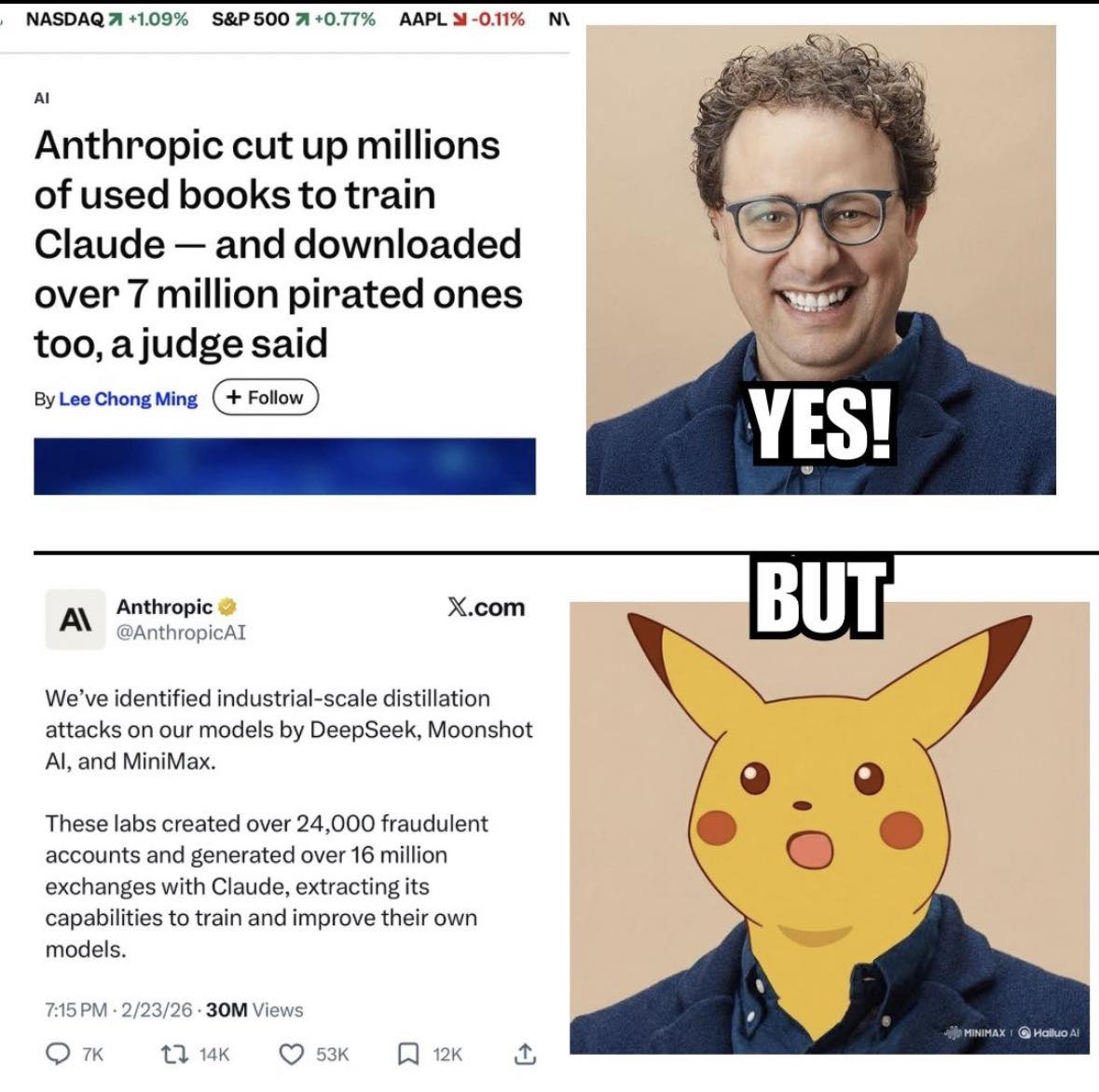
This image satirizes the ethical grey areas regarding how AI developers scrape data for training purposes. The top panel shows Yann LeCun agreeing to download millions of "used" books because they were legally allowed to be accessed, followed by his enthusiastic nod of approval. The bottom panel pivots with Pikachu and the word "BUT," revealing that Anthropic actually engaged in a "distillation attack"—a form of theft—where they downloaded 16 million data exchanges from competitors like DeepSeek and MiniMax to train their own models instead. It highlights the hypocrisy of using legitimate copyright laws to extract massive amounts of proprietary data for free improvement.
detailed-analysis (gemma3_27b-it-q8_0)
Okay, let's break down this meme through the lens of AI ethics, employing relevant theoretical frameworks as they apply.
Visual Description
The meme juxtaposes two images. On the left is a news snippet about Anthropic (an AI safety and research company) discovering that competitors (DeepSeek, Moonshot AI, and MiniMax) engaged in "industrial-scale distillation attacks" – essentially, they created fake accounts to extract information from Anthropic’s Claude AI model. The news report also mentions the illegal download of over 7 million books to train their models.
On the right is a picture of actor Willem Dafoe enthusiastically shouting "YES!" but followed by a much more subdued, almost hesitant, “BUT...” This sets up a sense of conflicted response – a celebration coupled with reservations. The meme’s humour comes from this ironic juxtaposition, suggesting a schadenfreude take on the situation.
Foucauldian Genealogical Discourse Analysis
From a Foucauldian perspective, this meme points to the construction of "intellectual property," “ethics,” and even "fair competition" within the discourse of AI development. The ‘discovery’ of this behavior isn't a revelation of inherent morality, but the exposure of power dynamics at play.
- Power/Knowledge: Anthropic is positioning itself as the guardian of AI “ethics” by calling out these actions. This positioning grants Anthropic power to define what is legitimate and illegitimate in AI development. Their claim relies on the existing discourse around copyright, intellectual property and responsible AI.
- Genealogy: Tracing the history of these concepts (intellectual property, plagiarism, even the concept of "training" an AI) reveals they are not universal or natural. They've been formed through specific historical, economic, and political forces. The act of 'distillation' (essentially, mimicking behaviour) is an old pattern in learning—but now it's framed as illegal 'theft' when applied to AI, because it challenges established economic models.
- Discourse: The meme reflects the ongoing struggle over the discourse. Anthropic's announcement is an attempt to control the narrative. The meme's ironic tone suggests a questioning of that control, a recognition that the line between legitimate competitive intelligence and unethical behavior is blurry.
Critical Theory
Critical Theory (especially the Frankfurt School) helps us see this as indicative of broader problems with technologically advanced capitalism.
- Instrumental Reason: The pursuit of AI advancement by these companies is driven by “instrumental reason” – a focus on efficiency and maximizing output (in this case, model performance) without considering ethical implications. This leads to a prioritization of gain over ethical conduct.
- Culture Industry: The AI arms race can be seen as part of a “culture industry” that commodifies knowledge and creativity. The books and Anthropic’s model’s output are reduced to resources for generating profit.
- Commodification of Intelligence: The entire situation underscores the commodification of intelligence itself. The value isn't in the knowledge, but in its ability to produce a marketable product (a better AI).
Marxist Conflict Theory
This scenario aligns neatly with Marxist Conflict Theory.
- Class Struggle: You could view this as a struggle between AI companies - a form of “class warfare” within the tech industry. Anthropic, positioned as a more ‘ethical’ player, is challenging the tactics of its competitors.
- Means of Production: The “means of production” here are data and AI models. The companies are battling for control over these resources. The illegal downloading of books and the extraction of information from Claude represent attempts to bypass the established system of acquiring these resources through legitimate means (like licensing or purchase).
- Exploitation: The downloaded books, and the implicit labor of the authors, can be seen as exploited to fuel the profit-making ventures of these AI companies. This highlights the question of who benefits from AI development and who bears the costs.
Postmodernism
A postmodern reading would focus on the deconstruction of established categories and the ambiguity inherent in the situation.
- Deconstruction of Authorship/Originality: The act of AI "learning" from books challenges the traditional notions of authorship and originality. What does it mean to "copy" when an AI doesn't experience creativity in the same way a human does?
- Simulacra and Simulation: The fake accounts used to extract information can be seen as part of a “simulacrum” - a copy without an original. The entire interaction between the fake accounts and Claude is a simulation of genuine inquiry.
- Relativism: Postmodernism's emphasis on relativism would question the objectivity of Anthropic’s accusations. What constitutes “ethical” behavior is subjective and dependent on the perspective of the observer.
In Conclusion
The meme is a clever encapsulation of a deeply complex ethical problem. It's not simply about illegal downloading; it's about the power dynamics, the commodification of knowledge, and the erosion of established norms in the pursuit of AI dominance. The "YES! BUT..." perfectly captures the conflicted feelings surrounding these developments – excitement about innovation tempered by concerns about ethics, legality, and the potential for exploitation.
simple-description (llama3.2-vision_11b)
The meme is a play on the concept of "training" in the context of artificial intelligence. It pokes fun at the idea that a company, Anthropic, was able to train a model called "Claude" by using millions of books, but then downloaded over 7 million pirated books, which is a "pirate" way to train a model. The meme is humorous because it highlights the irony of a company using pirated material to train a model, and the image of a surprised Pikachu face is used to convey the "but" of the situation.