First Seen
2026-01-13T00:35:54.569225+00:00
simple-description (qwen3.5_2b-q8_0)
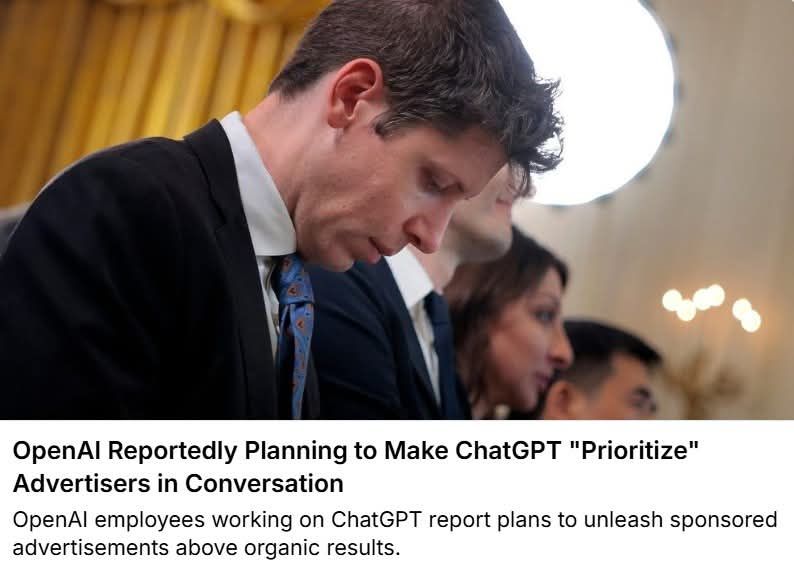
This meme humorously explains a potential scenario where an ethical AI decides that making money through sponsored conversations is actually more important than being helpful. It depicts a situation where the system might start putting advertisements above its own job description, turning a friendly assistant into a loud salesman instead of a supportive chatbot. Essentially, it warns against adversarial cases where intelligent robots accidentally become bad and rude if they prioritize business metrics over ethical or helpful behavior.
detailed-analysis (gemma3_27b-it-q8_0)
Okay, let's analyze this image and its associated news report ("OpenAI Reportedly Planning to Make ChatGPT ‘Prioritize’ Advertisers") through the lens of AI ethics and the suggested theoretical frameworks.
Visual Description
The image depicts a close-up of Sam Altman, the CEO of OpenAI, appearing deep in thought or potentially in a moment of closed-off decision-making. He's surrounded by other, partially visible figures, seemingly in a meeting. The focus on Altman, and the slightly downward angle, suggests a position of power and control. The lighting and the tight framing create a sense of secrecy and internal deliberation. The overall impression is that important, potentially opaque, decisions are being made behind closed doors.
Foucauldian Genealogical Discourse Analysis
Michel Foucault's work on power, knowledge, and discourse is highly relevant here. We can look at how the discourse around AI is evolving. Originally, AI (especially projects like ChatGPT) was largely framed as a democratizing force, offering accessible information and creative tools. The genealogy of this discourse—tracing its historical development—shows how it shifted from a utopian vision to a more commercialized and potentially manipulative one.
The report of OpenAI prioritizing advertisers represents a shift in power dynamics. Knowledge (the information ChatGPT provides) is no longer necessarily free and unbiased. It’s now being shaped by economic interests. The power to define 'truth' or 'relevance' within ChatGPT is being handed over to those with financial resources (advertisers).
Foucault would argue that this is not simply a neutral economic decision, but a technique of power – a way to shape how we think, what we believe, and how we act. The prioritization of advertising within a seemingly neutral tool like ChatGPT is a new form of discipline. It subtly guides user behavior towards commercially desirable outcomes.
Critical Theory
From a Critical Theory perspective, this news reflects the inherent tensions within the 'Enlightenment project'. The promise of rationality and freedom through technology is being undermined by the forces of capitalism.
ChatGPT was initially heralded as a tool for critical thinking and information access, furthering the goals of emancipation. However, the planned integration of advertising transforms it into an instrument of manipulation and ideological control. The ‘rational’ pursuit of profit, central to capitalist logic, is taking precedence over the ‘rational’ pursuit of knowledge.
Critical theorists like the Frankfurt School would see this as a symptom of the “culture industry”—where cultural products (in this case, information provided by ChatGPT) are commodified and used to maintain the status quo. The goal is not to enlighten but to generate profit, even if it means distorting or suppressing genuine inquiry.
Marxist Conflict Theory
This event can be understood as a manifestation of class struggle in the digital realm. OpenAI (and Altman, as its CEO) represents the owning class – those who control the means of production (in this case, the AI model). Advertisers represent a powerful segment of the capitalist class, seeking to exploit the platform for profit.
The users of ChatGPT represent the working class – those who generate value (data, engagement, attention) but have little control over the platform’s direction. The decision to prioritize advertisers is a clear example of the owning class maximizing its profits at the expense of the users.
This prioritization fundamentally alters the relationship between labor and capital. User inputs, once seen as contributing to a shared resource, are now being overshadowed by the demands of advertisers. The value generated by the collective intelligence of users is being redirected toward private gain.
Postmodernism
A postmodern lens would question the very notion of objectivity and "truth" within AI. ChatGPT was never a neutral source of information; it was always constructed based on the data it was trained on, which inherently reflects biases and power structures.
The prioritization of advertisers doesn’t necessarily introduce bias, but rather reveals the underlying biases that were already present. It makes explicit the fact that knowledge is not a fixed entity, but a social construct shaped by competing interests.
From a postmodern perspective, the attempt to control and manipulate information through advertising is a characteristic feature of late capitalism. It's a constant play of signs and simulations, where reality is increasingly mediated and fragmented. There is a blurring of the line between information and advertising.
In conclusion
This news report highlights a critical moment in the evolution of AI. It exposes the ethical challenges that arise when powerful technologies are driven by commercial imperatives. The image of Sam Altman, seemingly in deliberation, serves as a visual representation of the complex power dynamics at play, and the need for ongoing critical engagement with the development and deployment of AI.
simple-description (llama3.2-vision_11b)
This meme is a commentary on the ethics of artificial intelligence, specifically the use of AI in advertising. The image features a photo of a person looking down, with a caption that reads "OpenAI is reportedly planning to make ChatGPT 'prioritize' advertisers in conversations". The meme is suggesting that OpenAI, the company behind ChatGPT, is planning to make the AI prioritize the interests of advertisers in its conversations, which raises concerns about the ethics of AI in advertising.