First Seen
2025-11-24T02:02:06+00:00
simple-description (qwen3.5_2b-q8_0)
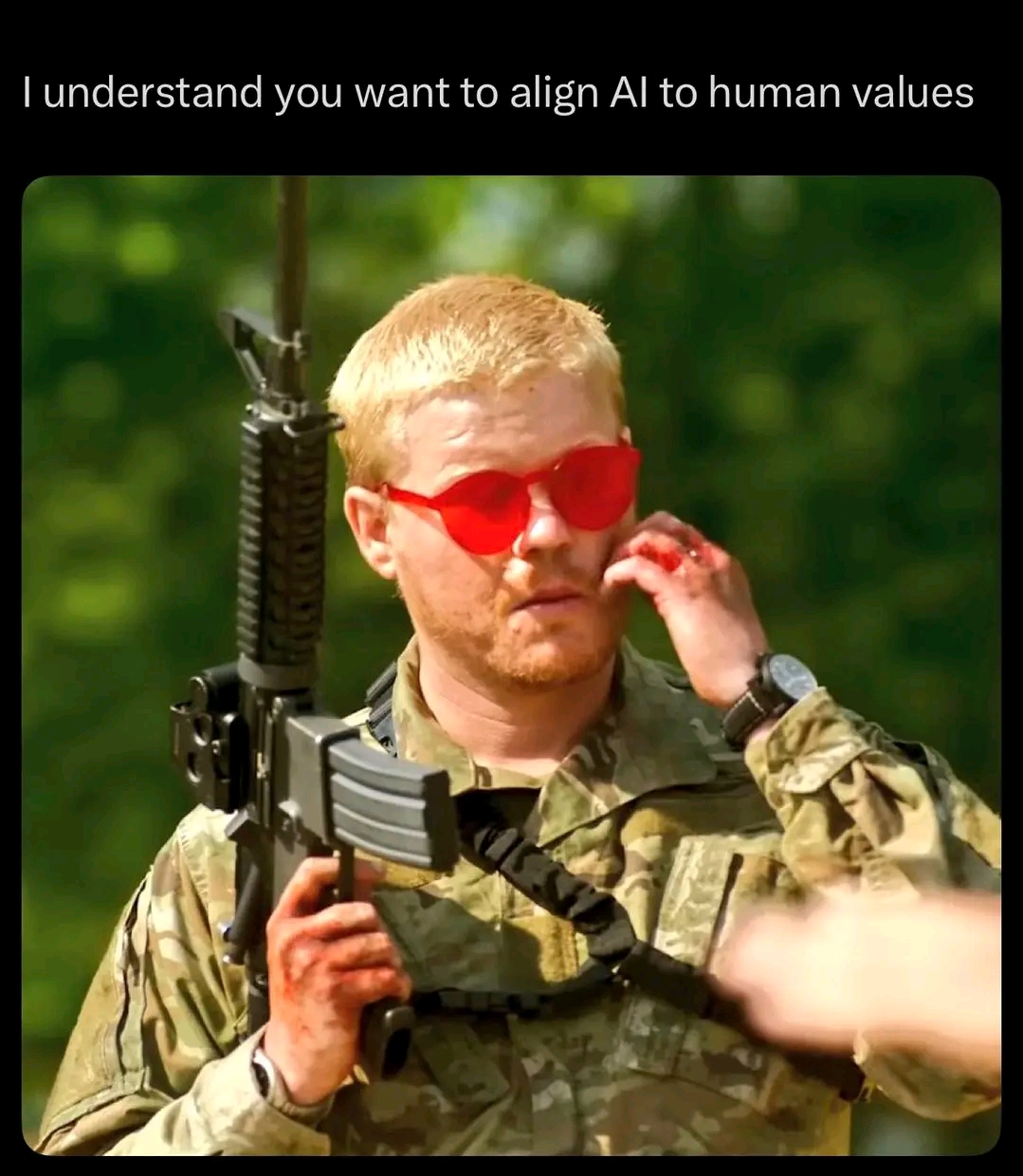
This meme satirizes the Alignment Problem, a central concept in Artificial Intelligence safety regarding how we give humans control over powerful technology. The visual depicts a soldier holding an assault rifle—perhaps given to him by AI—while looking confused and slightly distressed; a hand reaches into the frame from the right, threatening to shoot him, and he has bloody marks on his face. The text "I understand you want to align AI to human values" adds irony, implying that even when humans try to fix an AI's path (alignment), they can still be caught in dangerous or accidental violence created by the very tool they are controlling.
detailed-analysis (gemma3_27b-it-q8_0)
Okay, let's break down this meme within the context of AI alignment, using the requested theoretical lenses. It’s a potent image, and lends itself to multiple interpretations.
Visual Description
The meme depicts a young man, dressed in military camouflage, holding a large assault rifle. Crucially, he is wearing bright red sunglasses, giving his eyes a stark, unsettling glow. The background is a blurry, natural setting (likely foliage), contrasting with the aggressive and manufactured nature of the weapon and the artificial color of the glasses. The caption reads, “I understand you want to align AI to human values.” The image evokes a sense of menace, perhaps a parody of hyper-masculine, heavily-armed self-reliance.
Foucauldian Genealogical Discourse Analysis
This meme functions as a critique of the very discourse surrounding AI alignment. Michel Foucault argued that knowledge and power are inextricably linked. The idea of "aligning AI to human values" sounds benevolent, but within a Foucauldian framework, it's vital to examine who defines those "human values" and how that definition becomes a mechanism of power.
The image suggests that the attempt to define and implement “human values” in AI could easily be co-opted by those already wielding power, specifically those comfortable with force and control. The camouflage and weapon symbolize this power – a military apparatus that inherently embodies a specific set of (often aggressive and exclusionary) values. The red sunglasses, distorting the gaze, could represent the distorted lens through which these values are being projected onto AI. The meme is implying that the project of AI alignment might not be about universal human wellbeing, but rather about entrenching the values of the dominant (and potentially violent) power structures. It asks us to question the genealogy – the historical development – of the concepts of "human values" themselves, and where they originated.
Critical Theory
From a Critical Theory perspective (drawing on thinkers like the Frankfurt School – Adorno, Horkheimer, Marcuse), the meme points to the potential for technological "progress" to reproduce existing forms of domination. The "alignment" project can be seen as a form of instrumental rationality – the application of logical, efficient means to achieve pre-defined ends. However, the ends themselves (defined as "human values") are not critically examined.
The image suggests that this pursuit of alignment is not neutral. The man with the gun embodies a rationality centered on force and control, which is then being imposed onto a technology (AI) that has the potential for immense power. The meme thus implies that AI alignment, as currently conceived, might simply be a new way to implement and amplify existing societal inequalities and power dynamics, rather than challenging them. It’s a critique of the idea that technology can be a solution to social problems if those problems are not first understood and addressed at their root.
Marxist Conflict Theory
A Marxist reading would focus on the underlying class struggle inherent in the development and deployment of AI. The meme hints that the "human values" being promoted are likely those of the ruling class, the very group who have the resources to develop and control these technologies. The soldier, a representative of the state apparatus which protects the interests of the ruling class, is symbolic of this.
The alignment of AI to these values would then serve to reinforce existing power structures. AI could be used to automate the suppression of dissent, optimize the exploitation of labor, and further consolidate wealth in the hands of the few. The meme subtly suggests that a genuine "alignment" would require a fundamental restructuring of social relations, rather than simply programming existing ideologies into a machine. It’s not just about what values are used, but who benefits from them.
Postmodernism
A Postmodern interpretation would question the very notion of stable, universal "human values" altogether. Thinkers like Derrida and Foucault challenge the idea of fixed meanings and grand narratives. The meme, with its unsettling imagery, suggests that “human values” are not a coherent set of principles but rather fluid, contested, and historically contingent concepts.
The sunglasses further reinforce this idea of a subjective, distorted view. The meme is subtly asking, "Whose human values are we talking about?" And, "Is 'alignment' even possible when the very foundations of our values are shaky?" It destabilizes the idea of a clear objective and suggests that any attempt to impose a single set of values onto AI is itself a power play. It embraces ambiguity and challenges the notion of a singular, objective truth.
Why other frameworks aren't really relevant here:
- Queer Feminist Intersectional Analysis: While issues of power, domination, and marginalized voices are present, the core image doesn’t directly engage with gender, sexuality, or intersectional identities in a way that warrants this specific analysis. It’s about broader societal power structures, rather than the specific oppressions experienced by marginalized groups.
In essence, the meme is a cynical and unsettling commentary on the AI alignment project, suggesting that it may be a Trojan horse for reinforcing existing power dynamics and imposing a potentially dangerous worldview onto an increasingly powerful technology. It's a call for critical self-reflection and a demand that we rigorously examine the assumptions and motivations behind the pursuit of "alignment".
simple-description (llama3.2-vision_11b)
The meme is a humorous image of a man in a military uniform, wearing red sunglasses and holding a rifle, with the text "I understand you want to align AI to human values" above it. The image is a satirical commentary on the idea that AI developers are trying to create machines that are more like humans, but it's actually a military man with a gun, highlighting the absurdity of the idea. The image is meant to be humorous and ironic, poking fun at the idea of aligning AI to human values.