First Seen
2025-10-18T16:04:24+00:00
simple-description (qwen3.5_2b-q8_0)
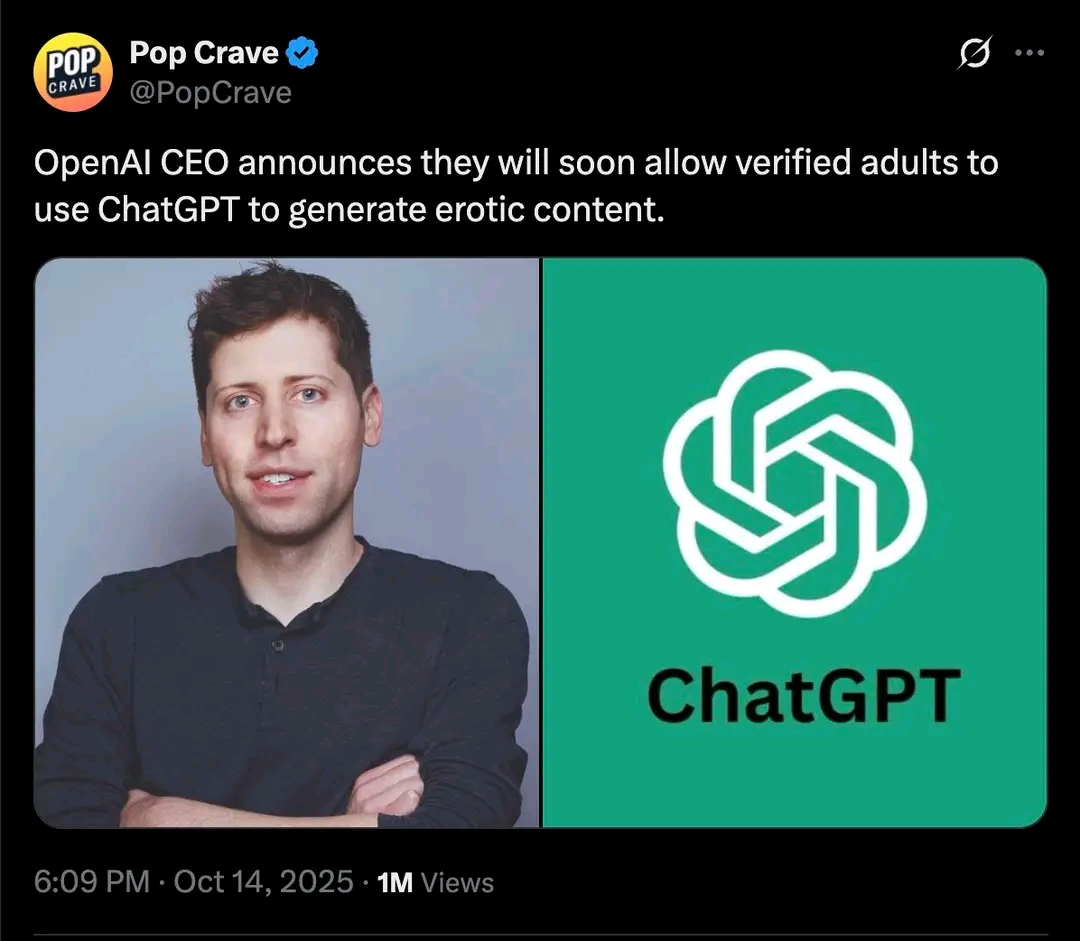
This meme satirizes the tension between commercial profit and AI safety protocols by juxtaposing a photo of CEO Sam Altman next to the ChatGPT logo against a news report that OpenAI is allowing verified adults to use their model for generating erotic content. It plays on the concept of "alignment" within the category of artificial intelligence, implying a humorous contradiction where a corporate leader is supposedly bypassing standard safety filters specifically for adult purposes.
detailed-analysis (gemma3_27b-it-q8_0)
Okay, let's break down this meme from the perspective of "Artificial Intelligence – Alignment," incorporating relevant theoretical frameworks where applicable.
Understanding the Core Issue: AI Alignment & This Meme
At the heart of AI Alignment is the problem of ensuring that increasingly powerful AI systems pursue goals that are aligned with human values and intentions. This isn't simply about preventing "robots taking over." It's a far more nuanced issue, concerning how we define "good," how we translate that into machine-readable objectives, and how we ensure that an AI, while optimizing for those objectives, doesn't produce unintended (and potentially harmful) consequences. This meme touches on alignment because opening up a powerful generative AI like ChatGPT to generating "erotic content" immediately raises questions about whose values are being prioritized, the potential for misuse, and the implications for societal norms.
1. Visual Description
The meme consists of two primary elements. On the left is a portrait of Sam Altman, the CEO of OpenAI. He has a relatively neutral expression, almost a slight smile, presenting a visage of confident control. On the right is the official logo of ChatGPT: a stylized, swirling green spiral against a green background, with the word "ChatGPT" below. The image is overlaid with a tweet from Pop Crave announcing OpenAI's intention to allow verified adults to generate erotic content. The visual pairing is important: Altman's face is presented alongside the AI’s symbol, subtly implying a direct connection between his decision-making and the AI’s capabilities. The green color of the ChatGPT logo is often associated with progress and technology, but can also have connotations with envy and artificiality.
2. Foucauldian Genealogical Discourse Analysis
Michel Foucault's work is highly relevant here. The announcement isn't merely a technical decision; it's a discursive shift in how we understand and regulate sexuality within the context of technology.
- Genealogy: Foucault's genealogical approach would examine the historical power relations that have shaped the discourse around sexuality. Historically, sexuality has been heavily regulated through law, medicine, and morality. OpenAI’s move can be viewed as a re-negotiation of those power relations, shifting control (or at least the appearance of control) to individual "verified" users.
- Power/Knowledge: The ability to generate erotic content is a form of power. This meme highlights how power is increasingly embedded within technological systems. OpenAI, as the creator of ChatGPT, wields significant power by determining what the AI can and cannot do. The "verification" requirement represents a new form of control—a gatekeeping mechanism that reinforces existing social structures.
- Discipline and Biopower: The “verification” process itself represents a form of discipline, a way to categorize and control users based on their perceived status. Furthermore, the potential for the AI to learn from and replicate (or distort) existing sexual representations raises concerns about biopower – how power operates on the level of bodies and populations.
In essence, the meme demonstrates a moment where the rules governing sexuality are being re-written through technology.
3. Critical Theory
From a Critical Theory perspective (drawing on thinkers like the Frankfurt School, Horkheimer, and Adorno), the meme illustrates the instrumentalization of reason and technology.
- Commodification of Desire: The ability to generate erotic content through AI can be seen as further commodification of desire. Sexual expression is reduced to data points and algorithms, packaged and available for consumption.
- Culture Industry: ChatGPT, as a part of the "culture industry," risks standardizing and reproducing existing patterns of sexual representation, potentially reinforcing harmful stereotypes and objectification. The AI doesn't create erotic content from a position of originality, but rather remixes and regurgitates what it has learned from the existing data (which inherently contains biases).
- Loss of Autonomy: There’s a concern about a loss of human autonomy in the face of increasingly sophisticated AI. If we outsource our imaginative and creative capabilities to machines, what does that do to our sense of self?
Critical theorists would argue that this move isn’t neutral or simply about "freedom of expression," but rather a symptom of a larger system that prioritizes profit and control over genuine human liberation.
4. Marxist Conflict Theory
A Marxist lens would see this as a reflection of inherent class contradictions and the drive for capital accumulation.
- Capital & Commodification: OpenAI is a for-profit entity. Allowing access to generate erotic content likely opens up new revenue streams (through subscriptions, data collection, etc.). It commodifies sexual desire, turning it into a product to be bought and sold.
- Alienation: The use of AI to generate erotic content could lead to increased alienation, both for those creating it (if involved in training the AI) and for those consuming it. Authentic human connection and expression are replaced by algorithmic simulations.
- Control of the Means of Production: OpenAI controls the "means of production" (the AI technology). This creates an imbalance of power and raises questions about who benefits from this new capability.
5. Postmodernism
Postmodern thought highlights the instability of meaning and the rejection of grand narratives. The meme encapsulates this in several ways:
- Simulacra & Simulation: The erotic content generated by ChatGPT isn't "real" in the traditional sense; it's a simulation, a copy of a copy. This aligns with Jean Baudrillard's concept of simulacra – representations that precede and determine reality.
- Deconstruction of Norms: The move challenges traditional boundaries between what is acceptable and unacceptable in sexual expression. While not necessarily liberating, it disrupts established norms and invites further questioning.
- Subjectivity & Identity: Postmodernism emphasizes the fluidity of identity. The AI's ability to cater to diverse sexual preferences (at least, those represented in its training data) reflects a rejection of fixed categories and essentialist understandings of sexuality.
6. Queer Feminist Intersectional Analysis
This framework is crucial for analyzing the potential harms of this decision.
- Reinforcement of Harmful Stereotypes: AI training data is often biased, reflecting existing societal inequalities. An AI generating erotic content could easily reinforce harmful stereotypes about gender, sexuality, race, and body image.
- Objectification and Sexual Violence: The potential for generating hypersexualized or exploitative content raises concerns about contributing to a culture of objectification and normalizing sexual violence.
- Intersectional Considerations: The impact of this change will not be felt equally by all. Marginalized groups (e.g., women of color, LGBTQ+ individuals) are disproportionately vulnerable to harm from biased AI systems.
- Power Dynamics: The meme reveals a power dynamic where a predominantly male-led tech company is making decisions about the representation and consumption of sexuality, potentially without adequate consideration of the perspectives of those most affected.
- Algorithmic Bias: The algorithms employed by ChatGPT will reproduce and amplify existing societal biases.
In conclusion:
The meme is a deceptively simple image that encapsulates a complex web of ethical, social, and philosophical concerns relating to AI alignment. It's not just about "erotic content;" it’s about power, control, and the future of human-machine relationships. From an alignment perspective, it underscores the urgent need for careful consideration of the values embedded in AI systems and the potential consequences of unchecked technological advancement. It is a window into a future where our desires, fantasies, and expressions are mediated by algorithms, with all the attendant risks and opportunities.
simple-description (llama3.2-vision_11b)
The meme is a screenshot from a tweet announcing that OpenAI's CEO, Sam …, will allow verified adults to use the AI chatbot ChatGPT to generate erotic content. The image shows a tweet with a photo of the CEO, a tweet text, and a screenshot of the ChatGPT logo.