First Seen
2024-03-17T22:56:41.104843+00:00
simple-description (llama3.2-vision_11b)
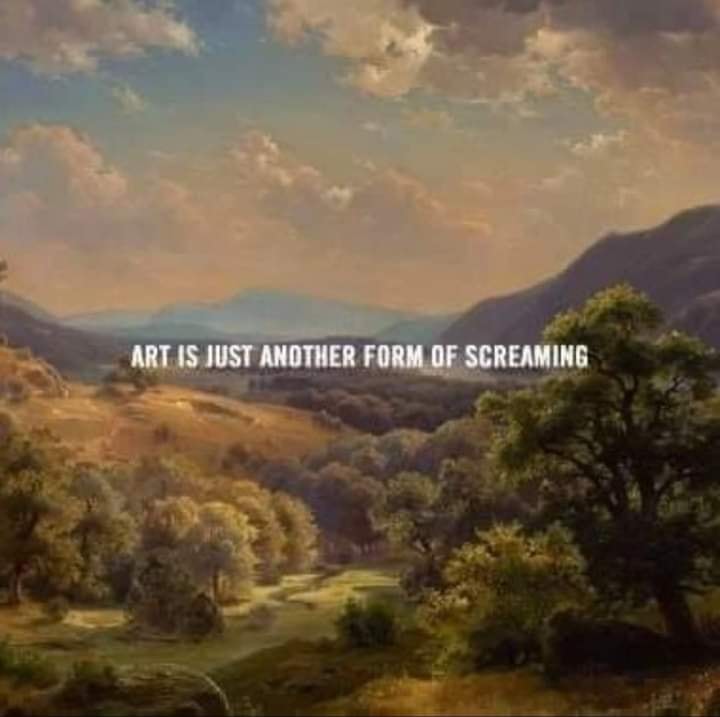
This meme is a humorous take on the concept of art, implying that it's not just about creating something aesthetically pleasing, but also about expressing emotions and experiences. The image likely features a quote or text overlay that reads "Art is just another form of screaming". This meme pokes fun at the idea that art can be a way to express and process emotions, even if it's not always comfortable or easy to do.
detailed-analysis (gemma3-27b-vision)
Here's a breakdown of the image, analyzing it through the requested theoretical lenses. I'll include sections only where the theory is applicable and provides insightful commentary.
Visual Description
The image presents a landscape painting in a romantic style. The scene depicts a lush valley, possibly mountainous, with heavily textured greenery. The overall color palette is dominated by warm tones of yellows, greens, and browns. The rendering style is characterized by bold brushstrokes and a sense of depth, creating a dramatic, almost theatrical effect. A dirt path appears to lead into the valley, subtly suggesting a journey or passage. Overlaid on the image, in a bold, white, sans-serif font, is the text "ART IS JUST ANOTHER FORM OF SCREAMING." This creates a stark contrast between the beautiful, natural scene and the provocative statement.
Foucauldian Genealogical Discourse Analysis
The statement "ART IS JUST ANOTHER FORM OF SCREAMING" is a powerful disruption of how we traditionally understand art. Applying Foucault's genealogical method, we can look at the historical formation of "art" as a discourse. Initially, expressions were simply acts – perhaps cries of distress, ritualistic behaviors, or representations of survival. Over time, these acts became categorized, controlled, and codified as “art” by institutions (academies, galleries, museums, the art market).
The image/statement suggests a return to the original function of these expressions: a raw, visceral response to the conditions of existence. The 'screaming' isn’t necessarily a literal sound but an attempt to communicate beyond the limitations of language, to express pain, joy, despair, or simply being. The image frames the landscape as a vessel for those “screams.” The historical power dynamics are evident – institutions historically have defined and controlled what constitutes acceptable “art.” This statement proposes that the inherent “screaming” always existed prior to, and underneath, the constructed meaning of “art.”
Critical Theory
From a critical theory perspective, particularly within the tradition of the Frankfurt School, the image and statement can be seen as an indictment of modern society and its alienation. The beautiful landscape serves as a symbolic representation of nature, a space of authenticity that stands in contrast to the increasingly commodified and controlled reality of modern life.
The “screaming” represents a desperate attempt to break through the layers of rationalization, consumerism, and oppression that characterize modern society. The statement suggests that art, at its core, is a reaction to the injustices and anxieties of the world, a way to express the suppressed emotions and experiences of individuals. This aligns with Adorno's view of art as both a reflection of and a potential resistance to the dominant ideology. It is a cry against the "totally administered society" that seeks to absorb and neutralize all forms of dissent.
Postmodernism
The image and statement embody several key tenets of postmodern thought. The blatant juxtaposition of a traditionally “high art” medium (landscape painting) with a seemingly “low” or visceral act (screaming) disrupts conventional hierarchies of taste and meaning. It deconstructs the notion of “art” as something sacred or separate from everyday life.
The statement implies that art is not a unique or exceptional form of expression, but rather one among many. It relativizes the value of art, suggesting that the “screams” of everyday people can be just as meaningful or powerful. There’s a performativity at play—the image performs a questioning of what art even is. The landscape itself, rendered in a style that is reminiscent of earlier eras, is a pastiche—a signal of the postmodern sensibility of appropriation and recontextualization.
Let me know if you’d like me to expand on any of these analyses or explore other theoretical frameworks!
tesseract-ocr
a on a at alae 2 . : igi as er St eon ead ec: it ce. SE aaa os Ee SS ae eA Pa me S35 ina. ME chee ste" 9 2 or ws rf
simple-description (llama3.2-vision)
This meme is a humorous image of a beautiful landscape with a serene lake and mountains in the background. The text "Art is just another form of screaming" is superimposed over the image, implying that even the most beautiful and peaceful scenes can be a form of emotional expression or "screaming" from the soul.