First Seen
2025-04-12T05:55:18.168915+00:00
detailed-analysis (gemma3_27b-it-q8_0)
Okay, let's break down this meme, "In what areas has the Trump administration gone too far, been about right, and not gone far enough?" from an explicitly anti-Trump perspective, and through the lenses of the requested theoretical frameworks. I'll proceed section by section, only including the sections where the theoretical framework is actually relevant.
Overall Framing: This meme is inherently loaded. The very question assumes the Trump administration did go "too far" in some areas. From an anti-Trump perspective, this framing is validating. It accepts as a starting point the premise that the administration's policies were problematic and seeks to quantify where that harm lay. The comparison between Democrats and Republicans is positioned as a direct contrast of ideologies, placing anti-Trump sentiment at the forefront.
---
Visual Description
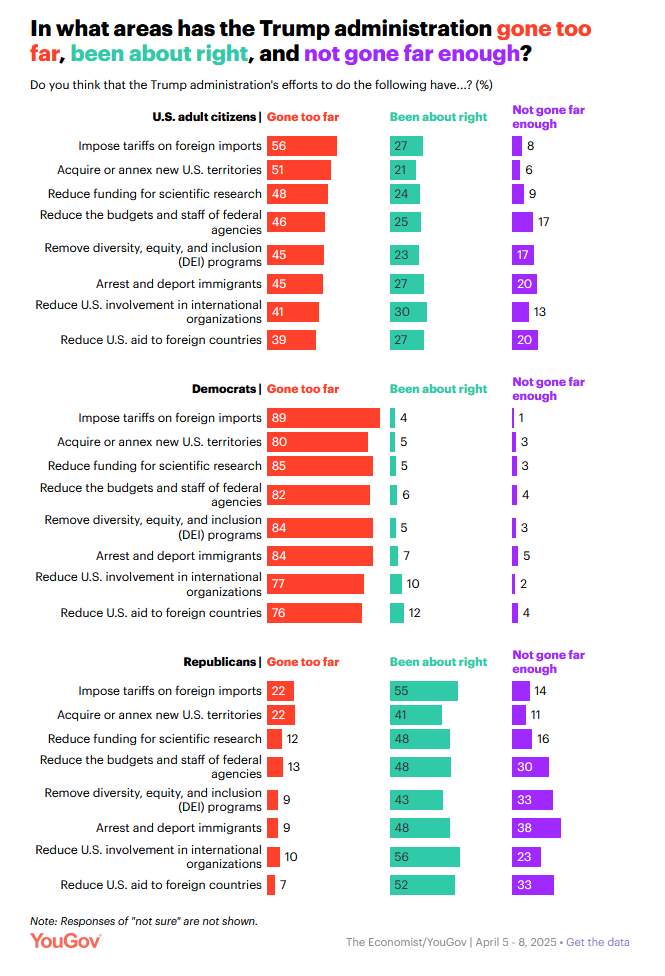
The meme is a series of horizontal bar graphs, each representing a specific policy or action attributed to the Trump administration. The graphs are divided into three sections: "Gone too far," "Been about right," and "Not gone far enough." Different colors represent the percentage of respondents who selected each option. The graphs are presented side-by-side for three demographic groups: "US Adults," "Democrats," and "Republicans."
The anti-Trump perspective is immediately highlighted by the stark differences in responses between Democrats and Republicans. Democrats overwhelmingly select “Gone too far” across almost all categories, while Republicans lean toward “Been about right” or “Not gone far enough”. This visual emphasis underscores the perceived chasm between the two groups and reinforces the anti-Trump narrative of radical and harmful policies. The percentages used in the meme reflect a desire to quantify and emphasize this sentiment.
---
Foucauldian Genealogical Discourse Analysis
From a Foucauldian perspective, the meme highlights the power dynamics inherent in defining "too far," "about right," and "not far enough." These aren't neutral categories, but constructs created through discourse. The framing of the question invites respondents to participate in a power/knowledge regime where the Trump administration is the subject of evaluation.
- Discourse & Truth: The meme reveals how "truth" about the administration isn't an objective reality, but is produced through discourse. The strong Democratic responses demonstrate a dominant discourse within that group that characterizes Trump's policies as inherently excessive. The Republican responses show a counter-discourse.
- Genealogy: Looking historically, the categories themselves (tariffs, deportations, aid reductions) are the products of long-standing power struggles. The meme isn't just about Trump; it’s about the historical lineage of these policies, and the competing narratives surrounding them. Trump’s actions weren't simply aberrations; they represented an intensification (or reconfiguration) of existing power relations.
- Governmentality: The meme implicitly critiques the "governmentality" of the Trump administration – the ways in which it sought to govern conduct through its policies. The "gone too far" responses suggest that these forms of governance were perceived as excessive, oppressive, or detrimental to the well-being of the populace.
From an anti-Trump perspective, the meme is a tool to disrupt the administration's own attempts to define reality and establish its own form of governmentality. It’s a contribution to a counter-discourse that challenges the administration's legitimacy.
---
Critical Theory
The meme is a prime example of how seemingly neutral "opinion polls" can be deeply implicated in the reproduction of social power. Critical Theory focuses on exposing the underlying structures of domination that shape our understanding of the world.
- Ideology: The question itself is infused with a specific ideology - one that assumes a need for intervention and evaluation of government policy. From an anti-Trump perspective, the meme exposes the ideological underpinnings of Trumpism: its perceived authoritarianism, nationalism, and disregard for social justice.
- Hegemony: The meme’s framing attempts to challenge the hegemonic (dominant) narratives that might have been used to justify the Trump administration's actions. By highlighting the widespread Democratic perception that policies went “too far”, it aims to disrupt the normalization of those policies.
- Instrumental Reason: Trump’s actions, particularly those related to scientific research and international aid, can be framed as an example of "instrumental reason" taken to its extreme - prioritizing efficiency and control over ethical considerations and social responsibility. The meme showcases the perceived damage inflicted by this approach.
- The Culture Industry: The meme itself is a product of the "culture industry" (advertising, media, etc.). From a Critical Theory standpoint, it’s a form of cultural production that seeks to expose and critique the dominant power structures.
---
Marxist Conflict Theory
From a Marxist perspective, the meme reveals the inherent class conflicts at play in the policies of the Trump administration. The policies targeted within the meme—tariffs, budget cuts, deportations, etc.—can be analyzed as serving the interests of the capitalist class and exacerbating existing inequalities.
- Class Struggle: Policies like reducing funding for scientific research or reducing aid to foreign countries can be viewed as attempts to consolidate wealth and power in the hands of the ruling class by prioritizing economic gains over social welfare or international cooperation.
- False Consciousness: The Republican responses, leaning towards "Been about right" or "Not gone far enough," can be interpreted as examples of “false consciousness”—a state where individuals unknowingly support systems that are detrimental to their own interests. This can be attributed to the dominant ideology perpetuated by the capitalist class.
- Exploitation: Deportations and restrictions on immigration, from a Marxist lens, are viewed as a means of suppressing the labor force, driving down wages, and increasing the exploitation of workers.
- Superstructure: The meme highlights the tensions between the "base" (economic relations) and the "superstructure" (political and ideological institutions). The policies are presented as manifestations of the underlying economic system and the power dynamics it creates.
---
Postmodernism
A postmodern analysis would focus on the destabilization of grand narratives and the subjective nature of truth.
- Deconstruction: The meme deconstructs the idea of an objective assessment of the Trump administration. There isn't a single "right" answer; instead, there are multiple, competing interpretations depending on one's ideological position.
- Relativism: The differing responses between Democrats and Republicans underscore the relativism of truth. What constitutes "too far" is not absolute, but rather a product of individual and group perspectives.
- Simulacra and Simulation: The meme itself could be seen as a simulacrum – a copy without an original. It represents a mediated representation of the Trump administration's policies, divorced from the complexities of the real world.
- Fragmentation: The meme's fragmented presentation—a series of isolated policy areas—reflects the postmodern condition of fragmentation and a lack of coherent meaning.
---
Queer Feminist Intersectional Analysis
While the meme doesn’t explicitly mention issues of gender, sexuality, or race, a queer feminist intersectional lens can expose how the Trump administration’s policies disproportionately harmed marginalized communities.
- Intersectionality: The policies, even seemingly neutral ones like budget cuts or tariffs, have a differential impact based on race, gender, sexual orientation, and class. For example, cuts to social programs disproportionately affect women of color, and immigration restrictions impact LGBTQ+ asylum seekers.
- Power & Oppression: The “gone too far” responses regarding deportations and restrictions on immigration reflect an understanding of the ways in which these policies are rooted in systemic racism, xenophobia, and homophobia.
- Deconstruction of Norms: The meme challenges the dominant norms that justified the Trump administration’s actions, such as nationalism, traditional gender roles, and heteronormativity.
- Anti-essentialism: The meme subtly counters essentialist views of identity and difference by showing how different groups perceive the same policies in vastly different ways, depending on their lived experiences.
In conclusion: From an anti-Trump perspective, this meme is a powerful tool for exposing the harms of the administration, challenging its legitimacy, and galvanizing opposition. The theoretical frameworks discussed above offer different ways of understanding how this is achieved, from the production of discourse to the exacerbation of class conflict to the destabilization of truth.
simple-description (llama3.2-vision_11b)
The meme is a graphic illustrating the results of a survey on the public's perception of the Trump administration's actions. The meme presents a chart comparing the percentage of people who believe the Trump administration has gone too far, been about right, or not gone far enough in various areas, categorized by political affiliation. The chart includes responses from Democrats, Republicans, and independents, showing that a significant majority of each group believes the Trump administration has gone too far in several areas, such as imposing tariffs on foreign countries, addressing climate change, and handling the economy.