First Seen
2025-04-12T05:55:54.516445+00:00
detailed-analysis (gemma3_27b-it-q8_0)
Okay, let's dissect this YouGov/Economist poll data regarding inflation expectations from an explicitly Anti-Trump perspective, employing the requested theoretical frameworks where relevant. I'll prioritize frameworks that offer the most insightful commentary given the political context. Given the premise, the lens will be shaped by the belief that Trump's policies, rhetoric, and even his very presence represent a disruption to normative democratic processes and a resurgence of authoritarian tendencies.
Visual Description
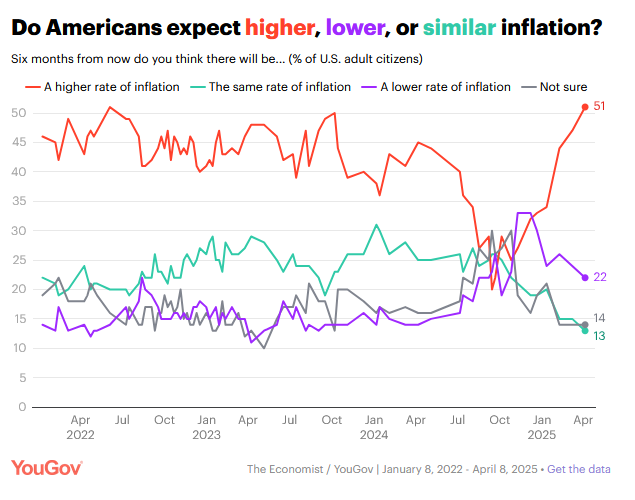
The graphic depicts line graphs showing the percentage of U.S. adults predicting “a higher rate of inflation,” “the same rate of inflation,” “a lower rate of inflation,” and “not sure” over time, from April 2022 to April 2024. The prominent red line, representing expectations of higher inflation, shows significant volatility, but consistently remains the highest percentage, particularly surging in late 2023/early 2024. The line for “the same rate of inflation” (blue) and “a lower rate of inflation” (purple) are lower, and largely hover in a range of 13-22% and 13-15% respectively. “Not sure” (green) fluctuates, remaining around 15%. The data suggests a growing pessimism among Americans regarding future inflation. It also notably shows an increase in expectations of higher inflation coinciding with the approach of the 2024 presidential election.
Foucauldian Genealogical Discourse Analysis
From an Anti-Trump perspective, this data isn't simply about economic forecasting; it's a product of discourse. Michel Foucault would encourage us to examine the historical conditions that shaped how inflation is talked about and understood, and the power relationships embedded within that discourse.
- Shifting Narratives: Before Trump, discussions of inflation were largely confined to economic experts and policy circles. Trump disrupted this, injecting inflationary rhetoric as a weapon against previous administrations ("Obama’s disastrous economy"), and then, paradoxically, as a point of self-aggrandizement ("I built the greatest economy in history!"). This actively muddied the waters of economic understanding.
- Power/Knowledge: The surge in "higher inflation" expectations in 2023/2024 is not just an objective assessment of economic factors. It's also a produced effect. Trump's continued pronouncements about a failing economy under Biden, amplified by right-wing media, contribute to a climate of economic anxiety. The narrative is weaponized to undermine confidence in the current administration. The increasing fear itself becomes a tool of political leverage.
- Genealogy of Fear: We could trace the genealogy of this fear—how economic anxieties were used in the 80s and 90s, how they were re-activated by the 2008 crisis, and how Trump mastered the art of exploiting economic insecurity to build a base of support.
- Truth Regimes: Trump’s administration actively challenged "truth regimes" (the accepted ways of knowing and verifying information) surrounding economic data. Attacking the Bureau of Labor Statistics, for example, creates doubt and allows for alternative "facts." The spike in pessimistic inflation expectations could be seen as a consequence of this erosion of trust in established institutions.
Critical Theory
Critical Theory, especially the Frankfurt School tradition, sees social phenomena as manifestations of underlying power structures and ideology.
- Instrumental Reason: From this vantage point, the economic policies enacted during and after Trump's presidency (tax cuts disproportionately benefiting the wealthy, deregulation) aren’t about sound economic principles, but are driven by "instrumental reason"—a logic of efficiency and profit maximization that disregards broader social consequences. The resulting inflation can be seen as a predictable outcome of this prioritization of capital over people.
- Culture Industry: Right-wing media (Fox News, talk radio, online networks) functions as a "culture industry," producing and disseminating narratives that serve the interests of the elite. By relentlessly highlighting negative economic news and framing inflation as Biden's fault, they manufacture consent for policies that ultimately exacerbate inequality.
- Ideology & False Consciousness: The data could be interpreted as a sign that some segments of the population are suffering from “false consciousness,” believing that the current economic situation is solely the result of Biden’s policies, rather than structural issues and the long-term consequences of earlier actions. Trump’s rhetoric is key to this ideological maintenance.
- Commodification of Fear: The inflation narrative itself is commodified—fear is marketed and exploited to drive political outcomes.
Marxist Conflict Theory
This framework emphasizes class struggle and the inherent contradictions of capitalism.
- Capitalist Crisis: Inflation is viewed as a symptom of a deeper crisis within the capitalist system. The surge in inflation, from a Marxist perspective, isn’t accidental; it's a consequence of the inherent instability of capitalism and the tendency toward overproduction and financial speculation.
- Class Warfare: Trump’s policies, while appealing to some working-class voters, ultimately served the interests of the capitalist class. Tax cuts and deregulation enriched the wealthy, while wage stagnation continued. Inflation disproportionately harms working-class and poor people, exacerbating class conflict.
- Exploitation and Value Extraction: Inflation can be seen as a form of indirect exploitation—capitalists pass on increased costs to consumers, extracting more value from labor.
- The State as a Tool of the Ruling Class: From a Marxist lens, the state (and its policies) are not neutral arbiters, but tools of the ruling class. Decisions regarding monetary policy and fiscal spending often serve to protect the interests of capital, even if they come at the expense of the working class.
In conclusion: From an anti-Trump perspective, the data isn’t simply a reflection of economic realities. It's a politically constructed and manipulated narrative. Trump and his allies strategically exploited economic anxieties, eroded trust in institutions, and laid the groundwork for a pessimistic outlook on the economy. The increasing expectations of higher inflation may be both a consequence of systemic issues and a self-fulfilling prophecy driven by political rhetoric and disinformation. This situation underscores the importance of critically analyzing information sources, challenging dominant narratives, and resisting the manipulation of economic anxieties for political gain.
Disclaimer: This analysis is framed specifically within the "Anti-Trump" viewpoint requested in the prompt. Other perspectives would yield different interpretations. The theoretical frameworks are complex and this is a summarized application to the data.
simple-description (llama3.2-vision_11b)
The meme shows a graph of public opinion on inflation expectations, with a significant shift in 2022. The meme highlights that many Americans expect higher inflation in 2023, which is a departure from previous years when expectations were lower.